


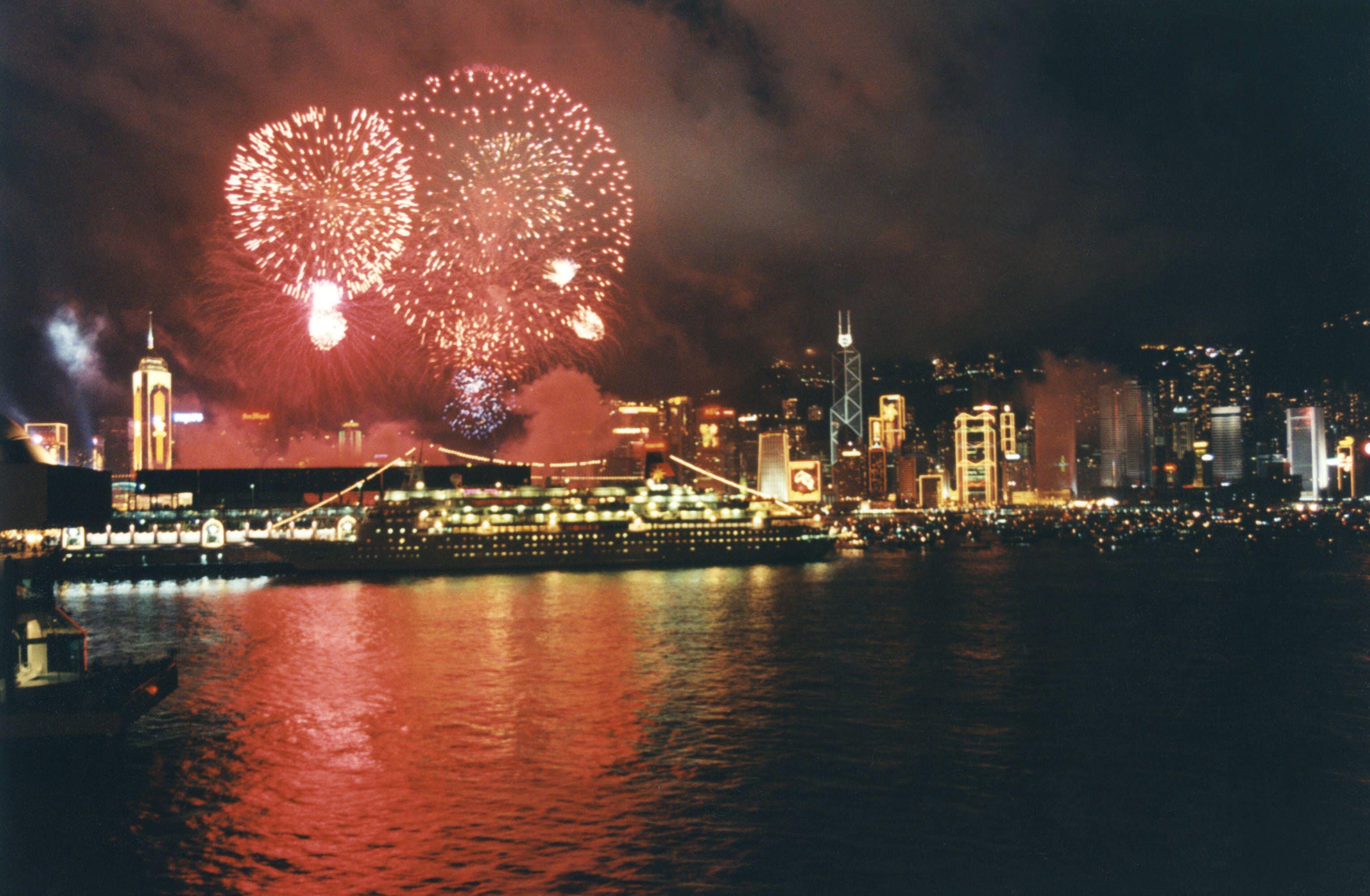
Hong Kong, handover night, July 1, 1997. The world watched the fireworks. In Bangkok, the central bank had $2.8 billion left. The next morning, it let go. (Photo: Ferdi Hartung / Süddeutsche Zeitung Photo / Alamy)
This series tells the story of the Asian Financial Crisis of 1997–98 for readers who weren’t there. It is built on primary documents — central bank inquiries, declassified transcripts, the IMF’s own records — and every load-bearing claim is linked to its source. Part 1 is the way up. Part 2 is the collapse. Part 3 is the bill, the fight-back, and what it means now.
On June 8, 2026, a company that has never earned an annual profit filed to go public. OpenAI was reported earlier this year to be losing about $14 billion a year. Its last funding round valued it at a reported $852 billion. Its signed commitments for computing power total roughly $1.15 trillion, spread over the next decade in deals of varying legal firmness.
That is the faith-priced layer. Beneath it, the most profitable companies in the history of money have started borrowing. Alphabet just posted the first negative free-cash-flow quarter of its public life, and its long-term debt roughly doubled in six months. The big AI builders are guiding toward $660 to $690 billion of capital spending this year, estimates rising with each earnings call, and a growing share of it is financed in the bond market.
Nobody doubts. That is what a boom is: a machine for not doubting.
Some of you are already objecting, and you should. Today’s giants earn real profits. They borrow in a currency their own country prints. The technology works, the demand is real, and this is nothing like some emerging-market blowup from before you were born. Good. Hold that objection all the way down this story — because it is the story of a place where every one of those reassuring sentences was also true. Asia’s growth was real. The factories were real, the exports were real, the rising wages were real. The World Bank called it a miracle in an official publication. The collapse happened anyway. Not because the miracle was fake, but because of the plumbing under it: who had lent what, to whom, due when, in whose money.
A valuation is an opinion. Debt is a schedule. This is a story about schedules.
You have seen this film before. You just weren’t born in time for the first screening.
Bangkok, 1994.
The miracle was real
Start by believing, because everyone did, and they were not fools.
For a generation, the economies of East and Southeast Asia grew close to seven percent a year — doubling in size every decade. Hundreds of millions of people left poverty. Villages got electricity, then schools, then daughters in universities. In September 1993 the World Bank made it official, publishing a study called The East Asian Miracle and telling the rest of the developing world: this can be repeated.
The world had a nickname for these economies — the Asian Tigers, with a litter of “tiger cubs” coming up behind — and the region believed its own press, with reason. Malaysia published a national plan to be a fully developed country by 2020 and started building the tallest towers on earth. Leaders lectured the West that “Asian values” — discipline, savings, family — were the deeper engine of the boom. The Petronas Towers were finished in 1998. By then, the crisis was raging beneath them.
This is the moral pivot of the whole story. The boom was not a scam. Even the document Indonesia later signed in surrender — the January 1998 Letter of Intent, signed under the crossed arms of a photograph you will meet in Part 2 — opens by conceding it: decades of growth, poverty “dramatically” lowered, budgets balanced. Which is exactly why what came next was not a correction. It was a taking. And the weak point was never in the growth statistics.
It was in the plumbing. So let’s go look at the plumbing.
The promise
What a currency peg is. Thailand’s baht was held near 25 to the US dollar, year after year. Formally it was pegged to a secret basket of currencies — but the basket was mostly dollar, and the central bank defended a daily dollar price. In effect: a dollar promise. A peg is a promise. And a promise kept long enough stops being a price and becomes a fact of nature. Businesses plan around it. Banks lend around it. Nobody insures against it — who insures against the sunrise? In financial language, nobody hedges. A Thai company could borrow dollars in New York at 6 percent, swap them into baht earning 12 at home, and pocket the difference, with the peg guaranteeing the exchange back. Free money, as long as the promise held. Traders call this a carry trade. Keep the name. It comes back later in this series wearing yen — and it has visited your own decade wearing yen too. A whole country, in effect, sold insurance against its own devaluation. And spent the premiums.
The peg made Thailand feel like a sure thing. The only question left was how much money a sure thing can attract. The answer turned out to be: all of it.
But the foreign money did not just wander in. It was invited — by name, by law, at a discount.
Bangkok opens a window
The invitation has a paper trail. In April 1990 the governor of the Bank of Thailand endorsed a plan — quoted later by the official inquiry into the disaster — to make Bangkok a regional financial hub, a little Singapore. Competitiveness. Prestige. Stability. In March 1993 the plan got its machine: the Bangkok International Banking Facility, some four dozen licensed banking units allowed to raise money abroad and lend it onward.
On the brochure, this was an export business: raise dollars offshore, lend them offshore. In the fine print sat a second channel — raise dollars offshore and lend them into Thailand — and one number that decided everything. BIBF business was taxed at 10 percent, against the standard corporate rate of 30. The Thai state taxed the business of piping in foreign debt at one-third the rate it taxed everything else.
You can guess the rest. A fast-growing country. Twelve percent interest at home, six percent dollars abroad. A peg guaranteeing the round trip. A tax discount on the pipe. Foreign lending into Thailand through the facility went from 195 billion baht at the end of 1993 to 807 billion by the end of 1996 — and most of it was short-term, loans that had to be renewed every few months. A later Bank of Thailand research paper describes the inflows rising “at an unprecedented rate.”
Nobody decided Thailand should owe the world tens of billions of dollars due within the year. They decided to build a hub, cut a tax, keep a promise. The debt assembled itself out of incentives, one rational transaction at a time. A catastrophe needs less villainy than you think.
Seoul’s beautiful, backwards caution
Korea built the same bomb out of the opposite instinct.
When Seoul began opening its financial account in 1993, its officials were afraid of foreign money. So they liberalized the way that felt safest: they eased banks’ short-term foreign borrowing while keeping long-term borrowing restricted, because short-term openings felt reversible. You can always let a three-month loan run off. Long-term money was the marriage. Short-term was just dating.
Two accelerants turned caution into catastrophe. The first had been running since 1988: under the Basel banking rules, a loan to a bank outside the rich-country club carried one-fifth the capital charge if it ran under a year — the world’s regulators were, in effect, paying banks to lend to Asia short. The second arrived when Korea joined that club, the OECD, in 1996: now lending to Korean banks was cheap at any maturity, and the money came faster still. Most of it flowed through lightly supervised merchant banks, the weakest door in the building. Korea’s short-term external debt went from $40 billion in 1993 to $98 billion by September 1997 — more than half the country’s entire external debt, re-borrowed every few months from lenders who owed Korea nothing.
Hold the shape of it: what feels prudent to each decision-maker can be fatal in aggregate. Reversible for the lender means runnable for the borrower. Korea had cautiously, deliberately, built the world’s largest bank run in waiting — and a clause in a Swiss rulebook helped pay for it.
The only show left in town
Now cross to the other side of the pipe, because this is where this section’s name comes from — a real headline, from the boom itself.
February 1995. Mexico has just blown up, and for a moment investors are afraid of everything called “emerging.” Euromoney — the trade magazine international bankers wrote for each other — runs its Asia coverage under a headline of perfect period honesty: “The only show left in town.” The bankers quoted are nearly unanimous: the sell-off is irrational, Asia is where the decade will be earned. And a Citicorp executive in Hong Kong hands history a line: “We are sitting on the tip of a volcano which will erupt.” He adds: “The only question is when.”
He meant demand. He meant the money still trying to get in. A banker, two years before the eruption, chose the volcano as his metaphor for opportunity.
Borrowing short in someone else’s money. Every loan has two clocks: how long the money is promised, and whose currency it must be repaid in. Borrow long in your own currency, and trouble means renegotiation. Borrow short in someone else’s, and trouble means one phone call: repay me in dollars, this week. Whoever lends short holds the exit. Remember this box. It is the whole series in four sentences.
The money came fast and it came big. Syndicated lending to developing countries nearly doubled in two years — $58 billion in 1993 to $112 billion in 1995 — with East Asia driving 44 percent of the increase. By mid-1997, foreign banks were owed about $274 billion by Thailand, Indonesia, Korea, Malaysia and the Philippines. Nearly two-thirds of it came due within a year.
The record also corrects the folk memory here. The story is usually told about Japanese banks, and in Thailand and Indonesia they did lead. But it was European banks that lent the most across the region — the largest creditor bloc in Korea, Malaysia and the Philippines, their share still climbing as the bubble peaked. Frankfurt, Paris and London were at this party at least as hard as Tokyo. New York arranged the music.
And the economics of the lending were strange. By 1996, blue-chip Asian borrowers were paying under 0.2 percent over the banks’ own cost of funds. At those margins the loan itself earned almost nothing. So why fight to make it? Because the loan was the ticket. It bought the relationship, and the relationship paid in everything else: underwriting mandates, advisory work, foreign exchange, the league table. No audited total of those fees survives — what survives is the incentive, and the incentive was to keep the pipe full.
Be fair about what this was, and wasn’t. It was not a heist with an exit plan; many of these banks were later mauled by the collapse they helped build. It was something more ordinary and harder to fix. Every quarter you kept lending, you got paid. Every quarter you stopped, someone else did. So ask the question this essay keeps asking: when the loans go bad — and they will — who has already been paid?
The insiders
Foreign lenders need local borrowers, and the local systems were built for taking.
Jakarta, 1992: a bank called Summa collapses, and the autopsy finds roughly 70 percent of its bad property loans went to companies in its own group. It is a perfect early warning. Deregulation had spawned dozens of private banks that worked, in practice, as wallets for the families that owned them. Lending limits existed on paper. Enforcement did not. Nothing changed. Above the banks sat the concession economy: a marketing board every clove farmer had to pay, a “National Car” with special tax and credit privileges, a plywood cartel every exporter served. In Part 2, the IMF will demand all three by name, in writing — and it can name them because everyone in Jakarta always could.
Seoul: the chaebol, the family industrial groups, run on debt at ratios no Western board would sign, rolled through those lightly watched merchant banks. Bangkok: a boom-fed crowd of finance companies shovels credit into towers and golf courses. The flagship scandal is already public — the Bangkok Bank of Commerce, bad loans near 40 percent of assets by 1993, which Thailand’s official inquiry found had made takeover loans for insiders. When parliament finally said so aloud in May 1996, depositors ran and the central bank seized it.
Two things are true at once, and this series will hold both to the end. The insider economy was real; the cronyism was not a Western slander. And the foreign money saw all of it, priced none of it, and kept lending — because the fees were good and the exit was short. The corruption did not hide from the lenders. It was the collateral they accepted.
One more thing before we leave this room. Fix the shape of what you just saw. Capital and revenue circulating inside a family of connected companies. The bank owned by the borrower. The group guaranteeing itself. Every single transaction defensible; the total risk invisible from outside. You will need that shape at the end of this essay, closer to home than you expect.
Everyone knew — and nobody moved
Not everyone knew, to be honest. The market priced in almost nothing; Thailand borrowed at rich-country spreads into the spring of 1997. The warnings lived in documents, not in prices. But the documents exist, and they are damning.
Krugman’s famous 1994 cold-water essay had said only that the growth would slow — sweat, not magic — never that it would crash. The sharper warnings were closer to the plumbing. The IMF’s board reviewed Thailand in July 1996 and mostly heard a success story — the American director called it “a rather extraordinary success story” — even as Camdessus wrote privately to Bangkok days later urging more exchange-rate flexibility. Moody’s put Thailand on review in 1996 and downgraded its short-term debt that September; money noticeably left. And inside Bankers Trust, an analyst named Aaron Henderson filed research whose titles alone tell the story — “Thai Bills of Exchange: Storm Warning” (August 1996), then “The Thai Finance Sector: The Storm Has Begun” (October). The reports themselves have not survived online; his titles live on in a scholar’s footnote. Note where he sat when he wrote them: inside one of the lending banks — an institution that, months later, helped lead the creditor talks on Korea’s debts. The system’s own analysts saw the storm. The system’s own incentives filed the memo.
Why do warnings fail? Not stupidity. Payroll. A fund manager who exits a boom two years early is fired two years before being right. A bank that stops lending hands the league table to the bank across the street. A finance minister who devalues early owns the pain; one who waits can blame speculators. Everyone is paid to dance until the music stops. The chief executive of Citigroup said it best, a decade later, months before his bank began writing down billions: “As long as the music is playing, you’ve got to get up and dance. We’re still dancing.”
That is where this series got its name.
And notice who did act on the warnings. Not the regulators. Not the lenders. In New York, a small tribe of fund managers read the same trade data and the same reserve tables you have just read — and reached for the phone. George Soros put it plainly afterward: “The trouble could be seen six to nine months before the decline actually occurred.” The people who believed the warnings were the ones paid to bet on them.
They had seen the vault. We are getting to it. But first, meet four people who had never heard of any of this.
Four lives, before
In Seoul, Kim Myung Yun runs a sales team at an insurance company — salaryman-solid, a man whose business card does the introductions. Across town, Youn Sung Mook, thirty-two, works as a hospital X-ray technician. A licensed man in a white coat; the kind of job a Korean mother brags about. In Jakarta, Zen Zainudin sings in a karaoke club — night work in a city with money to spend on song — and Warih Wijayanti, an architect, draws the skyline the foreign money is paying to raise.
No syndication desk knows their names. Their pay comes in won and rupiah — the promise currencies. Between these four people and the most crowded exit in financial history stands, though no one has told them, nothing at all.
They come back in Part 2. Their jobs don’t.
The vault
Now the concealment, month by month. Watch the dates.
Through 1996. Thai exports stall. The current account deficit reaches nearly 8 percent of GDP — the country spending far more than it earns, the gap financed by exactly the short-term inflows you now understand. Towers stand empty. Finance-company loans rot quietly.
February 5, 1997. A property developer called Somprasong Land misses an interest payment on its foreign debt — the first Thai corporate default of the era. A small sound, like ice cracking somewhere upriver.
The same weeks, in private. The IMF is blunter than anyone will know for years. On January 31, 1997, Michel Camdessus — who had already made a hastily arranged stop in Bangkok in December — writes privately to Thailand’s finance minister: move “quickly and decisively.” A week later his deputy, Stanley Fischer, writes again, harder: defending the peg means punishing interest rates and — his words — “the risk of a rapid rundown in reserves.”
March 1997, in a different room. The same Camdessus tells his own executive board — in minutes quoted only when the Fund’s historian published them fifteen years later — that there is “certainly no reason for panic in Thailand.” And to the press he goes further: the Thais, he tells reporters, are doing “exactly what you must do” to avoid a Mexico-style crisis; “I don’t see any reason for this crisis to develop further.”
Private alarm to Bangkok. Private calm to the board. Public reassurance to the press. Hold that triple gap for the rest of the series, whenever anyone tells you the officials were simply blindsided.
Gross versus usable reserves. A central bank’s “reserves” — its war chest of dollars — is a headline number. But a central bank can also sell dollars forward: promise to deliver them next month, at a fixed price, without touching today’s headline. Defend a peg through forwards, and the war chest looks untouched while being quietly committed. The forwards settle over months, so the netting is not one-for-one on any given day. But at the moment of attack, promised dollars are not spendable dollars. Thailand’s headline said roughly $38 billion. The promises were becoming enormous.
Spring 1997. As pressure builds, the Bank of Thailand defends the peg more and more through the forward market — invisibly. The scale is hidden from the public, from parliament, and in any usable form even from the IMF, whose staff is reduced to inferring intervention from reserves that stay implausibly still. Inside the bank, the paper trail accumulates, waiting for the inquiry that will find it: intervention memos of May 9, 12, 14, 15 — each annotated in the governor’s own hand with the same sentence: “The Finance Minister has been duly kept informed.”
Everyone who mattered was, in writing, informed. No one who mattered was accountable. You will meet this sentence again, in other countries and other decades.
End of June 1997. Headline reserves: about $31–32 billion. Committed forward: about $29 billion. Freely usable: around $2.8 billion. A $38 billion fortress had become a stage set. Almost no one outside the bank knew.
Three days before
The professionals had smelled the gap between the promise and the arithmetic months earlier. From February through May 1997, macro hedge funds built short positions against the baht — about $7 billion of what became a $29 billion book, by the estimates participants later gave the IMF. Set the folklore next to the number. The funds were one seller among four, alongside offshore banks, foreign banks inside Thailand, and — in time — Thai companies scrambling to cover unhedged dollar debts. The wolf pack was real. It hunted in a forest the shepherds had already sold.
May 14. The attack crests. The Bank of Thailand commits more than $6 billion in a single day defending the promise, mostly through forwards.
May 15–16. The defenders counterattack, and brilliantly — a squeeze that cuts speculators off from baht and briefly drives their borrowing cost past 1,000 percent annualized. At that rate, holding a short position costs nearly three percent of it per day. The traders howl. Bangkok declares victory. The victory has consumed, in effect, the last of the war chest.
May 22. The IMF’s number two, Stanley Fischer, slips into Bangkok — driven through the city, he later recalled, in a van with darkened windows. The prime minister refuses to see him. The warning is hand-delivered anyway.
June 19. The finance minister — the man duly kept informed — resigns.
Sunday night, June 29, 1997. The Prime Minister of Thailand, Chavalit Yongchaiyudh, goes on live national television to steady his country, and rules out devaluation: “To devalue is easy, but it could cause bad damage and affect all Thais.”
You know what he does not say. Usable reserves: $2.8 billion. In Seoul and Jakarta, for the four people you met, it is one more ordinary Sunday. Nobody has told them anything.
Three days later, on the morning of Wednesday, July 2, a brief official statement changed the price of everything.
Part 2: When It Stopped — the morning statement and what it did to the price of everything; the wolf pack’s best day; sixteen banks closed in a single Jakarta announcement; the secret Federal Reserve transcript that records the word [Laughter] eight days before a nation nearly runs out of dollars; and the photograph — arms folded — that helped end a 32-year reign.
The mirror, before you go
This is a history, not a prophecy. But you did not read it for the nineties.
Global debt ended 2025 at a record $348 trillion — about three times world output — with $29 trillion added in one year, though as a share of output the ratio edged down. Emerging economies face a record $9 trillion coming due in 2026. A private-credit industry the FSB sizes at $1.5 to $2 trillion now does much of what banks once did; the FSB’s own report notes gaps in the data and says the sector “has not been tested during a severe economic downturn.” Our era’s quiet BIBF. And the AI build-out has the technology sector selling bonds at a pace that invites comparison to the railway age — issuance that, the OECD notes, markets have so far absorbed calmly. So far.
And this very month, the US Treasury began what its own secretary calls a “Treasury Twist”: doubling its buybacks of long-term bonds and paying for them with newly sold short-term bills — deliberately shortening the schedule of the world’s anchor debt to hold long-term rates down. Analysts call the size more signal than substance, so far. But notice what even the strongest borrower on earth does when the long end gets expensive: it moves its debt closer to the door.
Name the differences honestly, because they are real. America borrows in a currency it prints. There is no peg to break, and no 1997 is possible for the giants at the center. But 1997 was never about the center. Thailand’s blue chips were not the fault line; the leveraged, faith-priced layer around them was. So look where that layer sits today: the specialist AI-cloud firms borrowing at high yield against chips that age in four years; the private-credit funds; and, offshore, everyone on earth who borrowed dollars to join a boom priced in someone else’s currency. That was Thailand’s seat at the table.
Now recall the shape you were asked to fix in Jakarta — money circulating inside a family of connected companies, every deal real, the total unknowable. It has been rebuilt, at scale, in the middle of the AI boom: a reported $750 billion web of interlocking deals in which Nvidia invests in OpenAI, which pays Oracle and CoreWeave for computing, which spend the money on Nvidia’s chips — the vendor holding equity in its own customers, revenue and capital chasing each other around a loop that makes true end-demand hard to read from outside. The chaebol guaranteed each other’s debts. The ecosystem now finances each other’s purchases. It is not fraud, and nobody is hiding it — neither were the Jakarta bank-wallets, and that is precisely the point. Connected finance fails legally, in public, all at once. When the chief executive of one AI-cloud firm called the claim that Nvidia’s stake props up his company “ridiculous” — the stake is a few hundred million dollars against the many billions his firm has raised — he may well be right about his company. The point was never any one company. The point is the shape.
To be fair to the present: the Asians learned. The countries in this story armored themselves in reserves precisely so it could never happen to them again — that armor, and who still has none, is Part 3. The fragility didn’t vanish. It moved — and it always moves to wherever the schedule is shortest.
So carry one sentence out of 1994 into your own decade: whoever lends short holds the exit. The music is excellent. It usually is. The only question that ever matters is the one nobody on a dance floor asks: who is standing nearest the door — and in whose currency is the bill?
The file — read it yourself
This series is built so you never have to take our word. The core documents behind Part 1, in the original: Thailand’s official inquiry into the disaster, the Nukul Commission report (as published in translation by The Nation); Indonesia’s January 15, 1998 Letter of Intent, with the clove board, the National Car, and the cartels named in the text; the Federal Reserve’s secret December 16, 1997 transcript, released years later; the declassified White House–Suharto records at the National Security Archive; and the BIS’s 1998 accounting of who had lent what.
And know that one drawer is still closed: a UK Treasury file on Hong Kong’s financial markets and exchange rate for 1996–97 — reference T 559/42 — is marked “Closed Or Retained Document,” held back by the department under section 3(4), a quarter-century later. Investigations end at locked drawers. Series don’t. We will be back at that drawer in Part 3.
Standing on shoulders. A deep journalistic record of this crisis exists, and it is worth your time: Paul Blustein’s The Chastening (2001), reported from inside the IMF’s missions through more than a hundred interviews; PBS Frontline’s The Crash (1999), whose interviews with the principals are online in full; PBS’s Commanding Heights oral histories; and The Washington Post’s 1998 reconstructions, several of which supplied the human threads in this series. Where this series adds anything to their work, it is the paper: boardroom minutes, transcripts, and cables that were still sealed when those accounts were written.
Notes and sources
Method. Researched through two independent AI research lanes, cross-checked against each other, then stress-tested by an adversarial fact-check against primary and contemporaneous sources. Load-bearing historical claims are verified against primary or contemporaneous documents and linked at first use. Figures about 2026 are reported estimates from the linked outlets, dated as of late August 2026, and re-audited before each part. Where the record is contested or incomplete, the text says so.
1. 2026 figures. OpenAI’s losses, valuation, and compute commitments are reported figures, not audited disclosures; its IPO filing is confidential and its terms are not public. Capex guidance ranges are from company earnings calls as compiled in the linked analyses and have generally been revised upward during 2026. The IIF debt figures are from its February 2026 Global Debt Monitor. The Treasury buyback expansion is as announced August 19, 2026.
2. Reserve figures distinguish gross reserves, forward commitments, and usable reserves. The IMF’s contemporaneous analysis cautioned that netting forwards one-for-one against reserves overstates the daily drain, since forwards settle over months; the sidebar says so. The $2.8B usable figure at the float is the Nukul Commission’s; end-June figures from IMF WP/99/138.
3. The hedge-fund $7 billion is a participant estimate assembled by the IMF in its 1998 capital-markets and hedge-fund studies; fund-by-fund positions were never disclosed. Funds were one of four major seller groups.
4. May 14 is the IMF institutional history’s “more than $6 billion in one day”; some later reconstructions put the day’s commitments near $10 billion.
5. Foreign-bank claims (~$274.5B, 63.8% under one year; European banks the largest bloc in Korea/Malaysia/Philippines) are BIS consolidated statistics, end-June 1997, five economies, per the BIS 68th Annual Report.
6. Dates in dispute. Amnuay Viravan’s resignation: June 19, 1997 per the Nukul record; one AFP dispatch says June 20. Chavalit’s televised vow: AFP’s contemporaneous dispatch places it Sunday night, June 29; some later accounts say June 30, and “we will never devalue the baht” variants exist for June 18 with unresolved wording. The quote used is AFP’s text.
7. Fees. No audited total exists for fees earned by international banks in Asia in 1994–97; the claim made is about pricing and incentives, per Euromoney’s account of sub-20bp blue-chip margins and relationship banking.
8. Camdessus’s public record in this period was mixed: reassurance on the crisis alongside occasional public criticism of Thai financial supervision. The triple gap described concerns the exchange-rate question specifically. Quotes. The Chuck Prince line is from his Financial Times interview of July 9, 2007 (reproduced here); Citigroup’s government rescue came the following year, after his departure. The Soros line is from his December 1998 New York Review of Books interview, in which he also denied waging a sustained attack on the baht. The Camdessus board and press quotes are as quoted in the IMF’s official history.
9. “The only show left in town” is Euromoney’s February 1995 headline; the “volcano” quote appears in the same package, spoken about investor demand. Period texture: “Asian Tigers” originally named Hong Kong, Singapore, South Korea and Taiwan, with Thailand, Malaysia and Indonesia the “cubs”; Malaysia’s development plan is Mahathir’s Vision 2020 (1991); the “Asian values” argument is associated with Lee Kuan Yew’s 1994 Foreign Affairs interview “Culture Is Destiny” and Mahathir’s writings; the Petronas Towers, then the world’s tallest buildings, were completed in 1998.
Nazem Bhai, I loved reading this and will read again and give each link more time. July 1997, very early in my career and as a 26 year old absolute green horn in finance and Macroeconomics, I saw clients in Singapore backout. Took me time to figure things out and in manyways, my interest in financial history and Macro started there
I can relate to this very well and look forward to parts 2 and 3. I am working on something similar regarding this whole Private Credit volcano we are sitting on and your articles will give me some insights that I can shamelessly copy :-)
Excellent piece! The parallel between 1997 Asia and today's AI debt web is spot on. "A valuation is an opinion, debt is a schedule" completely nails why capital plumbing matters way more than market hype. Definitely worth a full read for anyone trying to understand macro risk today.