


In August 1978, Turkey owed Iraq roughly $300 million for oil. Its energy minister named wheat, peas, household appliances and buses among the exports whose proceeds would help clear the bill.1
Turkey needed Iraqi oil. Iraq needed the Turkish pipeline to carry crude to the Mediterranean. The customer who had fallen behind on payment also controlled an outlet for the supplier.
Deliveries to Turkey had been interrupted. An agreement signed on 25 August promised to restore them. Three days later, the American embassy in Ankara reported that Iraq must have extracted a price for the concession.
“We don’t know yet what it is.”1
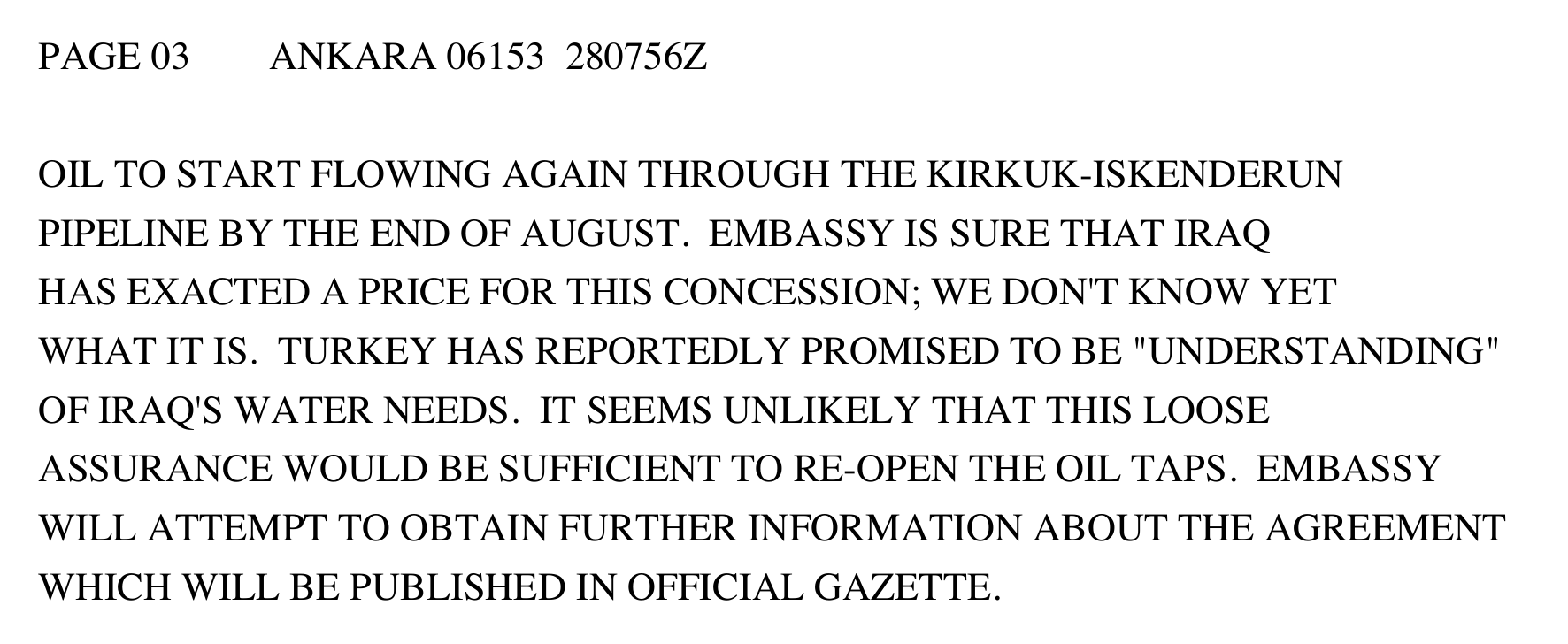
Ankara 6153, 28 August 1978, paragraph 5 (continued). A direct excerpt from the released-text PDF, not an original telegram scan. Released PDF
On 31 August, a Turkish foreign-ministry petroleum official, Ferhat Ataman, supplied a fuller account. Current oil purchases would be paid for within sixty days. Export proceeds would discharge the old debt through an arrangement between the central banks. He was not at liberty to disclose the timetable.1
Ataman also described an oral assurance about the planned Karakaya dam. Turkey would not use it in a way that harmed Iraq. Baghdad would resume its position as Turkey’s leading oil supplier through 1979. The embassy suspected he was understating the water commitment. When the oil arrangement came up for extension, its diplomats reasoned, Iraq might seek an assurance about the next dam, then the next.1
Turkey had an oral assurance of its own. Iraq would pay royalties “as though the pipeline were operating at full capacity”. The 1973 treaty already provided for minimum annual payments. Here was a further promise, reported inside a settlement over oil, debts and water.1
These were American diplomats relaying Turkish accounts. The cables disagree over the part played by technical trouble and political pressure in interrupting supplies. They do not establish that transit to third countries stopped altogether. The written August agreement has not been located.1
Even with those limits, the bargain shows how much could be required to resume deliveries through an existing pipe. Nearly half a century later, Turkey would declare its section technically ready. Exports would take almost two more years to return.2
What had to be restored after the pipe was declared ready?
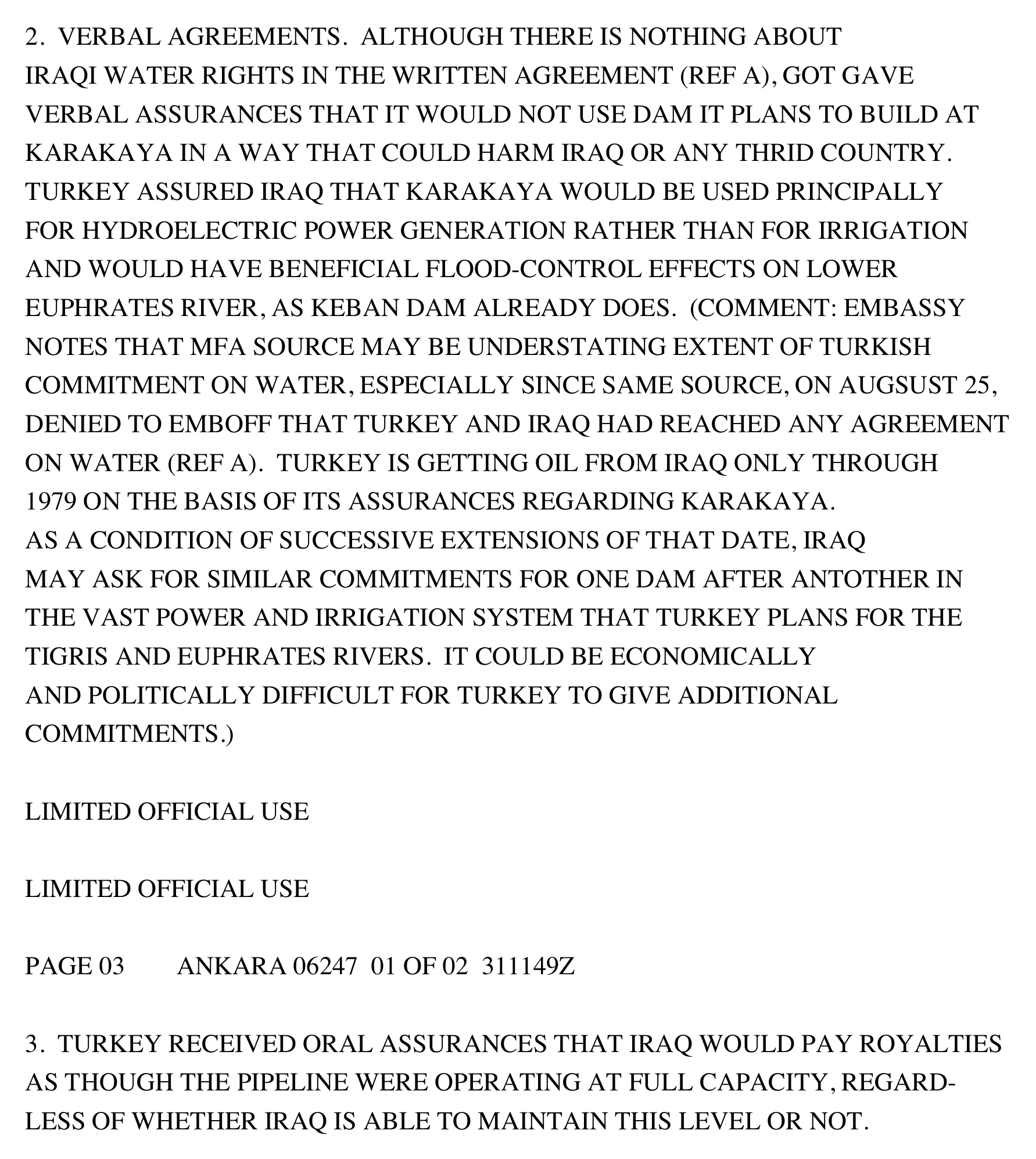
Ankara 6247, 31 August 1978, paragraphs 2–3: the oral assurances on water and royalties. Direct excerpt from the released-text PDF. Released PDF
· · ·
Iraq had built itself some room to negotiate. Its strategic pipeline carried northern crude south to the Gulf without crossing a foreign border. In January 1976, the American mission reported the first tanker shipment and expected Baghdad to press Syria over transit fees. Later that year, the CIA credited this line and the new Turkish route together with giving Iraq greater freedom to negotiate.3
By November 1978, a BOTAŞ official said the Turkish line had been pumping 540,000–625,000 barrels a day since the late-August resumption, apart from a fire interruption in October. He claimed repairs had taken nine days. Other contemporary accounts put the return later.4
Northern crude was also travelling south through the strategic line. Yet the embassy still saw a reason for Baghdad to reopen Syria: a third outlet could reduce Turkish leverage over water, transit fees and Kurdish relations.4
Within four years, those choices had narrowed. War had shut the Gulf outlets; Syria closed its pipeline in 1982. Turkey was left as Iraq’s only export outlet, in the CIA’s assessment, with capacity of about 700,000 barrels a day. Before the war, Iraq had exported more than three million.5
The Turkish line could not replace that lost volume. It did carry oil Iraq could sell to help pay for the war. Sabotage had interrupted it only briefly, the CIA reported.5
There was a reciprocal undertaking behind that service. Turkey had promised to maintain the flow and load oil as Iraq required. Iraq had promised minimum annual payments, except in cases of force majeure. In 1985, the guaranteed volume rose to 35 million tonnes. A second line expanded the route in 1987.5
Iraq also financed a route across Saudi Arabia to the Red Sea. The CIA warned that it depended on Saudi willingness, while expecting Riyadh to accommodate Baghdad. Oil began flowing in 1985. By Iraq’s later count, the line carried 876 million barrels before closing in 1990.6
Then Iraq invaded Kuwait. Turkey closed its line under the UN embargo in August 1990. The Saudi route closed that month too, although the governments’ later accounts differed. Riyadh said it had “disconnected and blocked both ends” immediately after the invasion. Baghdad dated the halt to 13 August and said the reason given was high inventories at the terminal.6,7
In June 2001, Saudi Arabia declared that the pipeline and its associated facilities would revert to the Kingdom. Iraq called it “unlawful confiscation”. The investment remained across the border. Baghdad could no longer use it to export oil.6
· · ·
At Haditha, the K-3 junction connected the strategic pipeline with the northern lines. Southern crude could travel inland and turn towards either Mediterranean outlet. Damage at that junction could put both choices in doubt.
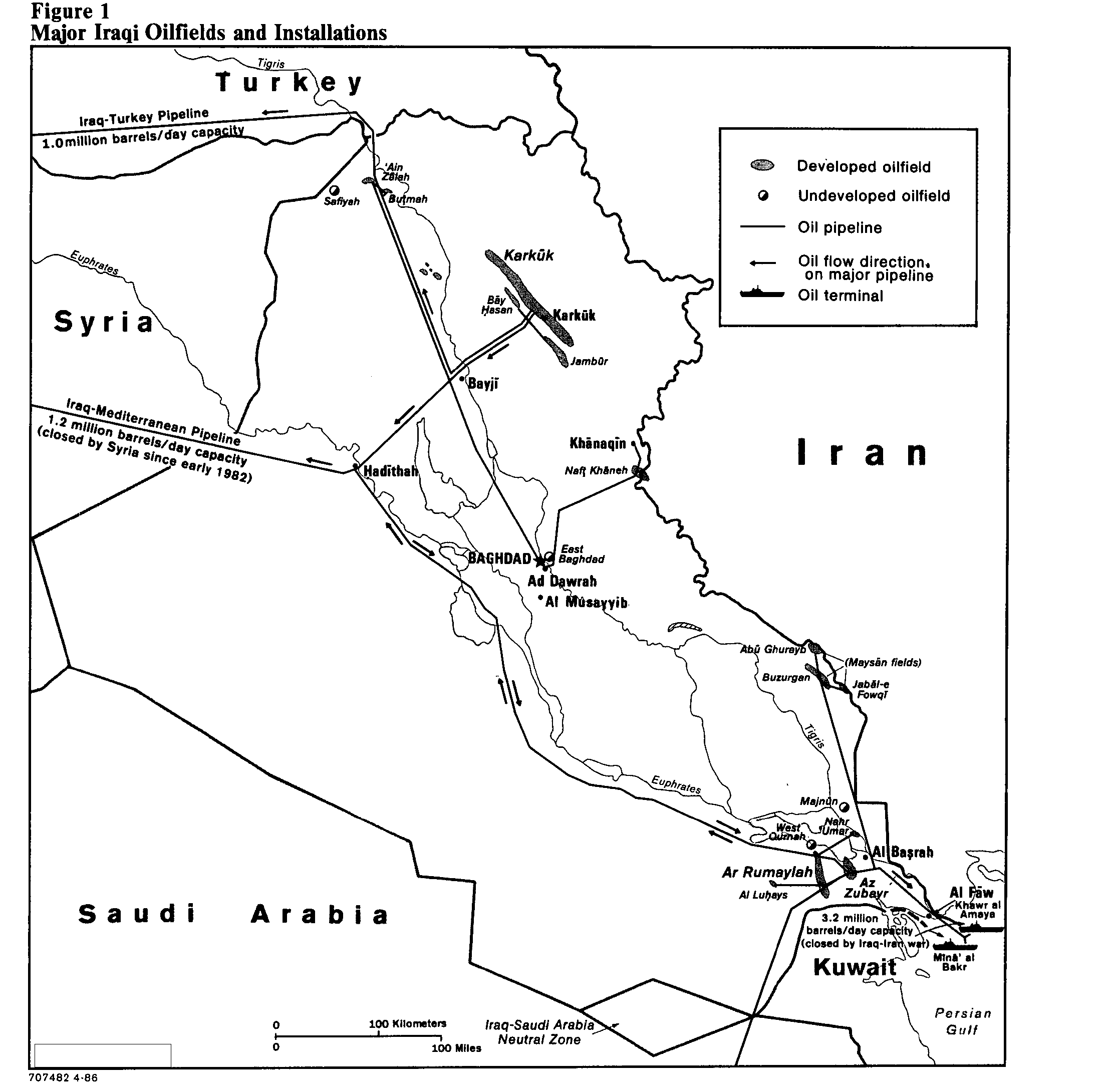
Iraq’s export routes in May 1986. The CIA map marks the Syrian line and Gulf terminals closed. Original map crop; full credit below.
K-3 and southern pumping stations were damaged in 1991; the EIA later reported repairs completed in 1992. In April 2003, American imagery showed installations burning near K-3 again. The accompanying assessment warned that destruction of the junction would prevent southern crude reaching either Turkey or Syria. It described a possible consequence, rather than establishing the full extent of the damage.7,8
In 2026, the exposure was spread across a region. War curtailed northern Iraqi output and Ceyhan exports, damaged Saudi Arabia’s bypass and disrupted Fujairah’s terminal. Several alternatives were affected by the emergency that had made them necessary.9
Saudi Arabia’s restart was reported in stages. Kpler’s imagery showed no tankers at Yanbu Crude or Muajjiz on 13 September. By the 27th, all seven Yanbu berths were occupied. Between those dates, the EIA reported repairs and a partial resumption of East–West pipeline flows. The occupied berths did not establish that normal volumes had returned.10
The public account names Saudi repair crews and authorities. It identifies no foreign government whose permission was required to restart. The passage beyond the pipe remained exposed: ships faced a Houthi threat in the Red Sea, Britain announced refuelling support, and France described personnel and equipment deployed to help protect Yanbu.10
For Iraq, a larger diversion of southern crude first requires work inside its own borders. In March, the IEA described limited connections to the north and a strategic pipeline needing repair. The proposed Basra–Haditha connection would open larger onward options towards Turkey, Syria or Jordan. Existing northern exports and road tankers can move without it. The larger southern diversion depends on it.11
A choice of ports begins with whether the oil can reach the junction.
· · ·
The Turkish line was idle in 1991. Its payment obligations were still alive.
When BOTAŞ brought its claim to the UN Compensation Commission, the panel found that minimum annual remuneration remained contractually owed for 1991–96. The Commission’s rules admitted only the 1991 loss, when war damage supplied a qualifying cause alongside the embargo. Excluding the later years from compensation did not cancel the underlying debt.12
The calculation reached down to the electricity the stopped pumps had saved. From a starting figure of $195.3 million, the panel deducted $18.96 million in avoided electricity costs. The approved award was $176.34 million.12
In 2016, a Turkish audit official told parliament that BOTAŞ had received approximately that principal. Interest was never paid. Oil had returned to Ceyhan much earlier: the first Oil-for-Food tanker loaded in December 1996. The programme paid Turkey’s pipeline charges from Iraqi oil proceeds.12
The minimum was not absolute. In its 2023 award, the tribunal excused Iraq’s minimum-throughput obligations from March 2003 through July 2007 under force majeure. Turkey still received an award of $46.25 million in ordinary charges for the oil actually carried.8
For 2014–18, the tribunal counted KRG barrels towards Iraq’s minimum even though they had left Ceyhan against the federal ministry’s instructions. Much of Iraq’s gross award concerned excess transport charges: the treaty tariff still applied to oil Baghdad had opposed loading. After Turkish counterclaims, the award left roughly $1.47 billion in Iraq’s favour before interest. It does not establish that Iraq collected the money.13
Minimum commitments also feature in Aramco’s and ADNOC’s pipeline financing, while operation remains under domestic control. They can support financing without giving another state control of transit.14
Iraq’s experience asks more of the contract. The minimum could preserve a claim to income for the operator during a closure. What would preserve Baghdad’s ability to earn from its oil?
· · ·
In August 2026, Ankara and Baghdad announced a one-year replacement for the treaty that had ended in July. Both used the figure of 750,000 barrels a day. Turkey called it allocated capacity. SOMO called it a minimum export quantity. Neither public description establishes what Iraq must pay if fewer barrels arrive.15
The following month, BOTAŞ recorded transport averaging about 262,000 barrels a day. Its ledger does not separate Iraqi from any Turkish crude in the total. Even taken together, the recorded traffic was far below the announced figure. For Baghdad’s accounts, the difference between reserving space and guaranteeing payment for it matters.15
Water is again part of the negotiation. Under the 2024 framework, Turkish purchases of Iraqi oil would finance water infrastructure in Iraq. A financing mechanism was signed in November 2025. Iraq’s Cabinet later authorised a first-stage ceiling of 33,000 barrels a day. That is a ceiling on the arrangement, not evidence of sales or money reaching an account.16
The published 2014 memorandum promises equitable and reasonable water releases after an assessment of resources and use. It fixes no volume. The recovered record supplies no clause exchanging specified oil volumes or prices for specified releases of water. In 1978, the assurance was oral. The present financing mechanism has been signed, but its text has not been recovered.16
The other routes remain at different stages. Fuel oil is reaching Baniyas by road through Syria. The Syrian and Jordanian pipeline plans remain proposals, and Jordan’s announced minimum pumping volume does not establish a bill for unshipped barrels.17,18 At sea, Baghdad announced an Iranian exemption for Iraqi oil passing through Hormuz; the IEA later described American escorts. Baghdad’s precise obligations behind that protection are not established in the reviewed record.19
To see what can delay a restart, the Turkish line offers a more complete account.
· · ·
After exports stopped on 25 March 2023, Gulf Keystone shut production at Shaikan completely in April. It recorded no revenue in the second quarter. Its annual report described a reduction of more than 60 per cent in the expatriate workforce. Roughly half the local workforce went onto reduced hours before local sales began.20
On 19 July, local buyers gave the field an outlet again. They paid in advance. In 2024, those sales generated $151.2 million.20
Turkey declared its section technically ready from 4 October 2023. The producers’ association, APIKUR, had already responded: its members needed clarity about payment for past deliveries and future sales, “even if the ITP reopens”.2,21
In August 2024, Gulf Keystone put the difficulty into its accounts. It warned that “reopening of the pipeline with a deferral of revenue receipts could result in liquidity pressures”. Local sales brought money before delivery. Returning to exports could mean waiting to be paid again.21
Iraq’s February 2025 budget amendment provided provisional advances of $16 a barrel for production and transport costs, subject to later reconciliation. In August, the Kurdistan government announced an export mechanism agreed with Baghdad. Federal coordination with Turkey still remained, it said. Turkey’s declaration of technical readiness had not completed that process.2,21
There were other impediments. Attacks damaged producing facilities in July 2025. The documents do not assign every month of the closure to one dispute. They do show that exports resumed while historic receivables remained under discussion.21
On 25 September, HKN announced an agreement in principle. The Kurdistan government and companies would meet within thirty days after exports resumed to work towards a mechanism for settling old debts. That meeting would follow the return of the oil.21
Later that day, ShaMaran reported executed interim agreements. Initial production and transport compensation would be $16 a barrel, adjusted after an independent consultant’s review. A nominated trader would pay the companies from cargo allocations at Ceyhan. Historic receivables were still being discussed.21
DNO took a different course. It would deliver the Kurdistan government’s share for export while selling the contractors’ share to local cash-and-carry buyers. Those buyers, it understood, had arranged to put the oil into the pipeline themselves.21
“We have elected not to engage directly in exports at this time,” its executive chairman, Bijan Mossavar-Rahmani, said.21
Exports resumed on 27 September 2025, thirty months after they stopped. By 10 December, Gulf Keystone had reported its first receipt under the new arrangements.2,21
Oil returned while historic receivables remained unresolved. The companies had described new arrangements for payment, almost two years after Turkey declared its section ready.
Before Baghdad guarantees income to a transit operator, what has it secured about the return of its own?
Source notes
Research cutoff 24 October 2026. These notes separate what a document records from estimates, interpretation and evidence of performance. A formal order establishes what was ordered; it does not by itself establish compliance. A primary source may repeat another institution’s account without becoming an independent witness.
1. The interruptions and bargain of 1978. REPORTED CLAIM throughout: United States missions relaying Turkish officials, Turkish press and unnamed sources; no Iraqi document was found. Baghdad 2269, 27 December 1977, para. 3, relaying what the mission had heard:“SADDAM HUSSEIN ORDERED RESUMPTION OF OIL FLOWS AS SOON AS SHE [sic] LEARNED THEY HAD BEEN INTERRUPTED BY OFFICIALS AT WORKING LEVEL”. Baghdad 210, 4 February 1978, Mack, paras. 2–3 and the first paragraph numbered 6: the line at no more than half its 40-million-ton capacity for technical reasons; the “RUMOR THAT RCC VICE CHAIRMAN SADDAM HUSSEIN PERSONALLY ORDERED RESUMPTION OF PUMPING AFTER OIL MINISTER ABDUL KAREEM HAD CUT OFF OIL SHIPMENTS LAST DECEMBER BECAUSE OF GOT’S ARREARAGES”. Baghdad 469, 4 March 1978, Peck, paras. 2–5: “THE PIPELINE, WHICH THE IRAQIS ARE OPENING AND CLOSING AS THEIR MOOD CHANGES, ACCORDING TO OUR SOURCES”; the arrears reading is the Turks’ interpretation. The Iraqi government cited technical problems; another source suggested pressure over the Syrian railway. The cable does not settle the cause. Ankara 5123, 13 July 1978, Dillon, paras. 1 and 12: “RESUME OIL EXPORTS TO TURKEY THAT HAVE VIRTUALLY HALTED SINCE THE BEGINNING OF 1978”; “SINCE IRAQ HALTED ITS OIL SUPPLY TO TURKEY AT THE BEGINNING OF 1978”; the Libyan, Soviet and Iranian supply agreements of May to July. Ankara 6153, 28 August 1978, Dillon, paras. 1 and 5–6, reporting the signing “TODAY (AUGUST 25, 1978)”: the AP correspondent, “WIFE OF CHIEF ENGINEER OF THE PIPELINE”, that “NO OIL HAS BEEN FLOWING THROUGH THE LINE FOR A CONSIDERABLE PERIOD” and that the Turks “WERE INSISTING THAT IRAQIS PAY OIL TRANSIT FEE DESPITE FACT THAT NO OIL IS BEING PUMPED”; the embassy was “SURE THAT IRAQ HAS EXACTED A PRICE FOR THIS CONCESSION; WE DON’T KNOW YET WHAT IT IS”. Paragraph 6 also reports persistent technical problems; its no-flow claim cannot establish a wholly political shutdown. Ankara 6247, 31 August 1978, Dillon, from Ferhat Ataman of the Turkish foreign ministry: summary and paras. 1–7 and 9 (the summary’s “IN CASE” is clarified by para. 4’s two months’ credit); the Karakaya assurance and the comment that the source “MAY BE UNDERSTATING EXTENT OF TURKISH COMMITMENT ON WATER”; “AS A CONDITION OF SUCCESSIVE EXTENSIONS OF THAT DATE, IRAQ MAY ASK FOR SIMILAR COMMITMENTS FOR ONE DAM AFTER ANTOTHER [sic]”; “TURKEY RECEIVED ORAL ASSURANCES THAT IRAQ WOULD PAY ROYALTIES AS THOUGH THE PIPELINE WERE OPERATING AT FULL CAPACITY”, about “$45 MILLION PER ANNUM”; debts “ESTIMATED AT $300 MILLION” (TRT had $320 million, the July cable $330 million); the energy minister’s wheat, peas, “HOUSEHOLD APPLICANCES, AND BUSES”; two months’ credit. Paragraph 6 specifies repayment from export proceeds through a central-bank mechanism; Ataman expressly denies barter. Paragraph 5 records that he was not at liberty to disclose the agreed debt-repayment schedule. Baghdad 2269, para. 3, also judged Turkey to be in the stronger bargaining position in December 1977. Whether the pipeline stopped entirely or only Turkey’s own liftings is not settled by these cables, which say “no oil” in Ankara and “on-off” in Baghdad. The written agreement of 25 August 1978 was expected in the Official Gazette and has not been located.
2. The halt and its price. REPORTED CLAIM for official and company dates and for the published terms; declarations of readiness are distinguished from observed resumption. The shut-in of 25 March 2023: DNO and Gulf Keystone statements of 27 and 31 March 2023; DNO adds that the line carried “some 400,000 barrels a day of Kurdish oil and another 70,000 barrels a day of Iraqi oil” before it. Bayraktar, 19 April 2024: “4 Ekim 2023 itibariyle petrol boru hattımız teknik olarak çalışmaya hazırdır”; our translation. Restart: SOMO, 27 September 2025, “الساعة السادسة صباحاً”; Bayraktar via Anadolu, the same morning, “bu sabah saat 07.07 itibarıyla petrol akışı yeniden başlamıştır”; Gulf Keystone’s export start. Fidan, joint press conference, 10 October 2025: “bu sıkıntı Irak’taki tarafların anlaşmasıyla çok şükür nihayete erdi”; our translation. Law No. 4 of 2025, Iraqi Gazette 4814, pp. 65–66: provisional advances for production and transport costs, subject to reconciliation, of “(16) ستة عشر دولاراً للبرميل الواحد” and the reasons paragraph, “تمكين شركة تسويق النفط (سومو) من الاستخدام الأمثل لمنافذ التصدير وتنويعها”; our translation. Cash: Gulf Keystone, information document, 17 February 2026, pp. 38–39, “received cash of around USD 30/bbl” against $27–28 in local sales; DNO, 26 September 2025, “USD 14 per barrel (after deduction of transportation costs)”. Termination: Presidential Decision 10113, Resmî Gazete 32962, 21 July 2025, effective 27 July 2026; BOTAŞ’s crude-oil page, “27 Temmuz 2026 tarihi itibarıyla sona ermiştir”. The second arbitration: the award, pp. 40 and 173, Turkey “seeking to cover unpaid MGT fees from the Claimant in a separate arbitration”; the Turkish energy ministry’s 2025 activity report lists “ICC Irak II/BOTAŞ’ın Alacakları Davası” as pending; Gulf Keystone, February 2026, “The second arbitration remains outstanding”. Whether these are one case is INFERENCE; that no public document claims fees for March 2023–September 2025 is a statement about the record reviewed, not about the parties’ files.
3. The strategic line and the 1976 cut-off. REPORTED CLAIM, one chain each. Baghdad 89, 27 January 1976, Wiley: the line “INAUGURATED ON DEC 20 BY RCC COMMAND COUNCIL VICE CHAIRMAN SADDAM HUSSEIN”; “IRAQI PRESS ON JAN 8 ANNOUNCED THE FIRST SHIPMENT OF NORTH IRAQ OIL BY TANKER FROM BKR TERMINAL IN THE GULF”; “WE WOULD EXPECT THEM TO PRESS SYRIANS FOR RENEGOTIATION OF OIL TRANSIT FEES”. FRUS 1969–1976, vol. XXVII, doc. 317, CIA research study of November 1976: “Turkish assistance in construction of the 610-mile pipeline to Iskanderun on the Mediterranean and Italian aid in completing a 400-mile reversible-flow pipeline connecting Kirkuk and Rumaylah with the Gulf or the Mediterranean give Iraq the freedom to negotiate alternative oil export arrangements independent of the Syrian pipelines”; the two lines are credited together. The cut-off of 9 April 1976 and its telling are Essay II’s (PDB of 22 April 1976; Damascus 2361, “APRIL 9 OR 10 CUT”). Design: INOC’s 1974 review gives 44 million tonnes a year north from Rumaila to Haditha and 48 in the opposite direction; Baghdad 2311, 6 November 1978, paras. 2–3, gives “STRATEGIC 960,000 BPD (PUMPING SOUTH) 880,000 BPD (PUMPING NORTH)” and the Syrian line “CLOSED SINCE APRIL 1976”.
4. The fire of 18 October 1978. REPORTED CLAIM from the cited diplomatic accounts; cause and duration conflict. Repair is not necessarily first sustained flow. Baghdad 2311, 6 November 1978, Peck, paras. 2–3: “AN OIL INDUSTRY SOURCE HAS TOLD US THAT THE STRATEGIC PIPELINE IS CURRENTLY BEING UTILIZED AT CAPACITY TO TRANSPORT KIRKUK LIGHT TO THE GULF”; “THROUGHPUT HAD REACHED 500,000 BPD PRIOR TO THE OCTOBER 18 FIRE WHICH CLOSED THE LINE. REPAIRS ON THE LINE ARE EXPECTED TO BE COMPLETED SHORTLY”; “IN MID OCTOBER, THE STRATEGIC AND TURKISH PIPELINES WERE TRANSPORTING ALMOST 1.5 MILLION BPD OF KIRKUK CRUDES”. Ankara 8074, 9 November 1978, Spiers, paras. 1 and 4–5, reporting Muharrem Akman of BOTAŞ (the cable’s “MUHAREM”) on 8 November: “TURKEY MANAGED TO REPAIR THE PIPELINE ONLY NINE DAYS AFTER SABOTAGE ON OCTOBER 18, CONTRARY TO STATEMENT AT END OF REF A, PARA 2”; the same paragraph expressly excludes the fire interruption before stating “PUMPING 540,000 TO 625,000 BPD OR [sic] IRAQI OIL EVER SINCE IRAQ AGREED IN LATE AUGUST TO RESUME SUPPLYING TURKEY”; a guaranteed minimum of 300,000 b/d and “A TRANSIT FEE OF 38.9 CENTS PER BARREL”; the comment quoted on water rights, transit fees and Kurdish relations, and “$210,000 TO $243,000 PER DAY”. FRUS 1969–1976, vol. XXXVII, doc. 166, a State Department paper forwarded on 3 November 1978: the line “returned to service in early November”. The three accounts are not reconciled here. The nine-day statement dates a claimed repair, not independently established first or sustained flow.
5. What the floor was for. REPORTED CLAIM for the instruments and for the agency’s and trade press’s figures; INTERPRETATION for the value of the route. Crude Oil Pipeline Agreement, Ankara, 27 August 1973, Resmî Gazete 15268 (17 June 1975): Article 11, “not less than fifteen million metric tons” and payment for the minimum save force majeure; Article 12(1), Turkey’s undertaking on continuous flow, loading and export. Supplementary Agreement of 30 July 1985, Law 3265: 35 million tons, “Mücbir sebep halleri hariç”, 75 US cents a barrel. CIA, “Iraq: Alternative Trade Routes”, September 1982, key judgments: “This pipeline has a capacity of only about 700,000 barrels per day. Before the war, Iraq exported over 3 million barrels per day.” CIA, “The Iran-Iraq War: Some Oil Vulnerability Issues”, July 1982, p. 1: “Sporadic sabotage has taken place during the war, but the flow through the Turkish pipeline has only been interrupted for short periods.” CIA, May 1986 (source 6), p. 9: the Turkish line raised to a rated 1 million b/d by late 1984, and p. iv, 1.5 million b/d expected in 1987 with the second line, whose August 1987 start is in BOTAŞ’s 2013 report (Essay II, note 14). Oil & Gas Journal, 22 January 1990: “IPSA-2 raises Iraq’s total export capacity to 4.9 million b/d”, “2.3 million b/d of flexibility”; one chain. The route’s value is INTERPRETATION; the record does not price the whole bargain or establish that the contractual floor alone kept it operating.
6. The Saudi line. REPORTED CLAIM for the negotiation, volumes and each government’s statements in the 2001 letters. CIA, “Iraq: Rebuilding the Oil Export System”, May 1986 (CIA-RDP97R00694R000600080001-6): p. iv, “Much of Iraq’s ambitious program is hostage to Saudi willingness to provide access to the Red Sea”; p. 14, fifteen months “overcoming numerous political and technical problems—including questions of ownership and procedures for storing and shipping Iraqi crude through the Saudi East-West line—before a design contract was awarded in March 1984”; p. 21, “the Saudis control Iraqi access to the Red Sea”. The CIA records a 19 September 1985 startup; MEES reports pumping from 21 September and a first cargo at Yanbu by 30 September; Iraq’s later letter dates pumping from 1 November. These are different accounts and potentially different stages; neither the day nor the month is treated as settled. Iraq’s letter, S/2000/869, 12 September 2000: first IPSA-2 tanker 19 September 1989, halted 13 August 1990 with the Saudi reason given as high inventories at the terminal, 876 million barrels in all (the English text’s “500 barrels a day” is a translation slip for the Arabic’s 500 thousand). Saudi Arabia’s letter, S/2001/567, 4 June 2001: “disconnected and blocked both ends of the Iraqi crude-oil pipeline immediately after the invasion”; “allowed the Government of Iraq to build a pipeline”; “will revert in its entirety to the Government of Saudi Arabia with effect from the date of this letter”. Iraq’s reply, S/2001/588: “unlawful confiscation”. No intergovernmental instrument for the line, and no fee clause, was found in any opened record; OGJ’s MEES-sourced “no transit fees are paid” (29 April 1991) is one chain. The value of the five years is INTERPRETATION; the barrels are Iraq’s count. The CIA’s May 1986 assessment also expected Saudi accommodation (printed p. iv); the dependence judgment should be read with that qualification.
7. Shared joints. REPORTED CLAIM from the Turkish government note, the panel’s account of the telex and the other cited records. State 92093, para. 6: “DESTRUCTION OF K-3 WOULD PREVENT DELIVERY OF SOUTHERN IRAQI OIL TO THE IRAQ-TURKEY AND THE IRAQ-SYRIA PIPELINES”, a conditional sentence about imagery, not a damage survey. Turkey’s note, S/21514, 14 August 1990: “Measures taken by Turkey as of 7 August 1990… (d) The oil pipeline between Turkey and Iraq has been shut down.” UNCC panel report S/AC.26/2001/18, paras. 101, 103 and 120: “BOTAS alleges that, starting on 7 August 1990, the operation of the Iraq-Turkey pipeline was suspended”; the telex from BOTAŞ to SOMO “dated 7 August 1990” closing the Ceyhan jetty. The Saudi pumps: Iraq’s letter (source 6) for 13 August, the Saudi reason given as high inventories at the terminal, and “estimated at 11 million barrels” in the tanks with the whole Saudi section full; OGJ, 29 April 1991, has “about 10 million bbl” in the Yanbu tanks and another 10 million in the line; one chain each, reconcilable as INFERENCE, not reconciled by any document. Rumsfeld, Pentagon briefing of 15 April 2003 (Essay II, note 19). Iraqi Ministry of Oil, statement of 17 April 2022: Haditha–Aqaba “the realistic option” given Syria’s “political instability” and Turkey’s “legal problem”; our translation.
8. Ownership and protection. REPORTED CLAIM for the damage and for what the tribunal held. EIA, Iraq country brief, June 1997 (archived mirror): destruction of K-3 and four other southern stations in 1991, “Repairs were finished in 1992”. State 92093, 9 April 2003, para. 6 (source 7). Final Award, ICC case 20273, 13 February 2023, conclusion on the force-majeure defence, p. 234: “from 1 March 2003 to 31 July 2007 a situation of force majeure existed in Iraq, such that the Claimant was excused from payment of MGT fees during this period”; dispositive para. 826(g) excuses Iraq’s minimum-throughput obligations “between 1 March 2003 and 31 July 2007”. GAO-07-677, pp. 33–35, and the SIGIR reports describe the sabotage and the Kirkuk–Baiji exclusion zone of 2007; the tribunal reinstated the fees from August 2007 (826(i)). The excuse concerns minimum-throughput obligations. The same award, p. 264, paragraph 826(l), separately finds US$46,253,517.75 in outstanding ordinary transportation charges for 2003–07; see also its discussion of actual charges. The period was not one continuous zero-flow interval.
9. One war, every door. MODELED ESTIMATE for the IEA’s flows; REPORTED CLAIM for the ministry’s April account and the other statements. Repetition of that account by the IEA is not independent confirmation. IEA, Oil Market Report, 12 March 2026, p. 22; 14 April 2026, pp. 15 and 19: Ceyhan flows “resumed in late March but were 120 kb/d lower m-o-m, at 80 kb/d, after halting in early March due to security concerns”; “loadings from Ceyhan recommenced from 26 March”; the 9 April Saudi statement recorded at p. 18. Fujairah’s debris damage on 9 March is Argus’s report as the Module 3 research carried it, one chain. The Houthi embargo: source 10. Sanctions: Executive Order 14312 of 30 June 2025 (90 FR 29395, 3 July 2025); Public Law 119-60, §8369(a), repealing the Caesar Act, 18 December 2025; Public Notice 13114, 91 FR 55965, 31 August 2026, rescinding the state-sponsor determination effective 24 August 2026. These remove general restrictions; they are not a licence for a particular project.
10. September and April 2026. REPORTED CLAIM for official dates, capacity statements, restoration and protection; MODELED ESTIMATE for measured or estimated flows and prices. The IEA repeating a ministry statement is not a second independent witness. Saudi Ministry of Energy via SPA, 11 September 2026: attacks on the morning of Thursday 10 September in the Riyadh and Madinah regions, the line stopped “احترازيًا” (as a precaution), technical teams at work “بالتنسيق مع الجهات ذات العلاقة”; our translation. Ministry of Foreign Affairs via SPA, 11 September 2026: “بعدة مسيّرات قادمة من العراق”, several drones coming from Iraq; GCC statement, “originating from Iraqi territory”. Three stations: JMIC Advisory Note, update 100, 27 September 2026, §4B, “three stations damaged”, and the Reuters report of 17 September the EIA links to; the JMIC note of 11 October relays a ministerial figure of “5.8 million barrels” on 6 October without a per-day unit, and the ministry’s original was not opened, so no restoration level is asserted. The IEA’s October public overview dates the bombing to 11 September, differing from SPA’s 10 September; neither reading is silently substituted for the other. EIA, Short-Term Energy Outlook, October 2026, p. 5: “more than 5.0 million barrels per day (b/d)” before the attacks, Brent $131 on 15 September, “repaired and partially resumed flows as of September 22”. Kpler, 17 September 2026: “No crude has loaded from Yanbu since 11 September”; “materially worse than an April incident that hit a single station and was repaired within three days”; Kpler explainer: “On 13 September, Kpler imagery showed no tankers at the Yanbu Crude and Muajjiz terminals”; “On 20 July, Yemen’s Houthis declared a maritime embargo on vessels serving Saudi ports”, Yanbu cargoes “turned north through Egypt’s Sumed pipeline”, “By 27 September, as the pipeline restarted, all 7 Yanbu berths were full again”. April: Ministry of Energy via SPA, 12 April 2026, referring to its 9 April statement of “the loss of approximately 700,000 barrels per day of pumping capacity through the East–West pipeline” and announcing restoration of “approximately seven million barrels per day”; the IEA’s April report (source 9) independently records the 9 April statement; the 9 April text itself was not opened. Protection: UK Ministry of Defence, 22 September 2026 (air-to-air refuelling; air-defence equipment and personnel already in place); Written statement HCWS394, 20 October; Élysée, 21 October 2026: “depuis huit jours maintenant, on a des effectifs qui sont déployés”; the Sénat question of 1 October references the 24 September announcement of soldiers, radars and defence systems “afin de contribuer à la protection de Yanbu”. Attribution is divided in the record: the Saudi statements say drones from Iraq, while Kpler, the Élysée and the British statements speak of Houthi attacks, and JMIC recorded no claim of responsibility; the essay carries Riyadh’s attribution as Riyadh’s. The request to Washington is Reuters’ sourcing as carried by Insurance Journal, 25 September 2026, one chain. The owner-restart finding is INTERPRETATION of this record; no document names a foreign consent to the restart, and absence from the record is not proof that none was sought. The conflicting date appears in the IEA October 2026 public overview, Highlights, final bullet.
11. The stem. MODELED ESTIMATE for the IEA’s figure, REPORTED CLAIM for the contracts. IEA, 12 March 2026, p. 12: “Additional flows via the Iraq-Türkiye Pipeline (ITP) that runs from Kurdistan to Ceyhan are less likely due to security concerns and field shut-ins in the north and limited connections from southern fields to the north”; p. 22: “the country recently exported around 200 kb/d via the Iraqi-Türkiye Pipeline”; “The original design capacity of the ITP was 1.6 mb/d, but the pipelines in the system have sustained severe damage and disrepair since they were commissioned in 1976”; “Iraq’s Strategic Pipeline, allowing 850 kb/d to flow north from southern fields needs repair.” The same page’s “commissioned in 1976” for the Turkish line is the agency’s loose date; Essay II dates the opening to 1977. Iraqi Prime Minister’s Office, Cabinet session of 30 December 2024: the Basra Oil Company–Oil Projects Company contract for Basra–Haditha, financed within the Iraqi–Chinese agreement, “2.25 million barrels” of capacity with no unit printed; INA, 26 April 2026: a follow-up body for the line, $1.5 billion in 2026 “بموجب الاتفاق العراقي الصيني”, flexibility toward Ceyhan, Baniyas and Aqaba; our translation. The IEA’s June report gives the line “a planned capacity of 2.5 mb/d”; the two figures are left as printed.
12. The Compensation Commission. REPORTED CLAIM for the panel recommendation, approval, award principal and audit testimony. The claimant-specific payment schedule remains UNSUPPORTED; a proposed reconstruction is INFERENCE. Turkey’s note of 5 August 1996 (S/AC.25/1996/COMM.7649, reproduced in House hearing 109-43, pp. 62–64): “The annual revenue from the pipeline was $ 400 million.” S/AC.26/2001/18, signed 23 March 2001: para. 132, “there was a parallel cause, other than the trade embargo”, for 1991 (para. 121 finds none for the throughput-fee claim); compensation for later years nil. Paragraph 132 distinguishes that result from the contractual minimum remuneration owed for 1991–96; the panel did not extinguish that debt; Table 8, $195,300,000 less $18,959,345 of saved electricity; interest from 9 February 1992 (para. 342). Decision 134, 27 September 2001. Payment: eight government-transfer rows from 27 July 2006 to 29 April 2008 total $121,340,655 and each list one Turkish category-E claim. They do not identify BOTAŞ or prove that each concerns the same claim. Attributing them all to BOTAŞ would require an earlier $55 million, but that is an arithmetic reconstruction, not a recovered receipt; the Court of Accounts’ representative told the TBMM enterprises committee on 9 November 2016, p. 43, that “176 milyon 340 bin dolar bir para ödendi BOTAŞ’a Birleşmiş Milletler tarafından, onun dışında başka bir ödeme yapılmadı”; our translation. Decision 243, 10 March 2005: “Decides to take no further action with respect to the issue of awards of interest”; the Council’s final report, S/2022/104, para. 69. The fund: resolutions 705 (30 per cent of export proceeds), 1330 (25) and 1483 (5). Reopening: first tanker at Ceyhan 16 December 1996 by Turkey’s UNECE submission, p. 18; resolution 986 (1995), para. 2; S/2003/576, Annex I, $1.2 billion paid to Turkey by 30 April 2003. The afterlife: Hasan Macit’s question in the TBMM General Assembly, 8 November 2007, printed p. 378, citing the High Audit Board’s computation of receivables for 2004–06 “her yıl için 195 milyon 825 bin dolar asgari taşıma bedeli üzerinden”; our translation; a question put, not an answer given. Source links: UNCC payment-release archive; UNCC payment release of 29 April 2008.
13. The award and the order. REPORTED CLAIM for what the award and judgments state; performance and collection require separate evidence. Final Award, ICC 20273, 13 February 2023, as filed: p. 172, 622,061,679 KRG barrels and 61,490,173 SOMO barrels exported between 21 May 2014 and 30 September 2018, counted toward Iraq’s minimum (paras. 506–507); para. 826(e), $1,997,976,023.50, of which $1,324,941,586 is excess transportation charges because the treaty tariff applied to KRG oil (paras. 628–633 and 659). Paragraphs 826(h)–(i) provide two minimum-fee set-offs of $67,607,024.62 and $281,337,301.50; all counterclaims under 826(h)–(n), including other transport charges and reimbursements, total $526,585,537.45. The resulting principal balance is $1,471,390,486.05 before interest adjustments (p. 251; para. 826(o)); 826(d): “shall load all oil in the storage tanks at Ceyhan as at the date of this Award in accordance with the instructions of the Iraqi Ministry of Oil”. Cour d’appel de Paris, 10 March 2026, RG 23/08160: Turkey’s recours sought annulment of heads (b), (d), (e) and (o) of para. 826 (para. 13) and was rejected. Compliance with (d): UNSUPPORTED; no tank inventory, loading instruction or stock reconciliation establishing compliance was recovered in this review. The D.D.C. Report and Recommendation of 23 September 2026 addresses enforcement and monetary calculation; it does not establish performance of the loading order. Later cargoes do not identify the fate of stock held on 13 February 2023. Source links: D.D.C. Report and Recommendation of 23 September 2026.
14. Floors inside owned routes. REPORTED CLAIM from the company filings. Saudi Aramco, Annual Report 2022, Note 34(c): the 25-year lease of usage rights to Aramco Oil Pipelines Company, a tariff “backed by minimum volume commitments”, and “The Company will at all times retain title to, and operational control of, the pipelines”. Abu Dhabi Crude Oil Pipeline LLC, financial statements 2025, notes 1 and 4: “one US Dollar per barrel multiplied by the greater of” actual throughput or “six hundred thousand barrels per day”; minimum lease payments $219 million. The comparison is INTERPRETATION; the two Gulf arrangements preserve domestic operational control. Their financing forms differ, and the existence of a minimum does not itself establish a foreign transit veto.
15. The Turkish door in 2026. REPORTED CLAIM for the BOTAŞ series, termination, contract descriptions and the deputy’s account; INFERENCE for arithmetic daily means. Turkish Ministry of Energy, 1 August 2026: “boru hattı günlük kapasitesinin 750 bin varillik kısmı SOMO/NOC şirketlerine tahsis edildi”; SOMO, 2 August 2026: “الكمية الادنى لتصدير النفط 750 الف برميل يوميا”; our translations. The executed agreement is unpublished; UNSUPPORTED for any payment term. TBMM, 110th sitting, 14 July 2026, Lütfü Türkkan: “Irak’ın açıklamalarına göre, Türkiye masaya iki önemli talep koydu. Bir tanesi, boru hattı geçiş ücretinin artırılması … İkincisi de Türkiye’nin günlük 100 bin varil ucuz petrol alma talebi var”; a deputy citing Iraqi statements, one chain. The IEA’s 10 July report records the one-year arrangement “while negotiations on transit fees and minimum throughput guarantees continue”. BOTAŞ, crude-oil transport tables, IRAK-TÜRKİYE column, thousand barrels: October 2025 to February 2026, 6,021, 6,523, 6,207, 6,283, 5,856 (204,600 b/d over 151 days); March to August 2026, 3,176, 5,504, 5,924, 6,422, 5,504, 4,720 (169,800 b/d over 184 days); September 7,854 (261,800 b/d); nameplate “günlük toplam 1.520.000 varil”. The daily means are arithmetic on the published monthly totals; the column does not apportion Iraqi from Turkish crude, and the page says Gabar crude also uses the line. The IEA’s “around 200 kb/d” (source 11) is the second witness for the pre-war rate.
16. The water. REPORTED CLAIM for the published texts and mechanism descriptions. Actual funding and the 2014 memorandum’s current expiry or renewal remain UNSUPPORTED. The mechanism was signed in Baghdad on 2 November 2025 (Turkish MFA; Anadolu, “with financing to be provided through a system based on Iraqi oil sales”); the signed mechanism’s text was not recovered. Resmî Gazete 32634, 16 August 2024, Presidential Decision 8836, the Framework Agreement on cooperation in the field of water, English text: Article 3, “Financing of each project, shall be met via a system established on oil purchases of Türkiye from Iraq unless otherwise agreed by the two parties”; Article 9(2), ten years, automatic one-year extensions, six months’ notice; English prevails; no quantity of water. Iraqi Prime Minister’s Office, Cabinet of 8 September 2026: a first-stage ceiling of 33,000 barrels a day under the mechanism; the activation from 1 September was approved on 25 July. Rudaw, 18 October 2026, Turhan al-Mufti, the Prime Minister’s adviser for water: “Bu parayı doğrudan Türkiye’ye vermiyorum”; revenue from “30 ila 35 bin varil” a day assigned to a fund; “Irak’ın hiçbir zaman belirlenmiş sabit bir su payı olmadı”; our translation; the adviser’s “Süresi 15 yıldır” conflicts with the Gazette’s ten years. The 2014 memorandum (TBMM bill 2/1542 annex), Art. 2(a), “Turkey will release equitable and reasonable river waters to Iraq according to the above assessment”; Art. 8, negotiation; Arts. 10–11, five years from entry into force; approved by Decision 4499, Resmî Gazete 31595, 11 September 2021 under Law 7284; INA, 2 November 2025, reports it entered into force in 2021; the 2024 strategic framework’s Article 14 calls it “currently in effect”. A reported entry year does not fix the date of the last diplomatic completion notice or establish the absence of renewal or amendment. No current expiry date is asserted here. Disputes: the 2024 framework’s Article 7 provides consultations and negotiations; the 2014 memorandum’s Article 8 provides negotiation, while Article 9 preserves rights and obligations under other international agreements. These provisions do not establish that negotiation is the only remedy under every related instrument. The signed 2025 mechanism is missing. The 33,000-barrel figure is an authorised ceiling; account credits and disbursements were not recovered.
17. Syria. REPORTED CLAIM, Syrian official statements and trade reporting. SANA, 1 April 2026: first Iraqi fuel oil at the Baniyas tanks “من منفذ التنف الحدودي”. SANA, 7 August 2026: “تصدير أكثر من مليوني طن من النفط العراقي العابر للأراضي السورية بنظام الترانزيت، عبر 30 ناقلة”; our translation. Ahmad Qabbaji to al-Wehda, 27 September 2026: “حوالي ألف إلى ألف ومئتي صهريج يومياً”; the explicit fee passage concerns gasoline entering Iraq; “goes to the treasury” is the Syrian Petroleum Company’s communications director to Anadolu, 4 April 2026 (Essay II, note 23), an expectation rather than a receipt. The crude: S&P Global’s correction of 7 October 2026 that exports “have not commenced” (Essay I); Enterprise, 14 October 2026 on a first trial. IMF press release 26/272, 4 August 2026: one-off revenues “including from telecom license and fuel transit fees”, with no tariff or collector. The pipeline: SANA, 18 July 2026 and the consortium release of the same week; “about four years and at least fifteen billion dollars” is Reuters’ August sourcing as Essay I carried it. UNSUPPORTED for the applicable Iraqi export-service tariff, actual collector and executed pipeline contract. The gasoline transit passage concerns entry into Iraq; it does not establish the tariff on Iraqi exports through Syria. The consortium’s final scope, route, investment structure, timetable and commercial terms remained conditional on studies.
18. Jordan. REPORTED CLAIM. Iraqi Ministry of Oil, 17 April 2022 (source 7): 200,000 barrels a day minimum pumping, no contract awarded. Royal Hashemite Court, 19 October 2026: a call from Iraq’s president in which “the necessity of proceeding with the Basra–Aqaba oil pipeline project” was affirmed; our translation. Jordan’s Ministry of Energy project sheet describes the line; a Rudaw Arabic report of 17 August 2026 has the framework “متوقف حالياً لدى الجانب العراقي”. UNSUPPORTED for any obligation to pay for unshipped barrels; no executed instrument establishing that obligation was recovered. The 1984 case is Essay II’s (notes 10–12 there).
19. The sea. MODELED ESTIMATE for the IEA’s flows, REPORTED CLAIM for the arrangements. IEA, 14 April 2026: “Crude volumes transiting via Hormuz declined by 3.4 mb/d m-o-m to just under 40 kb/d”; “In early April, Iraq announced that Iran had granted an exemption for Iraqi oil to pass through the Strait”; 10 July 2026: Basrah loadings “+400 kb/d m-o-m to 500 kb/d”; October 2026 overview: Iraqi supply 4.1 mb/d in September; September overview: “US military escorts protecting flows through Hormuz”. CENTCOM’s Citadel, 26 September 2026: “more than one billion barrels of crude moved through the Strait of Hormuz under protection”, by the command’s statement of 19 September; the “June memorandum” between Washington and Tehran as the same publication describes it. MARAD advisory 2026-011, effective 9 September 2026. No Iraqi agreement, fee or undertaking behind the protection of Basra cargoes was found in the record reviewed; absence is not proof that none exists. The route measures are kept separate: BOTAŞ reports crude transport over March–September, while the Syrian statement reports fuel-oil tonnes over April–early August. They cover different periods and products; no combined daily total or share is calculated. Iraqi production, Basra loadings and protected Strait traffic are also different measures.
20. The cost at Shaikan. REPORTED CLAIM for Gulf Keystone’s operating and workforce account; RECORD for its reported financial results. 2023 half-year results, 31 August 2023, PDF p. 6: no revenue generated in Q2, April–June. This is recognized revenue, not a measure of unpaid invoices or aggregate Iraqi losses. Annual Report 2023, printed p. 8 (PDF p. 10), COO review: expatriate workforce reduced by over 60%; around half the local workforce placed on reduced hours before local sales. No absolute headcount is supplied. Printed p. 11 (PDF p. 13): complete Shaikan shut-in from 13 April to 19 July 2023. 2024 full-year results, 20 March 2025, PDF pp. 7 and 26: local sales generated $151.2 million revenue during 2024 and buyers paid in advance. These company-specific figures do not establish a loss for all Iraq, an unchanged counterfactual export price, or uninterrupted production suspension until September 2025.
21. The commercial restart. REPORTED CLAIM for government, association and company descriptions; executed commercial texts were not recovered. APIKUR, 3 October 2023, body paras. 2–3: clarity on past and future payments required despite Turkey’s readiness announcement. Association position, not an adjudicated legal finding. Gulf Keystone, 29 August 2024 half-year results, PDF p. 18, going concern: delayed receipts after reopening could create liquidity pressure; local buyers paid in advance. Directors nevertheless judged resources adequate. KRG natural-resources ministry, 13 August 2025, body paras. 2–5: mechanism signed 11 August; federal coordination with Turkey still required. ShaMaran, 5 November 2025, Sarsang operational update: attack on 15 July, seven-day shutdown, repairs completed 20 September. This prevents treating the whole delay as one commercial dispute. HKN issuer release via Newsfile, 25 September 2025, 11:36 EDT, paras. 4–7: agreement in principle, signatures prospective; KRG and IOCs would meet within thirty days after restart to work towards an old-debt settlement mechanism. ShaMaran, 25 September 2025, 17:30 Eastern, paras. 1 and 3–5: executed interim agreements; initial $16/barrel production and transport compensation, subsequent consultant reconciliation; IOC payments in arrears through a nominated trader from Ceyhan allocations. Historic receivables remained in discussion. These are separate timed announcements. DNO, 26 September 2025, paras. 1–6 and executive-chairman quotation: KRG share delivered for export; contractor share sold to local buyers, who DNO understood had arranged pipeline access. Not a withholding of all output. Gulf Keystone, 29 September 2025, opening paragraph: exports began 27 September. Gulf Keystone, 10 December 2025, opening highlights and export update: first payment recently received. Publication date is not the payment date. First company receipt, first flow and first cargo are different events. No single recovered document assigns responsibility for every month of the interruption.
Image credits
Hero illustration generated with OpenAI Image Generation for this essay; not a depiction of a specific site or event.
Historical map: CIA, “Iraq: Rebuilding the Oil Export System”, May 1986, Figure 1, “Major Iraqi Oilfields and Installations”, map 707482 4-86 (CIA-RDP97R00694R000600080001-6, declassified in part 18 November 2011). Cropped from the page scan; nothing altered. Public domain.
Released cable excerpts: Ankara 6153 (28 August 1978) and Ankara 6247 (31 August 1978), NARA RG 59, Electronic Telegrams 1978, identifiers 1978ANKARA06153 and 1978ANKARA06247. Direct crops from PDF page 2 of each released-text PDF; not original telegram scans. Source headers, spelling and line breaks preserved. No text retyped or generated. U.S. government text, public domain. 6153 PDF · 6247 PDF