


The session opened at 163.41. Before eleven in New York, USD/JPY had traded down to 159.18.
A carry trade is a man asleep in a rowing boat. What keeps him dry is not the boat. It is the flatness of the water.
The water moved once already, on 5 August 2024. After a Bank of Japan decision and a weaker-than-expected American jobs report, yen-funded positions began to unwind; by the close, the Nikkei had fallen 12.4 percent—its worst day since 1987—the S&P 500 had lost 3 percent, and the VIX had risen from Friday’s close of 23.39 to 38.57, after briefly reaching 65.73 in pre-market trading.
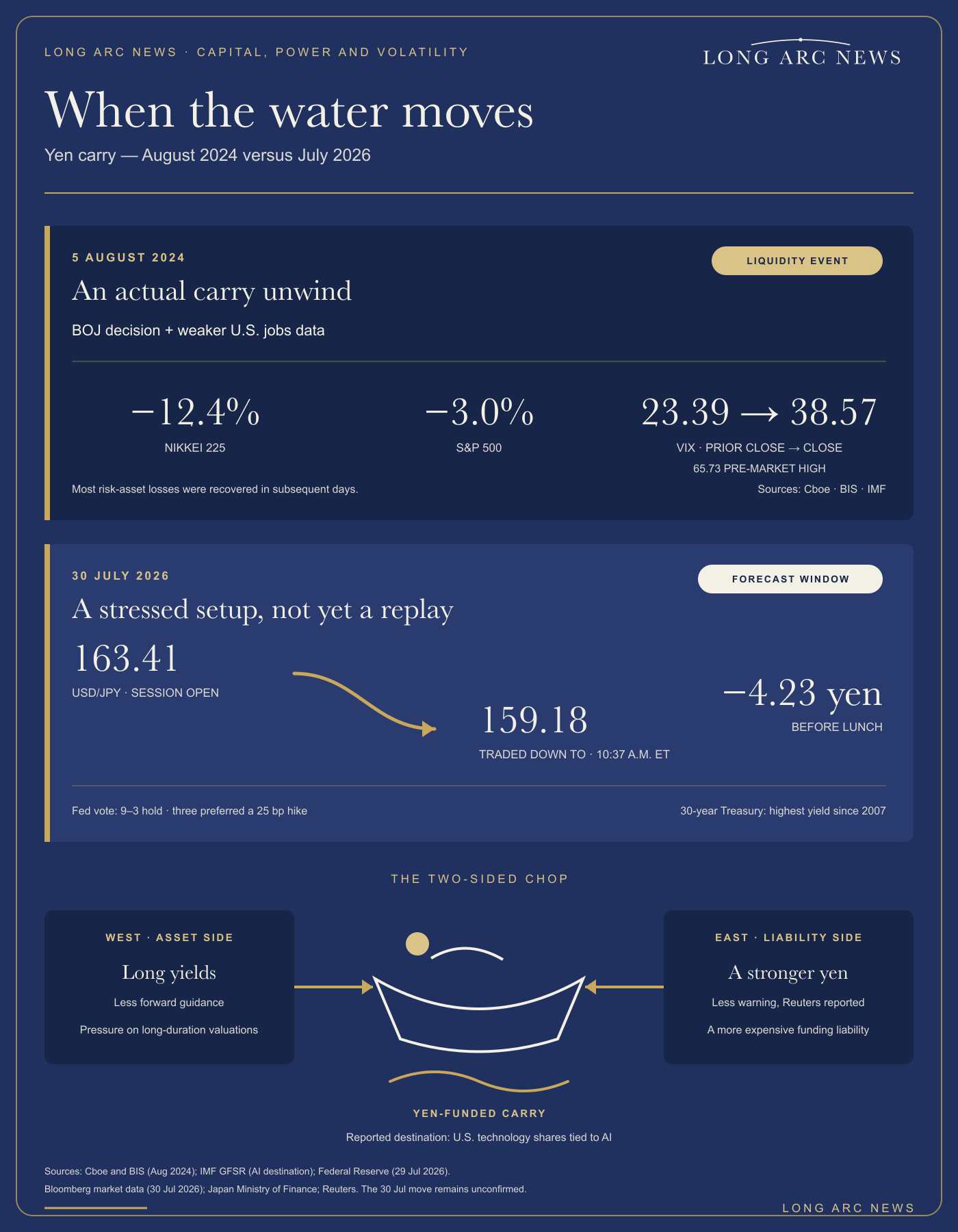
Most of it reversed within days. Liquidity and positioning moved before earnings did.
What makes this week different is that both ends of the trade are being disturbed at once.
From the west, Kevin Warsh has taken away the map. The Federal Reserve held on 29 July by nine votes to three, with three Reserve Bank presidents preferring a quarter-point increase—matching the three-person bloc that sought a hike in September 2016. The 30-year Treasury moved above 5.2 percent, its highest since 2007. Long yields press directly on the valuation of long-duration American growth companies.
From the east, Tokyo spent ¥11.7 trillion supporting the yen between 28 April and 27 May—a record for a month-long reporting period and roughly $73.5 billion over what Reuters said were probably several operations—and watched the gains disappear by early July. Sources told Reuters that officials were abandoning the habit of telegraphing intervention risk, hoping to squeeze speculators without naming a line. Whether Thursday was Tokyo’s hand cannot yet be known. The first official indication comes on 28 August, when Japan publishes the aggregate covering 30 July; the daily breakdown follows later. The silence is now part of the policy.
Chop from the west.
Chop from the east.
One crowded sleeper between them.
The BIS found ¥41 trillion of yen-denominated loans to non-banks outside Japan in the first quarter of 2024—about $250 billion at end-June exchange rates. It did not call that the size of the carry trade: the loans have other uses, derivatives hide much of the position, and the connection remained unclear. The IMF supplied the more specific destination, saying many investors had reportedly used yen funding for American technology shares tied to artificial intelligence.
Nobody financed the AI complex with a single carry trade. But leveraged sellers do not liquidate abstractions. They sell what is deep, liquid and still showing a profit.
I am not forecasting a crash before the closing bell.
I am forecasting a sequence of partial unwinds over the coming months: sharp yen rallies, thinning equity breadth and periodic compression in the largest AI names. The repricing should show in multiples well before it shows in earnings.
This comes apart over months, not in an afternoon.
How much of the American equity market still assumes the water will remain flat?