


The Valve, I
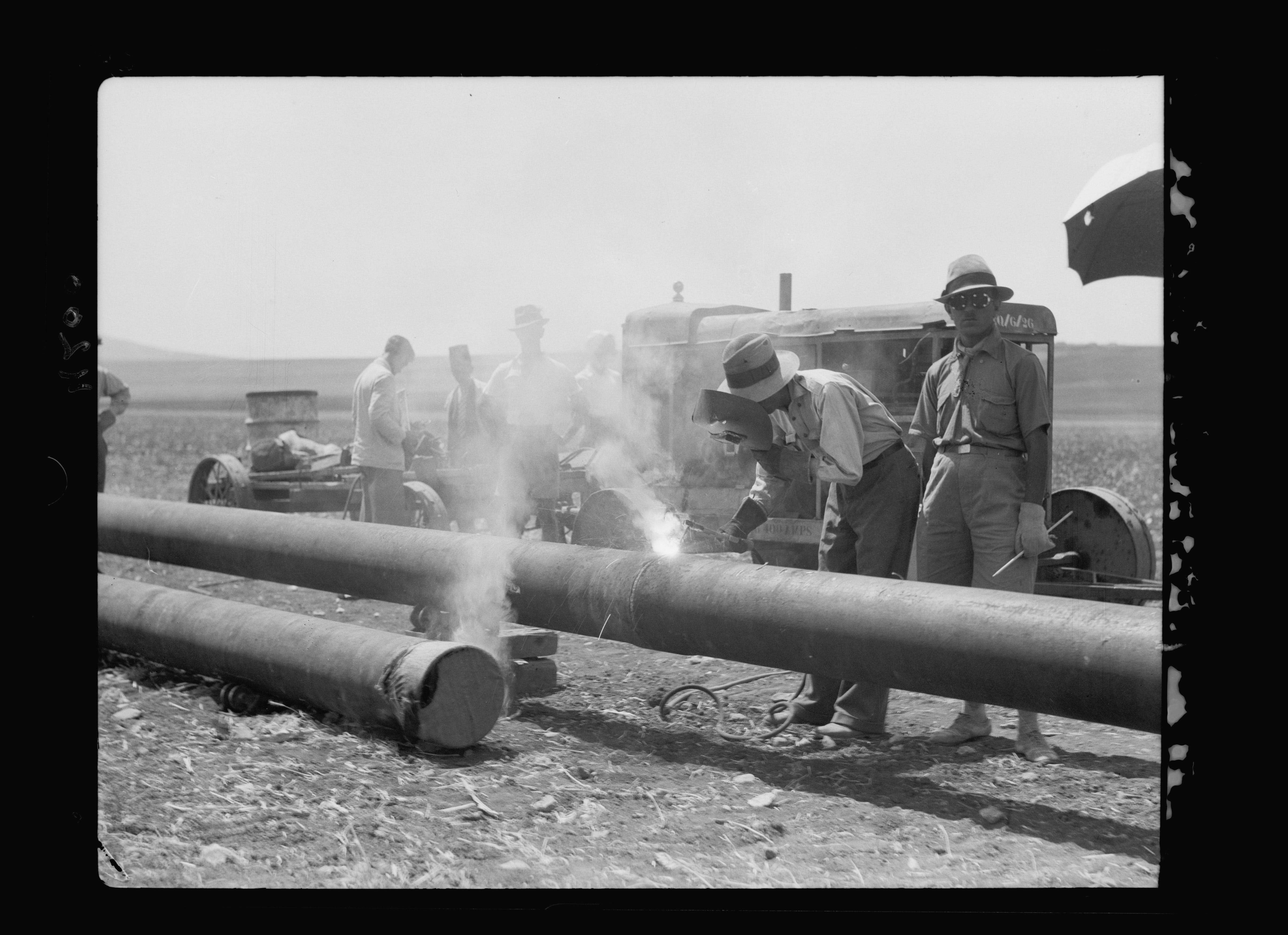
Welding the Iraq Petroleum Company pipeline across the Plain of Esdraelon, July 1933. Photograph: American Colony (Jerusalem), Photo Department. Library of Congress, Prints and Photographs Division, LC-DIG-matpc-15775.
At five in the afternoon on 2 November 1956, the Syrian government cut the Iraq Petroleum Company’s communications, according to the American ambassador. The company stopped pumping early the next morning. Iraq’s oil had lost its passage to the Mediterranean.[10]
That afternoon, three Syrian ministers met the ambassador, James Moose. The prime minister was there, along with the acting foreign minister and the minister of public works. They believed a pumping station had been seriously damaged. They said they did not know where, or who had done it.
“Visibly agitated,” Moose wrote of the men before him. He reminded them that the prime minister and acting foreign minister had already assured him the installations would be protected. All three now promised every possible assistance with repairs. The public works minister, himself an engineer, offered to help personally.[10,25]
The CIA’s bulletin of 12 November described two pumping stations destroyed and a third extensively damaged. Yet the company’s local superintendent believed some oil could move before they were rebuilt. New pipe could bypass the wreckage, allowing the surviving station in Iraq to push about 80,000 barrels a day towards the coast.
“This flow could be established in a few days if the Syrian government were willing.”[11]
Who, in Damascus, could give that permission?
· · ·
Long before the sabotage, British ministers had worried about France.
In 1930, a British Cabinet committee examined two routes from the Kirkuk fields to the sea. The shorter ran to Tripoli, through territory under French mandate. The longer reached Haifa. The estimates were £8.5 million and £11 million respectively. Britain could save on construction and accept a French-controlled outlet, or pay more to reach a port under its own mandate.
The Admiralty’s concern was explicit: “no oil would be obtainable in the event of a war with France”. France might also embargo shipments without explaining why. The Iraqi objection, reported by the British High Commissioner, was to an alignment through Syria.[4]
The compromise was a fork at Haditha. One branch would run through Syria to Tripoli; the other through Transjordan to Haifa. In February 1931, the Cabinet made its approval conditional on at least half the oil going to Haifa. By 1934, oil was reaching both ports. The arrangement gave the company two outlets and divided its political exposure.[4,5]
War took one of the outlets away. The Haifa refinery stopped in April 1948 amid the fighting in Palestine. The surviving records do not establish a single uncontested date for the last oil through the line. They are clearer about the political refusal. In June, Iraq’s defence minister told the British ambassador that Haifa must be in an Arab state or become a free port. Otherwise the line would have to be relaid through Syria and Lebanon. Iraq could not accept an outlet in a Jewish state.[6]
Syria now lay across the replacement route as well as the remaining one.
Another company was already seeking passage. Aramco’s Trans-Arabian Pipeline, Tapline, needed Syrian ratification for its shortcut to Sidon. That had not been secured when Colonel Husni al-Za’im seized power in March 1949. His government ratified the agreement by decree in May. The sequence is documented; the claim that Washington engineered the coup for the pipeline remains disputed. The CIA’s own contemporary summaries complained of delays in ratification after the coup.[7]
For IPC, the choice had narrowed. In April 1950, a Socony-Vacuum director told the State Department that IPC would proceed with a thirty-inch line to Baniyas. Reopening Haifa could not then be discussed, he said. Damascus, he reported, wanted a refinery at the terminus and some $15 million in retroactive transit payments. These were negotiating demands. The first Kirkuk crude was lifted at Baniyas in April 1952, according to the contemporary trade press.[8]
A State Department memorandum filed in June 1953 recorded a sixty-six-cent difference between the posted crude prices at Ras Tanura and Sidon. The gap had subsequently narrowed to fifty-four cents. Syria and Lebanon treated the difference as a saving created by the pipeline and wanted it shared equally with them. It was their bargaining argument, not an audited measure of profit.
For Kirkuk, the same memorandum recorded the decisive constraint: there were no facilities to export its output through the Persian Gulf instead.[9]
A pipeline is a foreign-policy commitment buried in the ground. IPC had laid a replacement for Haifa; Iraq had acquired a deeper dependence on Syrian permission. The company could compare the cost of a pipe with the cost of a ship. Baghdad needed an alternative route that actually existed.
· · ·
In November 1956, the assurances given to Moose had failed. The intelligence reports pointed towards the army.
On 4 November, the CIA attributed the sabotage to Egyptian agents. Two days later, it reported a witness to the demolition of the T-2 station who said a Syrian army unit had carried it out. The later account did not withdraw the allegation of an Egyptian role. It brought the Syrian army into the account, while the civilian ministers professed ignorance.[10,11]
The bulletin of 15 November supplied a name. Lieutenant-Colonel Abdul Hamid Sarraj, head of Syrian military intelligence, had threatened Tapline. According to a company official, its line would be blown up unless it agreed to supply Syria’s entire fuel-oil requirements. Sarraj had allowed forty-eight hours for a decision.
The CIA’s accompanying comment recalled his boasts that he controlled the pipelines. It attributed the IPC demolitions to “Syrian army personnel under his orders”. This was an intelligence attribution, not a recovered order. The comment disclosed no source for that particular conclusion.[12]
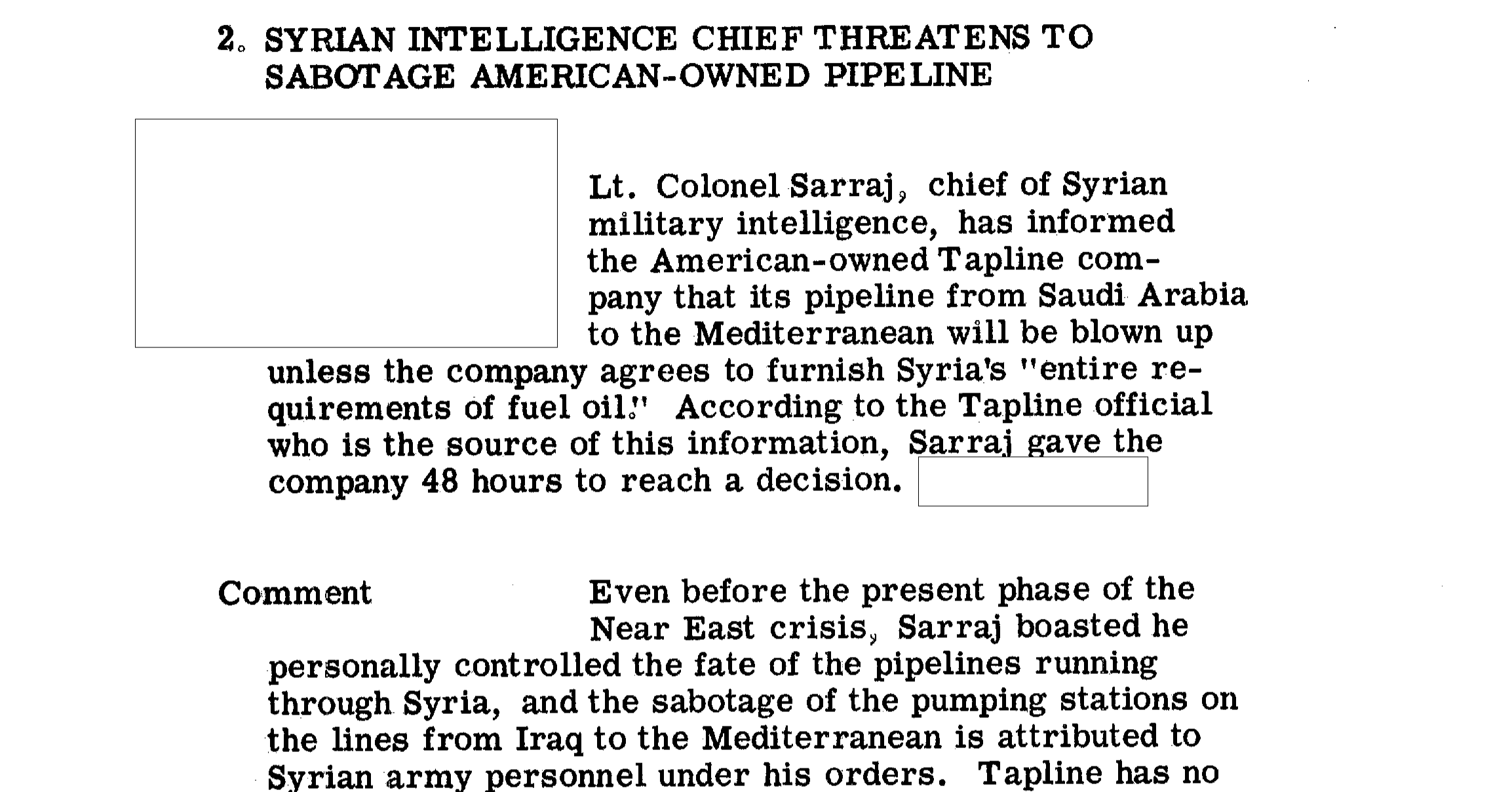
Current Intelligence Bulletin, 15 November 1956, page 5, item 2, as released by the CIA on 23 October 2019 (C02063769). The blank boxes are the agency’s redactions: the sourcing line that opened the item and a reference after it remain withheld. Public domain.
Sarraj’s reported demand also exposed a difficulty for Syria: the country needed fuel. The CIA subsequently reported a contract with Moscow signed on 15 November. A first delivery was promised at Baniyas in early December. By 21 December, it reported two Soviet deliveries. Even so, the agency warned that Syria faced a fuel crisis early in January.[12,13]
The same December bulletin recorded the condition Syria’s foreign minister attached to a bypass. Work could begin if Washington issued a statement fixing a date for Israel to withdraw from the Gaza Strip. A limited flow of Iraqi oil was technically possible. Its release had become conditional on a withdrawal from territory far from the pipeline. The agency judged that the decision would lie with the Syrian army leaders it held responsible for the demolitions.[13]
Repair would not settle the matter permanently. In January, the prime minister told the American ambassador that the stations could be stopped again, even after repair, if necessary. A few weeks later, IPC paid Damascus the equivalent of $13.72 million in transit dues owed up to November. The payment did not reopen the line.[13,14]
Nor was the explanation confined to Damascus. In February, Nasser told the American ambassador in Cairo that Syria’s refusal reflected an agreement between Egypt, Syria and Saudi Arabia. The surviving account is his description of the arrangement, not its text. His account suggests that Syrian policy alone cannot explain the continued closure.[14]
Baghdad had to plan around a closure it could not end. On 10 February, Nuri al-Said instructed his deputy to seek $238 million in credit from Washington or the World Bank. He estimated that lost oil revenue would reach $28 million by the end of March. It could reach the larger sum if the line stayed shut through March 1958. The CIA still judged Iraq’s finances sound and read the proposed borrowing as protection for its development programme.[16]
Syria authorised repairs on 6 March. Pumping resumed on 11 March. The trade press reported oil reaching Baniyas through the bypass that week, with the destroyed pumps still requiring months of work. Oil could move before the stations were rebuilt, once Syria allowed it.[15]
The effect reached beyond the two neighbours. A March paper for the British Cabinet set out the industry’s forecast for Western Europe’s spring supply. It expected 94 per cent of normal demand to be met under then-current conditions, or 100 per cent with the IPC pipeline open. Those were conditional forecasts, not a measurement of the stations’ share of European oil. The canal was still being cleared. This closure had occurred during the Suez war, and pumping restarted before the canal fully reopened.[16,17]
By August, someone writing to Washington had found a phrase for the mutual exposure. The author, whose name is deleted in the published record, offered personal views later forwarded to Dulles. Keeping the pipelines running, he argued, was evidence that Syria had not wholly moved into the Soviet camp. Closing them would alienate Iraq and Saudi Arabia and improve the West’s position for action. Yet intervention from outside would also put both lines at risk.
“These lines are therefore a kind of hostage in reverse.”[18]
The phrase contained a restraint as well as a threat. Syria could interrupt the oil. Doing so could bring consequences it did not control.
· · ·
Ten years later, Syria used a decree.
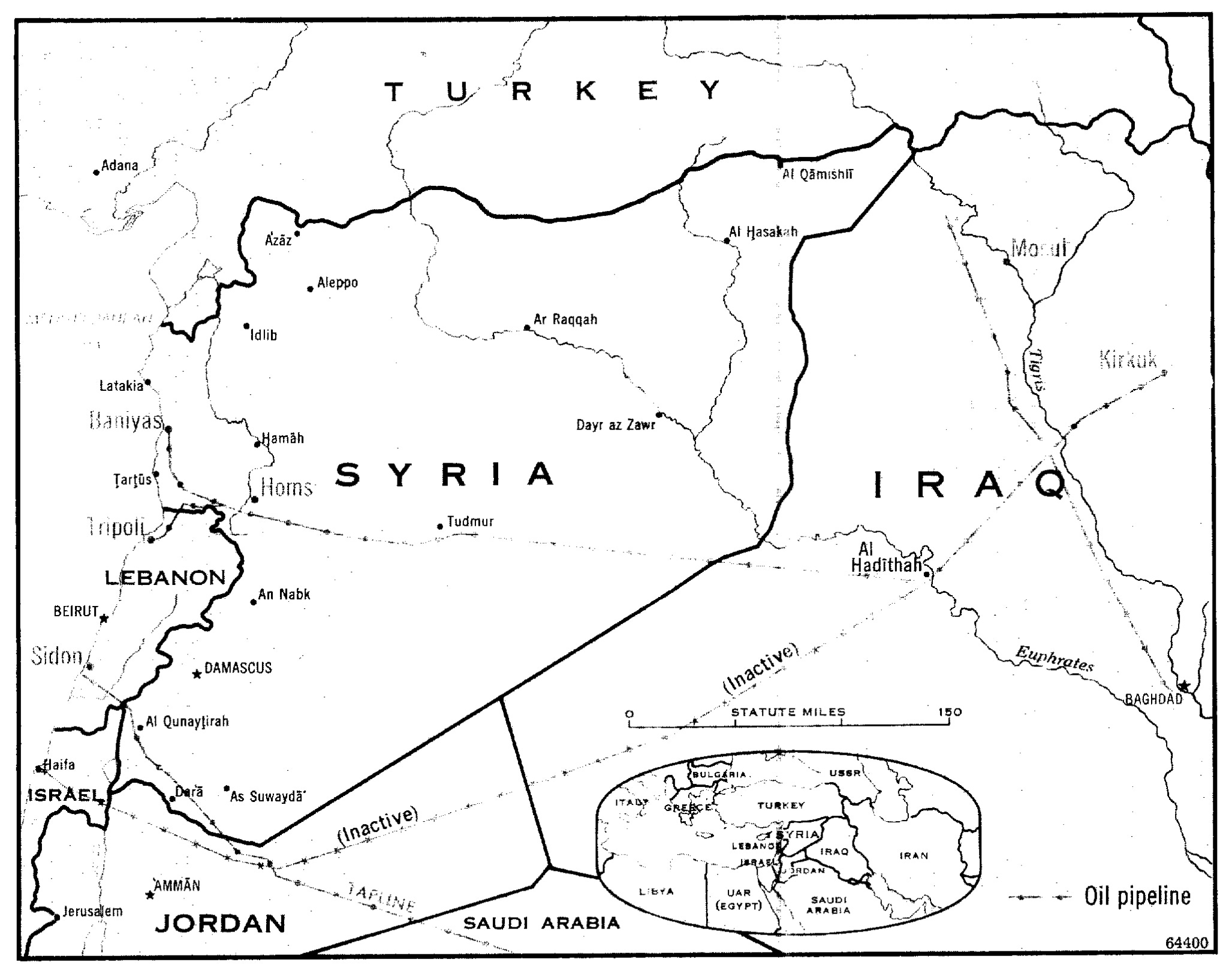
The valve as the CIA printed it the morning after the decree: Central Intelligence Bulletin, 9 December 1966, map page, with the Haifa limb marked “Inactive” (CIA-RDP79T00975A009400260001-9, released 27 February 2003). Public domain.
The Ba’ath government wanted higher transit fees and a retroactive increase reaching back a decade. Talks broke down on 23 November 1966. Five days later, an IPC representative argued that the company had reached its limit: a further concession would make shipping Kirkuk oil through Basra cheaper.[19]
Basra’s capacity imposed a limit. The American embassy considered maximum liftings through its existing facilities. Even then, under the assumptions it used, Iraq would receive less than half its previous income. Basra could not yet fully replace the Mediterranean route.[19]
In December, Syria doubled the fee, imposed a surcharge for the back payments it claimed and seized IPC’s assets on its territory. The CIA dated the action to the 8th; the State Department’s published account gave the 9th. From 12 December, Kirkuk oil stopped leaving the Mediterranean terminals.[20]
The company had time. Its pipeline was long amortised, the CIA noted, and its shareholders had other sources of oil. They were under no overwhelming pressure to concede.
In Baghdad, the prime minister was worrying about salaries.
On 23 January 1967, Naji Talib warned the American ambassador that he would soon be unable to pay officials and army officers in full. Iraq’s finances, he said, had been desperate even before the closure.[21]
Official estimates of the daily loss varied over time. The CIA put it at $750,000 a day in December, equivalent to seventy per cent of government revenue. A State Department paper in February used $630,000 a day. Neither figure was a settled account of the final cost.[20]
Syria was also paying to maintain the pressure. Its Homs refinery depended on IPC crude. The February State Department paper estimated forgone transit receipts at more than $2 million a month. In public, the Syrian information minister treated retreat as a political danger, saying a government that yielded would be overthrown by the masses. The closure had made compromise costly for Damascus while making delay costly for Baghdad.[21]
The American embassy in Cairo had doubts about IPC’s case. In December, the embassy in Cairo had asked for a candid appraisal of both sides. It suspected IPC might be reneging on its agreement or reading it too narrowly. That was an embassy’s concern, not a finding that the company had breached its obligations. Cairo was still asking whether Syria had a legitimate claim.[26]
IPC’s parent companies had already agreed, on 23 December, to pay $10.3 million against the Syrian claim for 1966. Other demands were left to arbitration. Exports resumed on 2 March 1967 under a new Syrian convention; a Lebanese agreement followed. IPC’s annual review recorded an average increase of more than fifty per cent in transit and terminal dues across the two conventions. The CIA also recorded a concession to IPC: no time limit on negotiations over back fees.[22,27]
In May, the company advanced Baghdad £13.9 million following the closure. Of that, £5.9 million was recovered from the year’s revenue. Talib’s government fell that same month. The fiscal crisis preceded the fall of the government. The documents cited here do not establish that it caused the fall.[22]
One response had already been suggested. During the closure, the American ambassador suggested offering a moderate Iraqi government the prospect of a new pipeline from K-2 to a Gulf loading terminal. A way around Syria could itself become an instrument of influence.[19]
· · ·
Reopening left Syria with the power to close the line again.
In May 1970, a bulldozer ruptured Tapline on Syrian territory. The CIA’s later account allowed that it might have been an accident. Syria nevertheless withheld permission for repairs while demanding a $50 million advance and higher fees.[23]
This time, the scarcity of ships increased the value of delay. Suez remained closed. A November intelligence estimate compared two routes to Europe. It reckoned that Gulf oil sent round the Cape required five or six times the tanker capacity needed for oil loaded at Mediterranean ports. Tapline’s closure and Libya’s production cuts together had absorbed spare shipping and raised new charter costs. The estimate also judged another politically motivated Syrian interruption of IPC likely within five years. In January 1971, the agency reported agreement to reopen Tapline on higher fees.[23]
Ownership changed the following year. Iraq nationalised IPC on 1 June 1972; Syria announced the takeover of the Syrian section in early June. The CIA considered the actions apparently coordinated. Under the supply conditions then prevailing, it judged that Western Europe would not be seriously affected because alternatives existed. For Iraq, the problem of finding buyers and getting oil to them remained.[24]
Syria’s leverage depended on the alternatives available to Iraq and its customers. Each interruption gave them another reason to seek alternatives.
· · ·
In July 2026, a driver called Abu Saif spent five days getting through the Syrian system to unload at Baniyas. One day was spent on the road, four in the queue. A New Lines reporter found him at the port. A Syrian Petroleum Company official described about five thousand Iraqi tanker trucks circulating through the system, arriving, waiting, unloading and returning.[1]
The cargo was fuel oil. Crude required a separate correction. On 7 October, S&P Global withdrew a statement that Iraqi crude was being exported through Baniyas. Such exports, it said, “have not commenced”. The 85,000 barrels a day in the earlier account were internal sales recorded in Baghdad on a revenue basis.[2]
Plans for a pipeline were further ahead on paper. In July, the State Department welcomed Iraqi and Syrian intentions to rehabilitate and reconstruct the old route. The consortium’s release left scope, route, timetable and commercial terms subject to technical studies. In August, two people involved in the project told Reuters that a new line would take about four years and at least $15 billion. These remained estimates and intentions. They were not a construction schedule.[3]
The queue gives the proposal an immediate appeal. A working line could move oil without that procession of lorries. But the old records describe another kind of waiting: pumps capable of moving some oil, a company ready to proceed, and governments arguing over the permission.
In 1956, a minister who was also an engineer offered to help with the repairs. The obstacle outlasted his offer. What would a new agreement change about who can stop the oil?
Source notes
These notes give the provenance and the limits of the evidence behind each passage. A primary document verifies what its author recorded; an intelligence attribution or a reported conversation does not by itself verify the event beneath it. Where a figure or a date rests on one witness, the note says so. CIA links go to the Internet Archive’s page-for-page mirror of the CIA FOIA Reading Room; the Cabinet papers were opened as scans ordered from the National Archives’ Discovery catalogue and are Crown copyright, quoted under research terms. The argument and the transitions are mine.
1. The driver and the queue. REPORTED CLAIM. Hussam Hammoud, New Lines, 5 August 2026: Abu Saif’s five days (8–13 July) and the figure of about five thousand tankers in the system, from Syrian Petroleum Company official Ali Qabahji. One reporting chain for each; the fleet figure is not daily throughput.
2. The accounting correction. VERIFIED FACT about the correction. S&P Global, 7 October 2026: Baniyas crude exports “have not commenced”; the 85,000 b/d were internal sales recorded in SOMO’s September export data on a revenue basis. It says nothing about fuel-oil movements, which continued.
3. The proposed reconstruction. VERIFIED FACT for the statements: State Department media note, 17 July 2026, checked against two reproductions; UCC Holding consortium release, 18 July 2026, final paragraph. REPORTED CLAIM for the four years and $15 billion: Reuters, 17 August 2026, two unnamed participants, one chain; Chevron said in the same report that refit, expansion and new build were all still options. No financing close or construction schedule exists in the record.
4. The Cabinet routing papers. VERIFIED FACT, read in the scans. CAB 24/211/35, C.P. 136 (30), report of the Cabinet committee on the Baghdad–Haifa railway and pipeline, 1 May 1930: £8.5 million against £11 million, three shillings a ton, £600,000 a year on four million tons, the Naval Staff’s “no oil would be obtainable in the event of a war with France” and the embargo sentence. CAB 23/64/5, conclusions of 21 May 1930: the High Commissioner’s telegram of 13 May, Baghdad “most strongly opposed to the adoption of an alignment through Syria”. CAB 23/66/13, conclusions of 5 February 1931, with CAB 24/219/36, C.P. 36 (31): “bifurcation at Haditha” and the fifty per cent condition, which is the Cabinet’s condition on production, not the wording of the concession. The completion dates are the agreement’s: Hansard, 15 February 1933, vol. 274 cc997–8, on the agreement of 24 March 1931.
5. Construction and first oil. REPORTED CLAIM. Petroleum Times, Review of Middle East Oil, June 1948 (Exeter scan), “The Iraq–Mediterranean Pipelines”: August 1932, 4,878 local and 182 foreign staff, first oil at Tripoli on 14 July 1934 and at Haifa on 14 October. Written with the company’s help; one witness for each figure.
6. Haifa, 1948. REPORTED CLAIM for the dates. FRUS 1949 VI d48, Mattison to Hare, 12 July 1949, reconstructs the 24 April closure and the 4 May Iraqi cut-off a year after the fact; one witness, and the day the refinery stopped is given differently by other official sources, so the month stands alone. A parliamentary answer of 1 June 1948 said to describe intermittent pumping could not be opened and is not used. VERIFIED FACT for the conversation: FRUS 1948 V/2 d392, Douglas to State, 18 June 1948, reporting the defence minister’s words to the British ambassador on 14 June.
7. Tapline and the coup. REPORTED CLAIM for the ratification: FRUS 1949 VI d24, editorial note, Legislative Decree 74 of 16 May 1949, from Damascus telegram 284. VERIFIED FACT for the coup date, two records: Hansard, 6 April 1949, written answer, vol. 463 c184W; FRUS 1949 VI d1132, Acheson to Truman, which does not mention Tapline. CIA Weekly Summary no. 44, 1 April 1949 (”delays in the ratification”), and no. 47, 22 April (”vacillation over the Tapline”). INTERPRETATION: analysts’ summaries show how the agency wrote about the coup, not what its operations side did; the question of American involvement stays open.
8. Baniyas and the back account. REPORTED CLAIM. FRUS 1950 V d18, Funkhouser memorandum of conversation, 25 April 1950, Charles Harding, “Director of Socony Vacuum”: the thirty-inch line, the refinery demand, “retroactive payments amounting to approximately $15,000,000” for fifteen years. Negotiating positions, one witness. First crude lifted at Baniyas, 11 April 1952: Oil & Gas Journal, 5 May 1952, p. 167, one trade-press chain.
9. The posted-price memorandum. VERIFIED FACT about the positions recorded. FRUS 1952–54 IX/1 d294, Eakens, Petroleum Policy Staff, file 887.2553/6–353, which is the source of the 3 June 1953 date; the memorandum prints none. Ras Tanura $1.75, Sidon $2.41 then $2.29, differentials of $0.66 and $0.54; “this saving should be shared equally with transit countries”; “no facilities for the export of Kirkuk output via the Persian Gulf as an alternative”. The memorandum does not say who posted the prices. The gap was the transit governments’ argument, not an audited margin.
10. The cut and the ministers. REPORTED CLAIM. FRUS 1955–57 XIII d336, Moose, Damascus telegram 1040, 3 November 1956: communications cut at 5 p.m. on 2 November; the ministers “claimed not to know where or by whom perpetrated.” The 3 a.m. stop is the CIA’s, Current Intelligence Bulletin, 4 November 1956, p. 11. The denial is reported speech, not evidence of what the ministers knew.
11. Attribution and the bypass. REPORTED CLAIM, each item one reporting chain. CIA Current Intelligence Bulletin, 4 November 1956, p. 11, “Egyptian agents”; 6 November, p. 12, the redacted witness and “a Syrian army unit”; 12 November, p. 3, the damage survey from Beirut reports of 8 November and the superintendent’s 80,000 b/d bypass “if the Syrian government were willing”. The bypass was a limited flow around the wrecked stations, not their repair. Six months to a year: FRUS 1955–57 XVI d554, 303rd NSC meeting, 8 November 1956. Release approvals on the scans are dated 23 and 24 October 2019.
12. Sarraj. REPORTED CLAIM, and an attribution rather than an order. Current Intelligence Bulletin, 15 November 1956, C02063769, p. 5, item 2 and its Comment, released 23 October 2019: the Tapline official is named as the source of the ultimatum; the Comment’s attribution to “Syrian army personnel under his orders” carries no disclosed source. No order, log or named engineer has been found. The same demand reached the embassy on 14 November from the public works minister (FRUS XIII d339, note 2), probably the same company source heard twice. The Moscow contract of 15 November, with first delivery at Baniyas by 3 or 4 December, is the bulletin of 1 December 1956; one witness.
13. The Gaza condition and Syria’s own fuel. REPORTED CLAIM. Current Intelligence Bulletin, 21 December 1956, p. 3: the foreign minister’s condition, the army leaders’ decision, stocks of 32,000 tons against about 600,000 a year, two Soviet deliveries, and the January crisis as a forecast, not a recorded outcome. Asali’s “even if repaired, could be stopped later ‘if necessary’”: bulletin of 9 January 1957, p. 7.
14. Payment and Cairo. REPORTED CLAIM, one chain each. Bulletin of 1 February 1957: $13,720,000 paid on 30 January for transit up to November, and a $700,000 advance on 10 January. Bulletin of 10 February, p. 3: Asali’s “request by Nasr” of 7 February and the Comment that “the decisions will continue to be made in Cairo”. Bulletin of 17 February, p. 3: Nasser’s “agreement between Egypt, Syria and Saudi Arabia”, said to the American ambassador on 14 February. Two leaders’ accounts, not a text of any agreement.
15. Repairs and the restart. VERIFIED FACT for the record, one witness for each date. FRUS XIII d348, editorial note: Damascus 4674 of 6 March 1957 (Asali’s authorisation) and Baghdad 1507 of 12 March (the Iraqi Economic Ministry’s report of pumping on 11 March). Oil & Gas Journal, 18 March 1957, p. 86: the first Iraqi oil in four and a half months at Baniyas through the thirty-inch line, “months to replace the destroyed pumps”, about 220,000 b/d planned through T-1 and auxiliary units.
16. Iraq’s credit and Europe’s spring. REPORTED CLAIM for Nuri’s instruction: bulletin of 15 February 1957, p. 7, which also reads “Iraq’s fiscal position remains sound” and takes the credit as protection for the development programme; no loan or realised loss of those sizes is established. VERIFIED FACT for the forecast, read in the scan: CAB 129/86/16, C. (57) 66, Oil Supplies, 13 March 1957, the two-column table for Western Europe, April–June: 94 per cent “under present conditions”, 100 per cent “with Iraq Petroleum Company pipeline open”. A forecast of supply, not a measure of the line’s share of European oil; the OGJ newsletter of 18 March carries the same 94 per cent from the same industry estimate.
17. The canal chronology. VERIFIED FACT about the statement: Hansard, 25 March 1957, “small vessels can apparently now pass through”, thirty-three-foot ships not before 10 April. A dated forecast, one witness; the point is only that the pumps restarted before the canal reopened.
18. Hostage in reverse. VERIFIED FACT about the argument, not about policy. FRUS XIII d371, letter of 24 August 1957 forwarded to Dulles as personal views, S/S Files, Lot 66 D 123; both the forwarding official and the quoted author are deleted in the published text. FRUS XIII d388, White House memorandum of 7 September 1957, Eisenhower Library, Whitman File: “Oil revenues account for half of the Iraqi income.” The “half” is the memorandum’s figure, not an audited share.
19. The Basra ceiling. REPORTED CLAIM. FRUS 1964–68 XXXIV d196, note 3: talks broken off on 23 November 1966; Baghdad telegram 1014 of 28 November, the company representative’s “cheaper ship Kirkuk oil via Basra”. d197, Strong, Baghdad 1135, 17 December: “less than half as much as heretofore” with Basra liftings “to maximum possible with existing facilities”, and the K-2-to-Gulf pipeline “held out to a moderate GOI as a reward”. The company’s comparison is qualitative; no freight series is supplied.
20. The decree and the losses. REPORTED CLAIM. Central Intelligence Bulletin, 9 December 1966, pp. 7–8, dates the decree and seizure to the previous day and supplies the amortisation, the alternative sources and the Homs dependency; FRUS d196 note 3 gives 9 December; the two dates stand. Export ban from 12 December: IPC’s Review for 1967 and the CIA’s bulletin of 2 March 1967. Bulletin of 19 December 1966, p. 3: $750,000 a day, 70 per cent of government revenue, Arif “had not been told”. The State Department’s 1 February 1967 paper, d202, used $630,000 a day; estimates of one loss, not two confirmations.
21. Payrolls and the walls. REPORTED CLAIM, one witness each. Baghdad telegram 1304 of 23 January 1967, quoted in d201, note 3: “desperate even before pipeline closure”; a warning, not a payroll ledger. d200, Damascus 809, 12 January 1967: Zu’bi “making issue political not economic”, the government “would be overthrown by masses”, posters on 11 January “including walls Embassy and ConGen Aleppo”. d202: Syria’s loss above $2 million a month and the Homs shortage, a State Department estimate.
22. Settlement and aftermath. REPORTED CLAIM for the concession: bulletin of 24 December 1966, p. 6, $10.3 million agreed on 23 December, Shell and BP over their American partners, the rest to arbitration. VERIFIED FACT from the company’s own record: IPC, Review for 1967 (Exeter scan): exports resumed 2 March 1967, the Lebanese agreement “shortly afterwards”, “over 50%” across the two Supplemental Conventions, the £13.9 million advance of May 1967 and £5.9 million repaid. Bulletin of 2 March 1967, p. 6: “knuckled under”. Talib replaced in May: d206, editorial note. INTERPRETATION: the sequence does not establish cause.
23. Tapline, 1970, and the tanker squeeze. REPORTED CLAIM. Central Intelligence Bulletin, 16 July 1970: the bulldozer of 3 May, “possibly by accident”, the $50 million advance demand, the $5 million counter. NIE 20/30-70, 14 November 1970, also FRUS 1969–76 XXXVI d61: five to six times the tanker capacity for Gulf–Cape–Europe against Mediterranean–Europe, a capacity ratio and not a freight ratio; Libyan cutbacks and Tapline named together as the cause of “sharp rises in new charter fees”; the two closures “for political reasons” and the five-year forecast. Reopening on higher fees: bulletin of 30 January 1971.
24. Nationalisation, and the consortium that was never built. REPORTED CLAIM. Central Intelligence Bulletin, 2 June 1972, p. 2: Iraq’s nationalisation of 1 June, Syria’s announcement “today”, the act “apparently” coordinated, Europe not seriously affected “because alternative supplies exist”, a judgment on the supply conditions of that moment. Bulletin of 24 March 1957, p. 7: the companies “tentatively agreed” on a consortium for two lines from the Gulf to the Mediterranean, 1.2 million barrels a day, the first by 1960, “protected by treaty”; a plan, recorded by the agency, that was never executed.
Images. The opening image is the Current Intelligence Bulletin of 15 November 1956, page 5, item 2, as released by the CIA on 23 October 2019 (C02063769); the blank boxes are the agency’s redactions, the sourcing line that opened the item and a reference after it, both still withheld. The map is the one printed in the Central Intelligence Bulletin of 9 December 1966, the morning after the Syrian decree, with the Haifa limb marked “Inactive” (CIA-RDP79T00975A009400260001-9, released 27 February 2003). Both are US government works in the public domain; both are reproduced from the Internet Archive’s mirror of the CIA FOIA Reading Room without alteration beyond cropping.
Hero photograph. American Colony (Jerusalem), Photo Department, July 1933; Library of Congress, Matson Collection, LC-DIG-matpc-15775, item 2019706553. The photograph shows construction on the earlier Haifa route, not Baniyas construction or the 1956 sabotage. Library of Congress catalogue; collection rights statement. The catalogue states: “No known restrictions on publication.” The CIA bulletin described as the “opening image” in the original image note above is reproduced in the 1956 section.
Supplementary source notes
25. The ministers’ meeting. VERIFIED FACT. Moose’s telegram 1040, Damascus, 3 November 1956, 9 p.m., records the meeting at 5 p.m. that day, the ministers’ agitation, their professed ignorance, the earlier protection assurances of 1 and 2 November, and Public Works Minister Jabri’s offer of personal assistance as an engineer. FRUS 1955–57, vol. XIII, document 336, pp. 594–595. Department of State, Central Files, 883.2553/11–356. Single witness for these details; verified as the ambassador’s account, not independent proof of the ministers’ ignorance.
26. Cairo’s reservation about IPC. VERIFIED FACT. Telegram 3385 from Cairo, 16 December 1966, paragraph 6, records the embassy’s suspicion that IPC might be reneging on the existing agreement or construing it narrowly and asks Washington for a candid appraisal. FRUS 1964–68, vol. XXXIV, document 196. NARA, RG 59, Central Files 1964–66, PET 15–2 SYR. Event and document date: 16 December 1966. Single witness; an embassy assessment, not a finding of contractual breach.
27. The concession to IPC. REPORTED CLAIM. The Central Intelligence Bulletin of 2 March 1967, printed p. 6 (PDF p. 7), Notes, Syria item, records IPC’s success in obtaining no time limit on negotiations over back fees for 1955–66. CIA-RDP79T00975A009700120001-1, release approved 18 April 2003. Single witness. The agreement was reported as subject to final Syrian ratification. Its forecast of reopening that day or the next is not evidence of completed reopening; the IPC annual review cited in note 22 supplies the reported restart on 2 March.