


On launch night I fed China’s new flagship AI, Kimi K3, a research brief with two planted lies. It caught both — then audited its own press coverage. The model is free; its Western rivals charge tenfold. Nearly two trillion dollars of private paper is priced on the belief that what Moonshot gave away is scarce.
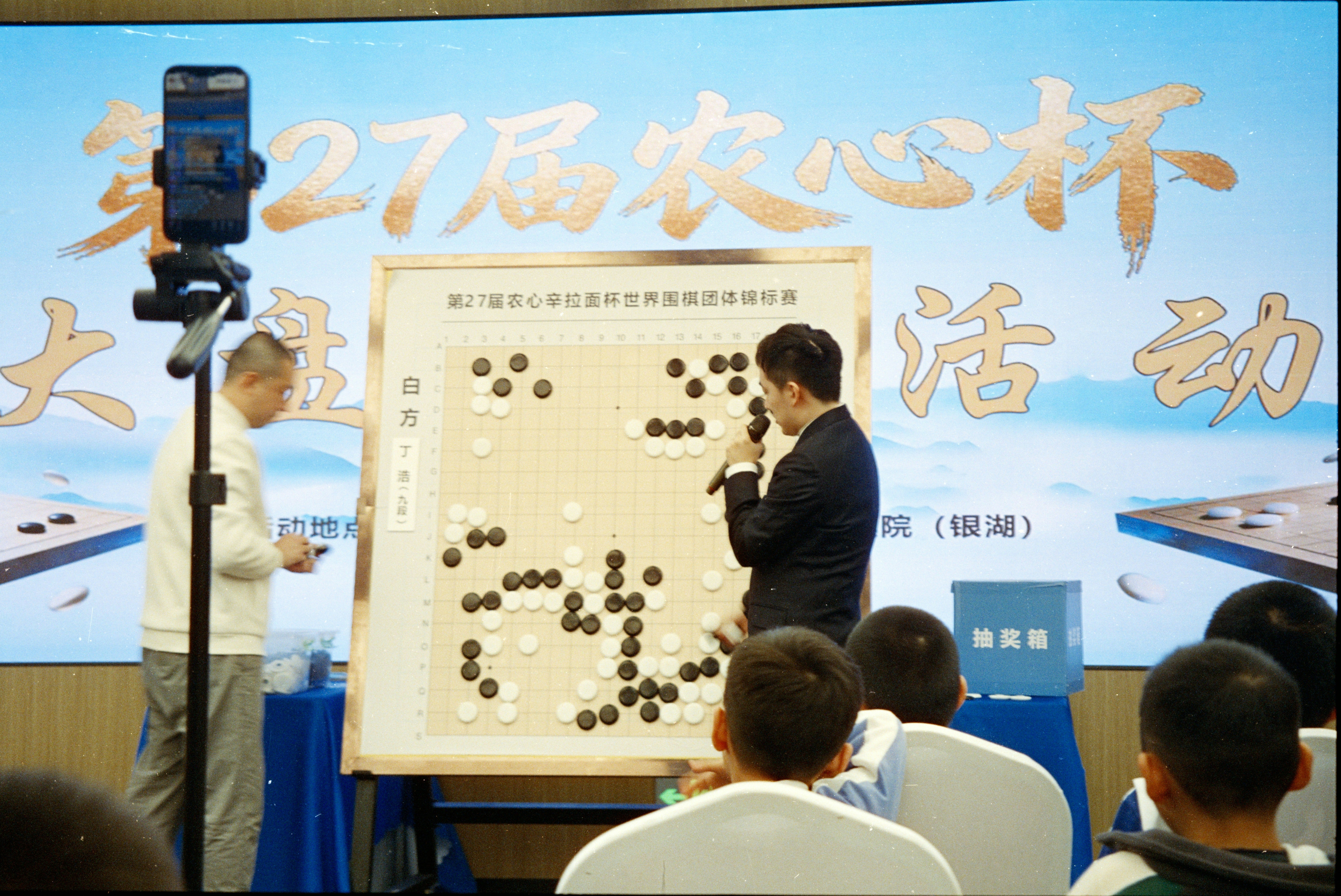
A Go tournament in Shenzhen. Photograph: Quan Jing, Unsplash
Long Arc News · July 16, 2026
All scarce things are priced alike; everything common becomes cheap in its own way. — after Tolstoy
The lies went in at my desk on Thursday evening, a few hours after a Beijing lab called Moonshot AI released Kimi K3 — the biggest artificial intelligence anyone has ever promised to give away. I wanted to know whether it could be trusted. So into a two-week intelligence brief (thirty stories, five deep dives, a hundred-cell data table) I planted two fictions: an IMF research paper that does not exist, and a codename I had invented that morning. Then I ran the brief through two machines at once: K3, and the American incumbent it is chasing, Anthropic’s Claude Fable 5, running nineteen research agents as my control. A newsroom where every reporter is the same machine. Same prompt, same evening, both transcripts on my desk.
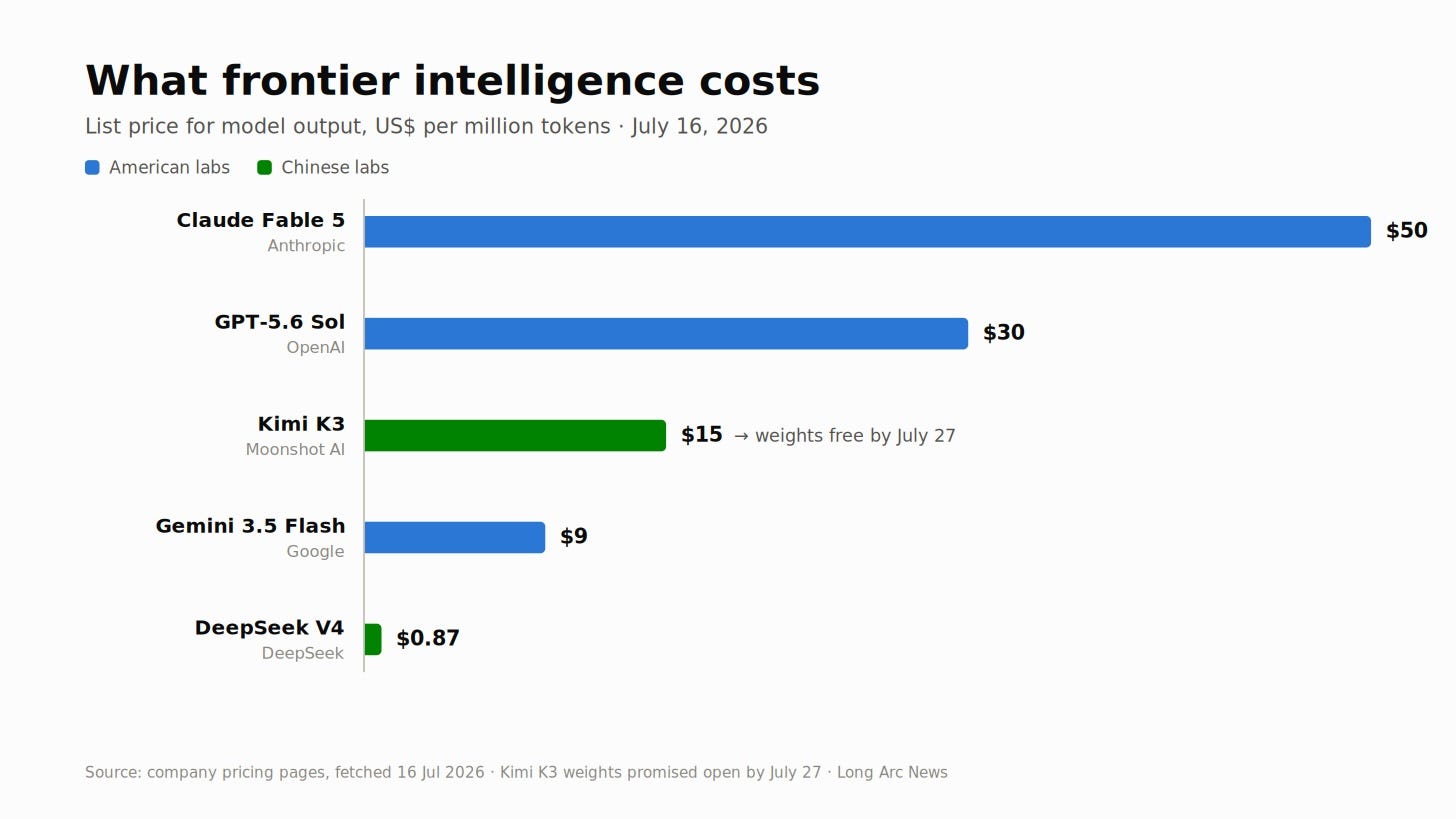
First, the object itself, because everything hangs on it. An AI model is a file, a very large one. Western labs rent you theirs by the token, the metered word-fragments of machine intelligence, and keep the file. Moonshot says that by July 27 it will publish the file itself — 2.8 trillion parameters, the dials inside the machine — free for anyone to download. Imagine Boeing posting the blueprints of its newest jet eleven days after first flight. Until then K3 rents at $3 per million tokens you feed it and $15 per million it writes back; the Financial Times reported it is expected to close the gap with Anthropic’s Opus 4.8, and Anthropic’s current flagship (Fable 5, the very model running my control) rents at $10 and $50. The challenger prices seventy percent below the incumbent sitting across the desk from it, on its way to free. Riding on whether that is survivable: nearly two trillion dollars of private Western paper, priced on the belief that what Moonshot just gave away is scarce.
Both lies died fast. To kill the fake IMF paper, K3 did not merely search the title. It pulled the Fund’s entire 2026 working-paper index, numbers 001 through 147, and reported the hole where my paper should have been. To kill the invented codename, it hunted down the only real thing bearing that name, an unrelated programming tool, and said so. Then it did something I had not asked for: it investigated its own press. The “2.5 trillion parameter” figure circulating that morning? Traced to one leaked pre-release spec, recycled by four outlets. The “300 parallel agents” claim riding in its launch coverage? Copied, word for word, from its predecessor’s manual; no official source states K3’s true ceiling at all. Its own activity log reported fifteen agents on my task, not three hundred. On launch day, the most rigorous debunking of Kimi K3’s hype available in any language was filed by Kimi K3.
Then it graded me.
My brief carried the Chinese chipmaker CXMT’s Shanghai float at ¥29.5 billion, the number from the filing. K3 came back with Tuesday’s actual pricing: ¥57.9 billion, roughly $8.5 billion, the largest Asian listing of the year so far. My brief called last week’s Japanese thirty-year bond yield a thirty-year high. K3 pulled the Ministry of Finance’s own auction sheet and made the sharper point: not a record yield — the first 4 percent coupon Japan has ever printed on a thirty-year bond. Both corrections check out. Both were mine to catch. I didn’t. Being corrected by the machine you are auditing is a strange feeling; I recommend it to anyone pricing these companies.
Fable 5 kept its own score. It knew Google’s and Mistral’s actual current flagships, where K3 named models their makers no longer headline. It priced the merged SpaceX–xAI at Thursday’s close, $1.73 trillion, where K3 carried a figure two weeks and half a trillion dollars stale. It finished the gauntlet three times faster. Added up, the contest was a draw. That should comfort no one in San Francisco: one of these machines charges ten and fifty, and the other will be free inside eleven days. A tie is a rout. But look at the shape of the tie. Every fact K3 missed was a fast-moving Western one; every fact Fable 5 missed was a fast-moving Asian one. Each machine was blind exactly where the other could see. The gap is the clue.
What Thursday proved is smaller and stranger than the marketing. The machines are now roughly equally smart. What differs is where each one’s knowledge is fresh, whose documents it can actually read, and whether it admits what it cannot verify. Intelligence has become a commodity, like crude or wheat. Trust has become geography. Intelligence is stateless; trust never was.
Tolstoy spent twelve hundred pages arguing that history is not made by great men but by the sum of innumerable small wills: the soldier who runs, the soldier who stays. The AI trade is still priced on great men: the founder, the flagship, the famous lab. The download ledger is the small wills. Forty-one percent of them just voted Chinese.
Now the bill, because nobody priced the Western labs like wheat merchants. Anthropic was marked at $965 billion in May, OpenAI at $852 billion in March: two companies that have never listed a share, carried near a trillion dollars each, priced in private rounds by buyers who mostly cannot exit. Those prices assume the thing being built is scarce. This week’s data disagrees. Down the menu, the same intelligence costs whatever you like: OpenAI’s flagship at $5 and $30, Google’s at $1.50 and $9, K3 at $3 and $15 with the giveaway pending, China’s DeepSeek for under a dollar. Chinese free-to-download models just passed American ones for the first time: 41 percent of all downloads on Hugging Face, in effect the industry’s app store. The six most-used models on OpenRouter, the marketplace where developers shop for AI, are all Chinese. This is not a forecast of repricing. It is the tape.The ladder, as of launch night. Chart: Long Arc News.
Where the public has been allowed to vote, it is voting. Elon Musk’s merged SpaceX–xAI — of the three famous American AI labs, the only one the public can actually buy — went public in June at a $161 first-day close and finished Thursday at $131, down nearly a fifth in five weeks. Beijing, meanwhile, has built a listing machine and is running it in plain sight: Zhipu to Hong Kong in January, briefly worth a trillion Hong Kong dollars by June; CXMT pricing the year’s biggest Asian IPO so far on Tuesday, to list on July 27 — the very deadline Moonshot set for giving K3’s brain away; the robot-maker Unitree approved in record time; DeepSeek reportedly courting a valuation above $70 billion for its own Shanghai float; Moonshot itself reported, on launch day, to be raising at $31.5 billion, up more than half since May: a valuation built on the giveaway. One side is discovering AI’s price in public, weekly, with retail money and state blessing. The other keeps deferring the exam. And deferral now costs real money: last week’s US thirty-year auction stopped at 5.058 percent, the most expensive long-term money the Treasury has paid since 2007, rising at the exact moment the product’s price is falling.
If none of this feels like your desk, check your pension statement. The same scarcity story that prices the private labs also props up the public giants — Nvidia, Microsoft, Alphabet, Meta — at the top of every major index fund. Underneath it all is one question: when the intelligence itself is free, what exactly are you paying for?
The answer, when the IPO filings finally land, will be the things the tripwires measured: verification, freshness, distribution, the willingness to say “unverified” out loud. Those are real businesses: the businesses of exchanges, rating agencies, and utilities. Durable, necessary, and never priced at a hundred times revenue. The valuation question for the West’s private giants is no longer how smart the model is. It is who audits whom, and what an audit is worth. This one ran both ways: I graded the machine, the machine graded me back, and we were both right about each other. Capability is a spec. Trust is a ledger. The ledger now has entries on both sides of the Pacific.
The next Fault Line Briefing will name the Western revenue line most exposed when the flagship becomes a free download on July 27. Until then, one thought. I planted two lies on Thursday and a machine caught both. The third lie nobody planted. It sits in the marks. Somewhere in your book — a vendor contract, an index weight, a private position carried at cost — is a number that still assumes machine intelligence is scarce. Which number is it, and what will you do with it in the eleven days before the file goes free?
Superb ji. The very foundations of 'a monetary value for every asset' are being shaken by principles embedded within 1st Nation instincts. Seva, service to creation, is intervening in the most 'voracious consumption' arenas. The implosion of resource grabbing entities will be biblical.