


It Happened in 1974. It Is About to Happen Again.
I spent close to thirty years inside Gulf sovereign wealth. Washington is preparing its quietest ask — again.
What follows is research where research exists, and recollection where only recollection does — each marked as what it is.
The week the long bond broke a seal
This week the US Treasury sold $42 billion of ten-year notes at 4.683% — the highest auction yield since August 2007 — and $25 billion of thirty-years at 5.216%, the highest since 2001. The bonds sold; they always sell. What has changed is the price, and who sets it.
The federal government has paid $963 billion of net interest in ten months, against $39.9 trillion of debt; CBO projects $16.2 trillion more interest over 2027–36. Somebody has to hold this paper, willingly, at prices the Treasury can survive.
My argument is a forecast, and I will label it as one: over the next few years, the United States will ask the Gulf’s official money — its central banks and its sovereign funds — to become committed buyers of its debt: not through a law or a communiqué, but the way it asked once before.
The proof that it can be done sat in a locked file for forty-one years.
Jeddah, 1974
In July 1974, Treasury Secretary William Simon flew to Jeddah. Before leaving, he told President Nixon: “I will try to get a commitment from them to put their funds in long and short term securities.” The July visit produced a proposal. By 30 September, Riyadh had decided. In December 1974, a US Treasury delegation and the Saudi Arabian Monetary Agency agreed the operating protocol in Jeddah. The cable is titled “SAMA AGREES TO PURCHASE TREASURY ISSUES”; it records the Saudi side pressing hardest on “the necessity of confidentiality,” and notes, almost in passing, the previous day’s Saudi decision to price oil only in dollars. Both legs of the arrangement converge in one document.
The mechanics were elegant: after each public auction, SAMA could take an “add-on” of the same security at the auction’s average price, settled through the Federal Reserve Bank of New York, outside the publicized offering — no competing bid, no footprint, no headline. A GAO review later found identifiable country data disappearing from Treasury publications from December 1974, the month the protocol was agreed; for four decades Saudi holdings dissolved into a line called “oil exporters.” Former officials told GAO confidentiality had been promised in exchange for the purchases; Treasury denied it. The dispute is part of the record. The concealment is not.
The attributed Saudi position grew from $1.3 billion at the end of 1974 to roughly $39 billion by 1982. The country-level number was not published again until May 16, 2016, when Treasury — pressed by a Bloomberg FOIA campaign — disclosed $116.8 billion and released the history.
Around the finance ran the security relationship — roughly $12 billion in arms commitments by the end of 1976 — and around both, the dollar itself: in June 1975, OPEC ministers in Gabon discussed repricing oil into SDRs — the Fed was studying the possibility that spring — and stood down. No opened document records a signed bonds-for-security bargain, and I will not claim one exists; David Spiro’s Hidden Hand argued the recycling was engineered rather than market-driven, and his critics disagree. What the record shows beyond argument is integrated statecraft: securities, security, and the dollar’s near-miss, running through the same capital in the same years.
The rest was understood rather than written, which is the subject of this essay.
From the rooms — I. When I entered the complex, the appetite for American paper was not a policy anyone announced. It was the water. The reasons at our level were sound on their own: Treasuries were the safest thing a fund in a volatile neighborhood could own; equities were still climbing out of the wreckage of the inflation years; and the institutions around us had been young when the money first came, so Treasuries were what an unbuilt system bought, and the habit outlived the reason. But there was another current above the desks. The political discussions were beyond my level, and I will not pretend I sat in them. What I can tell you is what came through the door: a continuous procession — Treasury secretaries, officials, the strategists of every Wall Street house — and all of them, whatever else they differed on, carried one unified message about the attractiveness of US fixed income. When the state and the salesmen sing in unison, a young allocator does not ask who wrote the song. Nobody called it a rule. Nothing that unquestioned needs a name.
The arithmetic that forces the question
Start with supply. The deficit through July was $1.8 trillion; CBO’s February baseline put the full year at $1.85 trillion, and its August review raised that to $2.1 trillion. Net interest crosses $1 trillion a year on CBO’s current projection — and reaches $2.1 trillion a year by 2036.
Now the refinancing machine. Treasury expects to refinance $9.7 trillion of maturing debt this fiscal year, up from the $9.1 trillion it rolled last year. Net coupon issuance is running toward $1.6 trillion this fiscal year; dealers put total net borrowing above $2 trillion a year through 2028. At the August refunding, the dealers told Treasury there is a median $1.45 trillion funding shortfall across 2027–28 at current auction sizes; most expect coupon auctions to grow in 2027.
An auction calendar is a supply chain. This one has no scheduled slack. Every week, the world must show up.
And the calendar now has a competitor. The AI buildout is financed with paper: hyperscalers and their affiliates have issued some $225 billion of bonds this year, a near-tenfold jump that puts them on pace for $400 billion, and they have displaced the banks as America’s biggest investment-grade borrowers. High-grade names, long duration, better spread. Call it reverse crowding-out: this time it is the private sector crowding the sovereign’s buyer base. Every mercenary dollar has somewhere else to go.
The composition problem
Consensus reads this data wrong in both directions. Foreign investors have not abandoned the Treasury market: total foreign holdings were $9.37 trillion in May, close to the record. The doom headline is false.
What is true is worse, and quieter. Since the end of 2020, foreign official holdings — central banks and sovereigns, the committed money — have fallen by roughly $338 billion, while foreign private holdings rose about $2.6 trillion. The official share of foreign holdings has collapsed from 59% to 41%. In March, during the war, it turned visible in one month: $138 billion off the total; Japan down $47.7 billion; China at its lowest since September 2008; even Saudi Arabia and the UAE selling, roughly $14 billion between them as the blockade squeezed export volumes — the reservoir being drawn, as we will see, the way it was built to be used.
The buyers who replaced the central banks are hedge funds, money funds, and foreign private accounts — including a basis-trade complex the Fed estimates may hold $1.4 trillion more Treasuries through the Cayman Islands than statistics capture, a model estimate. To be fair to the official view, Treasury’s borrowing committee calls demand healthy and foreign auction participation has risen. But its own February language gives the game away: “nearly all of the growth in foreign demand in recent years has come from the private sector.” The market has swapped committed holders for mercenary ones — money that must be re-recruited at every auction, at whatever price clears. The term premium on ten-year notes — a model estimate of the extra yield investors demand for holding duration — averaged below zero across 2020–24, years when the Fed itself was suppressing it. It stands near 0.8% today. How much is normalization and how much is the price of a mercenary base, no model can split. Whatever the split, it is charged against a $31.5 trillion marketable stock — more than half of which must be rolled within three years.
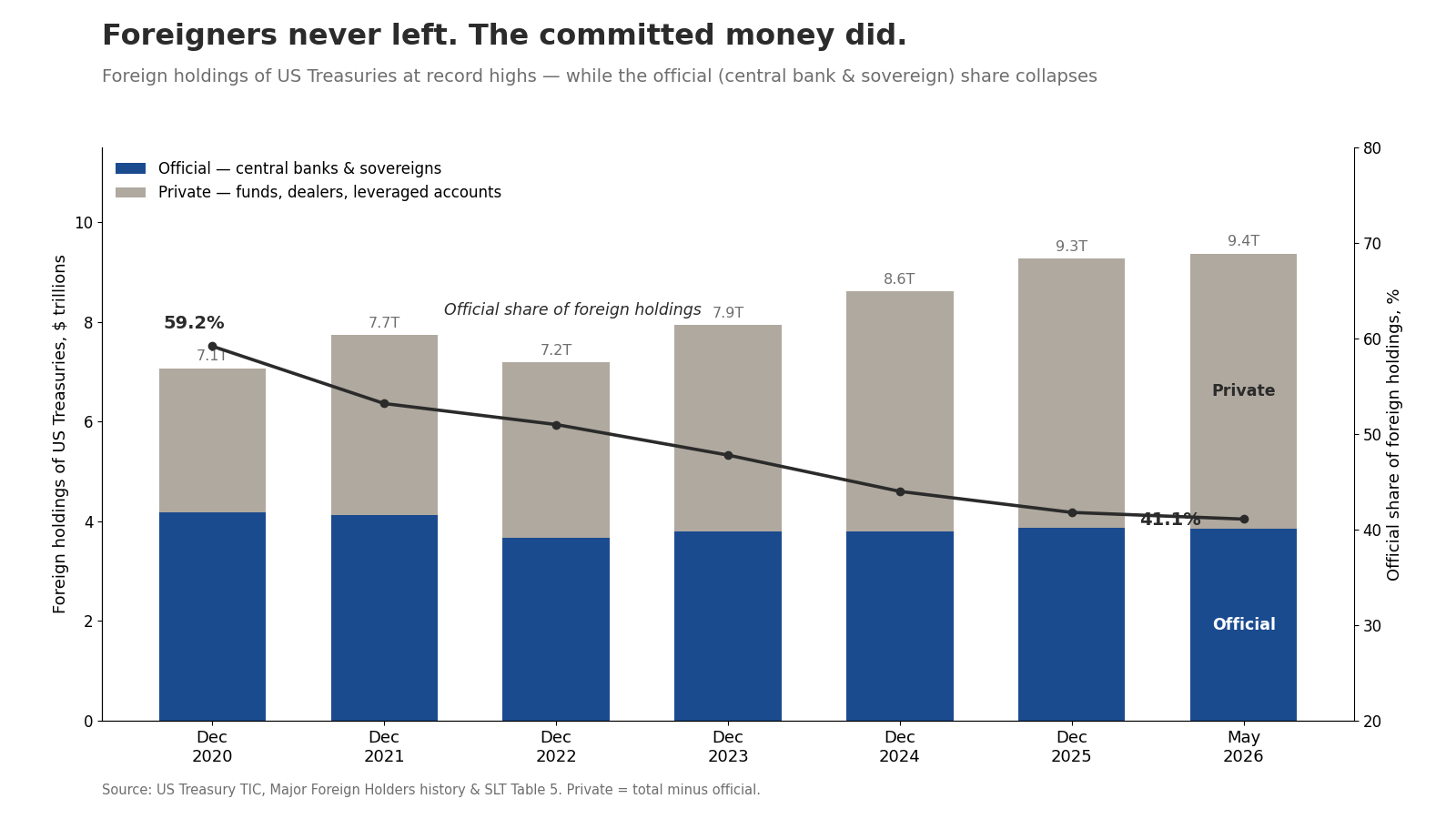
Foreign holdings of US Treasuries: record totals, collapsing official share
A composition problem is not solved with more mercenaries; it needs a committed holder, one who buys for reasons other than price and holds for reasons other than return. Scan the world for dollar pools whose owners run fresh surpluses and need what only Washington sells — protection and compute at once. The Pacific allies hold the paper, but their great surpluses are behind them. One region is left.
From the rooms — II. If an ask ever came, it did not arrive at my level as an ask; there was no document to refuse. What arrived at my level was a procession, and a climate. The secretaries and the officials came through continuously, and the political conversations happened somewhere above my head. What reached us was the message, from every official and every house strategist at once: the attractiveness of US fixed income. You heard it so uniformly that it stopped sounding like a pitch. And in the institutions of that era — everywhere in that world — it was the treasury desks, the ones that handled the American paper, that carried the most weight, because they sat in direct contact with the higher calculus: the bonds, and the politics around the bonds. They were staunch defenders of the allocation. The rule never needed writing; its defenders ran the strongest desks. There are meetings from those years I will not describe — I signed confidentialities, and I keep them. Take the pattern, not the particulars.
The last committed balance sheet
The top five Middle East sovereign funds manage roughly $4.35 trillion: ADIA around $1.19 trillion, Saudi Arabia’s PIF $1.21 trillion at end-2025, Kuwait’s KIA past $1.07 trillion, the Qatar Investment Authority above half a trillion, and Mubadala $385 billion. Add ADQ and the central banks and the pool is larger still. But the headline number misleads. ADIA and KIA are savings funds — liquid, diversified, mandate-compatible with large fixed-income books. PIF, Mubadala, and ADQ are strategic holding companies, stuffed with stakes in domestic champions and projects that cannot be sold. And Riyadh, the largest headline, is the most constrained in practice: the kingdom budgeted another deficit for 2026, and PIF’s mandate is domestic transformation, not liquid paper. The communiqués will be signed in Riyadh; the wires, if they come, will come from Abu Dhabi, Kuwait City, and Doha.
Visible Gulf holdings are modest: Saudi Arabia $140 billion, the UAE $119 billion, Kuwait $67 billion in May, Qatarsurveyed at $24 billion — roughly $350 billion in sight. How much more sits behind custodians in Brussels or London, no public number can say, and I will not invent one. A coordinated Gulf program of $150–300 billion a year — my estimate, assuming oil above $80 and rebuilt surpluses — would not absorb $2 trillion of issuance. It does not need to. The Treasury market does not lack money; it lacks an anchor tenant at the long end: a bid that shows up regardless of price and is known to show up. Historical official money was never quite that: March proved it, and the reservoir was always built to be drawn. What would be asked for now is a category no Gulf balance sheet has ever held: duration that is promised, undrawable without diplomatic cost. And because it is new, it must be paid for.
And the war has made the asking easier. Iranian projectiles fell hardest on the UAE — by IISS’s mapping, the largest share any Gulf state absorbed — while American sanctions moved within weeks against Iran’s toll regime at Hormuz. The umbrella stopped being an abstraction this spring. Protection has rarely been demonstrated more vividly, or priced more explicitly.
There is, in principle, another bidder. Beijing has courted the same capital for years, and some analysts argue the war will push the Gulf toward it; the courtship, though, outruns the settlement — S&P’s own assessment is that yuan-based Saudi oil trade “may take decades to grow to a meaningful scale.” A counterbid need not win to matter; its existence is one reason there is a price sheet at all. But March settled the essential auction: no Chinese umbrella to stand under, no Chinese Nvidia to buy, and Beijing shrinking its own Treasury book rather than defending anyone else’s. For protection and compute — the two things the funds are buying — there is one seller.
The deal already on the table
Look at fourteen months of signatures and announcements. May 2025: a $600 billion Saudi pledge anchored by a $142 billion defense package, and a $1.4 trillion UAE pledge over ten years — pledges, with no public deployment ledger. September 2025, after the Israeli strike on Doha: an executive order declaring an attack on Qatar a threat to the United States. November 2025: Saudi Arabia becomes the twentieth major non-NATO ally with F-35s attached, and Commerce clears 35,000 top-line Nvidia chips each for G42 and Humain. July 2026: the UAE enters the most favored export-control tier, its champions license-free — while Saudi Arabia still buys license by license. A rule for one, a leash for the other.
The shape of the exchange matters. The Gulf is buying equity in the machine — Stargate UAE, Humain’s $23 billion of technology partnerships, gigawatts of compute — and paying in pledges, arms purchases, and alignment. Washington sells security and silicon. Absent from every fact sheet, every order, every register notice: a bond. I have looked, and had others look — there is no documented Treasury leg. I expect there never will be one: the 1974 channel was invisible for forty-one years by design, and its mechanics still exist — add-ons at the New York Fed, private placements, custody that surfaces in Belgium. And the toolkit has grown since 1974: the reconstructed Saudi file was always a blend of marketable and non-marketable paper, and since 2021 the Fed has operated a standing repo facility for foreign official institutions that lets them raise dollars against Treasuries in its custody without selling a single bond. The facility was born in March 2020, when foreign officials sold over $100 billion in weeks and even the deepest market buckled; the Fed chose to lend cash against custody rather than watch the selling. Committed duration with a discreet emergency exit — just what a reluctant sovereign would demand. If the bond leg comes, it will not be announced; it will be understood — and, years later, a line in a data release nobody reads. This is inference, clearly labeled, and the only version consistent with how the arrangement has ever worked.
From the rooms — III. I joined in the late eighties, into the end of the old religion. Rates were coming down from the Volcker peaks, disinflation was underway, and equities — then technology — were becoming interesting to every type of fund. But I also saw what the Treasury book was for. As our countries moved up the development curve, the funds were asked, again and again, to finance projects at home — and the bonds were what you sold. They were liquid; they were the reservoir. You drew it down when the country called, and rebuilt it when the surpluses returned. That liquidity, to the desks I sat on, was the whole point. The idea that the reservoir itself might one day be committed — promised to the borrower, undrawable without consequence — would have read as a contradiction in terms.
Then Iraq drove into Kuwait, and the argument was settled for a decade. Washington froze Kuwait’s assets within hours — to keep them from Baghdad — and the Europeans followed. A nation scattered; Saudi Arabia and the Emirates took in the stranded. And when the releases began, it was the Treasuries that turned to cash fastest. The voices calling for less American paper — they existed; I heard them — went quiet. The reservoir had just carried a state through its darkest year, and everyone in the complex drew the lesson.
The claims on the reservoir
Now count what else is coming for the same pool — the part Washington consensus is not pricing.
Gaza will need rebuilding, and the Gulf will be asked: the joint EU–UN–World Bank assessment puts recovery at $71.4 billion, $26.3 billion of it needed in the first eighteen months. Syria is another order of magnitude — the World Bank’s conservative estimate is $216 billion, in a range reaching $345 billion — and Syria is not charity, it is the connectivity map: the rail and port routes that Turkey wants running through its own territory, the Gulf wants running through friendly ground, and everyone wants running somewhere. Lebanon waits on a settlement in the south. Libya remains open. Sudan’s own authorities speak of hundreds of billions — treat those as claims, not assessments — and Yemen’s published estimates run from $25 billion toward $60 billion. Egypt remains a standing draw on regional support, as it has been for a decade. On independent assessments alone — Gaza, Syria, Yemen — the docket runs from a third to nearly half a trillion dollars; let the governments’ own claims into the count and it runs toward a trillion, before Iran.
Then there is the one that dwarfs the rest. If the ceasefire with Iran becomes an agreement, more than ninety million people emerge from war and sanctions in hardship. Nobody in the Gulf can afford that population hungry; if the boats start crossing the water, every capital on the peninsula has a crisis with no military solution. Stabilizing Iran is border security by other means — and the capital will be asked from the same funds. The geometry is bitter: Washington will broker that peace — and, on every precedent above, will expect the Gulf to fund it, at the same time as it needs the Gulf to fund its deficit. The expectation is my inference; the pattern is not. Two asks, one reservoir, one asker. Add the third claim — after this war, every state in the region will boost defense spending, much of it flowing back to American contractors — and the picture completes itself: Washington stands on three sides of the same pool. It sells the security — documented. It asks for the duration — my forecast. It brokers the peace and passes the plate — anticipation, labeled.
The direction of Gulf capital — and the surpluses that feed it — is about to change materially. That sentence is my judgment, not a document; every component of it is on the record above. The cost will not be abstract: every dollar committed to duration or reconstruction is a dollar not compounding in the post-oil economy, for the youngest large workforce in the world. The first petrodollar era financed America’s deficits while the region under-built for forty years; Vision 2030 is the institutional memory of that arrangement, and the modern funds exist because the Gulf swore never to repeat it. The ask, when it comes, will test that memory. And if the Gulf nevertheless says yes, it will say yes only to a structure that resolves the contradiction — committed on paper, drawable in a true emergency, priced accordingly. The mechanics already exist; I described them above.
The case against — taken seriously
The strongest objection: Washington no longer needs to ask anyone, because it has built automatic buyers. The GENIUS Act, law since July 2025, forces stablecoin issuers into bills — the float nears $300 billion, and Standard Chartered projects $2 trillion by 2028 (a projection, not a fact). The rebuilt leverage ratio, effective this April, frees an estimated $210 billion of additional big-bank capacity to warehouse Treasuries. GAO finds demand adequate today; domestic funds are now the largest buyers.
All true, and all of it misses the August auctions. Stablecoins buy bills, largely rerouting dollars that already sat in money funds; banks warehouse at a spread — neither anchors the long end, where the stress lives and the mercenary base now charges 5.2%. The final backstop, the Fed buying duration outright, exists and everyone knows it; invoking it at 5% long yields, with inflation’s memory fresh, is fiscal dominance performed in public. A quiet Gulf arrangement is the alternative to that spectacle, as it was in 1974.
And there is a Gulf-side case against saying yes — stronger than Washington likes to admit. In February 2022, the G7 froze roughly $300 billion of Russia’s central-bank reserves; about $200 billion of it sat at Euroclear in Belgium — the same custodial address where unattributed Treasury holdings surface in the American data. Reserve managers everywhere reread their custody agreements that week. The Gulf knows both faces of that instrument: in August 1990, within hours of the invasion, Washington froze Kuwait’s assets at Kuwait’s own request to keep them from Baghdad, then released the paper to sustain a government in exile. Protection in 1990, seizure in 2022 — both precedents will sit at the table when custody terms are negotiated. Riyadh had already lived a version of it: in 2016, over the JASTA lawsuits, Saudi officials were reported to have warned of selling American assets — a threat later denied, but the leverage runs in both directions. Committed duration is custody risk wearing a coupon. If the arrangement comes, expect the Gulf to have priced that too: structure, custody terms, liquidity backstops, and the treaties themselves as collateral. Protection and seizure come from the same hand.
What would prove me wrong, and readers should hold me to it: long-end auctions clearing smoothly through 2027 with no growth in foreign official custody; the Gulf’s TIC lines continuing to fall with no policy event; a US–Iran settlement with no Gulf capital component; the term premium returning toward zero without a new committed buyer. If those happen, the thesis fails, and I will say so.
What to watch
The ask will not be announced, so watch the plumbing: the monthly TIC lines for Saudi Arabia, the UAE, Kuwait — and Belgium, where custody surfaces; the annual survey line for Qatar; foreign official custody at the New York Fed; the Foreign & International share of long-bond awards; SAMA’s total reserves, at a multi-year high even as the visible Treasury line fell — the mix is moving, though no public data says into what; and a ratified defense arrangement followed within weeks by an investment framework. One more tell, from inside the rooms: when the Wall Street houses begin recommending, in unison, that sovereign clients rotate from equities into duration — that is what the ask sounds like from the receiving end.
None of this is advice; it is what the tape would show. If the arrangement lands, the long end outperforms pure fiscal arithmetic and gold’s sovereign bid goes quiet at the margin. If it fails, the long end keeps repricing until the Federal Reserve must choose, in public, between the bond market and its own credibility.
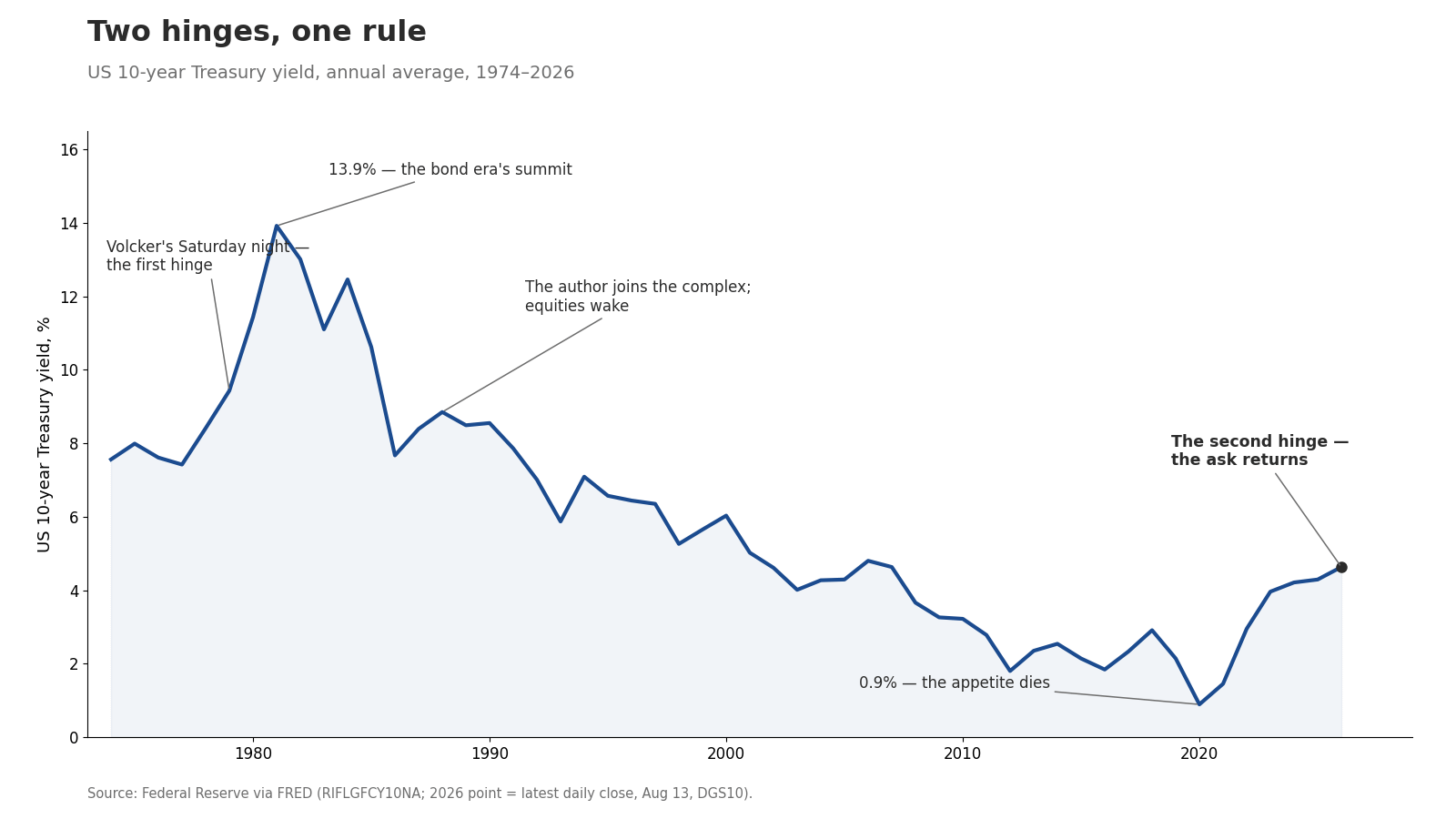
US 10-year Treasury yield 1974–2026: the two hinges
The unwritten option
The archive, read honestly, does not show an unwritten rule. It shows an unwritten option — a standing arrangement Washington can exercise when three conditions align: large surpluses in the Gulf, large financing needs in America, and a security dependence that only America can satisfy. In 1974 the terms, so far as the record shows them, were quiet mechanics and a deepening security relationship — exercised so discreetly that the men executing it needed no instruction. I know, because decades later, the quiet was still institutional; the appetite was still the water.
All three conditions are aligning again — with one difference. This time the Gulf knows what its capital is worth, and it is charging: Nvidia’s best silicon, treaties, a nuclear framework in negotiation, equity in the machine that will define the century. And this time the reservoir has other claimants — a region to rebuild, a neighbor to stabilize, a workforce to employ — so the price will keep rising. Nor should you picture the funds as unwilling. Seen from the Gulf, the ask can double as an offer: duration at five percent, with treaties, chips, and equity stapled to it, may be the cheapest durable influence in Washington any outside power has ever been sold. The portfolio has always been part of the relationship. The only questions are the price, and the paper. Consensus keeps asking whether foreigners will keep buying Treasuries — the wrong question; they never stopped. The right one is what the committed buyer now charges. Because when the Treasury market last needed a buyer of last resort before the Fed, Washington did not find one. It appointed one.
From the rooms — IV. I entered the complex at a hinge: rates falling, the bond religion loosening, equities and then technology pulling the future toward them. I am writing this at the second hinge. Equities have gone parabolic; the coupons are back at levels my first bosses would have recognized; and I expect the visitors’ message to converge once more — I have heard it converge before. Something significant is about to happen to this capital — to its direction, and to the surpluses that feed it. I was hired into the end of the last unwritten rule. I have spent close to thirty years watching the option it left behind. I know what this is.
The author spent close to thirty years inside the Gulf sovereign wealth fund complex. Recollections above are personal, general, and rendered without institutional identification, constrained by confidentiality undertakings the author continues to honor; no confidential information of any institution is disclosed. Factual claims are linked to primary or public sources wherever one exists, and estimates — including the author’s own — are labeled as estimates. The views are the author’s alone, and nothing here is investment advice.
"Washington sells security."
No, Iran just showed that the US offers zero security and never did.
Have you noticed that Iran can destroy the economies of every nation in the Gulf any time it chooses and there is nothing the US could do about it.? Have you noticed Iran's destruction of US bases throughout the Gulf? Have you noticed that the US is afraid to bring its warships closer than a thousand miles? Have you heard about US depletion if its defensive and stand off munitions? Have you read about how the expensive, fragile weapons systems upon which the US relies have proven to be nearly useless in an actual war?
Since 1974 the US has offered the ILLUSION of security to the gulf states. That illusion has now been shattered.
You have it backwards.
This is why I read Substack. Bravo!