


When the Music Stops · Part 3 of 3
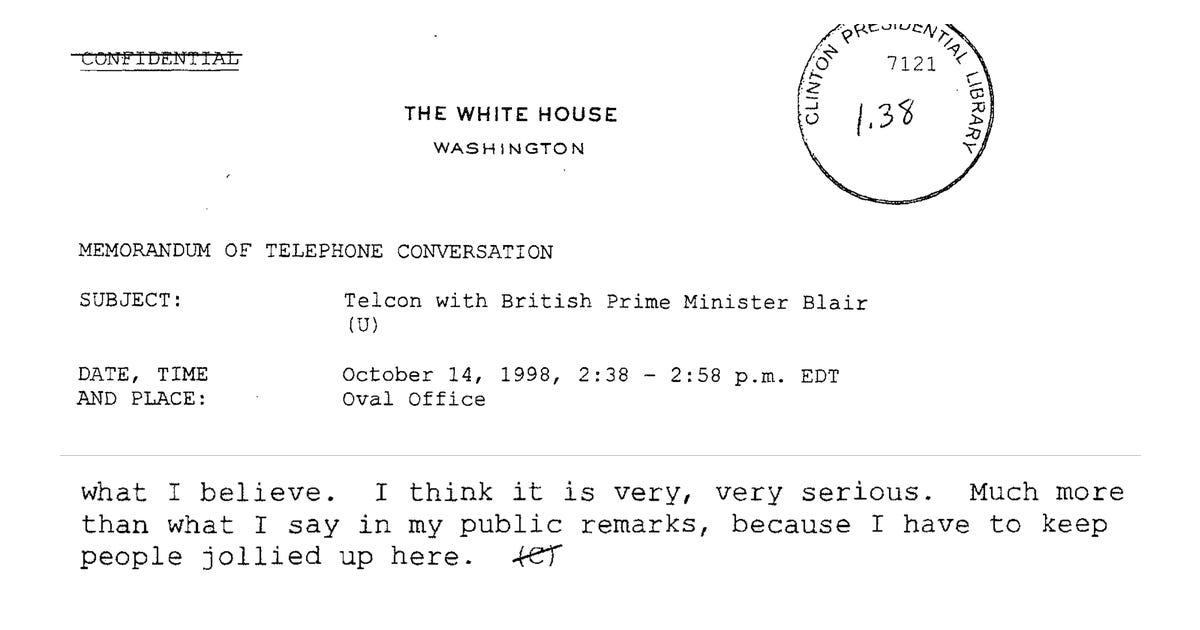
Memorandum of telephone conversation, the President and Prime Minister Blair, October 14, 1998, 2:38–2:58 p.m. EDT, Oval Office, CONFIDENTIAL, declassified October 14, 2015. The letterhead and page 5, set together: “I have to keep people jollied up here.”
Part 1 was the way up. Part 2 was the collapse. This is the year after: two refusals, the bill collected, and the second door. Every scene here happened twice. Once in public. Once in the file.
On the morning of Friday, August 14, 1998, the heads of Hong Kong’s three largest stockbrokers were invited to breakfast at the China Club. The invitation had come at short notice. One man was waiting for them: Norman Chan of the Hong Kong Monetary Authority. He asked them to finish their coffee and switch off their mobile phones. Then he walked them across to the Authority’s offices and told them that when the market opened, the government of Hong Kong would start buying it.
That is Chan’s account, written in 2019, when he ran the Authority, and it is memory, like the rest of his morning: half a dozen telephone lines with make-shift recording equipment, and a colleague, Amy Yip, running the room. The part that is not memory is in the minutes of the Legislative Council: the chairman of the securities regulator, the man whose job was to police the market, “was only informed of the Government’s intention in the morning on 14 August.” The exchanges had not been told either. Ten trading days later, on the day the August bets came due, the government had spent HK$118 billion, about US$15 billion, and was, in Chan’s words, “almost being the only buyer in town.”
Two governments broke the rules that year. Hong Kong bought its stock market. Malaysia shut the door on money leaving and fixed its currency. Both were criticized in public. The internal papers are milder: three weeks before the Vice President praised the “brave people of Malaysia” in Kuala Lumpur, the President told the British Prime Minister that “these capital credit controls for the short term can work,” and said why: “because they have the cash reserves.” Seoul and Jakarta, whose reserves could not cover what was falling due, took the program; the two that still had money could choose. The bill for everyone who followed the script went, as before, to people who never signed for a loan, and the countries that had been lectured spent twenty years building a second door.
Ten days in August
The trap Hong Kong was in was arithmetic. The Hong Kong dollar was fixed to the American one, and the price of that promise was that whenever anyone sold Hong Kong dollars, the Authority had to let interest rates rise until it hurt enough to stop them. In October 1997 the overnight rate had touched, in Joseph Yam’s words, “nearly 300%.” A fund that sold the currency pushed rates up. Higher rates pushed the stock market down. A fund that had already sold the market short was paid both ways. A family in a flat in Sha Tin was in the trade too. The rate the banks paid to fund its mortgage sat above 10 percent for months after October 1997, and the banks, by Chan’s account, held their lending rate down for as long as they could. Yam called it the double play, and by August 1998 he had counted four attacks, each costing the city the same way: a spike in the rate every borrower paid and a fall in everything priced in Hong Kong dollars, the profit booked somewhere else. He wrote about it in the South China Morning Post on August 24, ten days in: a handful of hedge funds treating Hong Kong “somewhat like an ATM machine, as others have put it.” He took responsibility: “As a firm believer in such a policy, I am responsible for conducting the intervention.”
The numbers Financial Secretary Donald Tsang gave the legislature on September 8 were the numbers of a siege. Outstanding bets on the index had jumped by more than ten thousand contracts in three days, to over 110,000, “giving strong indications,” he said, “that there was planned and co-ordinated cross-market manipulation.” The government’s answer was to stand on the other side. By Chan’s account the index rose 564 points on the first day.
Then the arithmetic ran in reverse. Yam had put the funds’ bet at 80,000 short contracts, HK$4 billion for every 1,000 points the index fell. Between August 13 and 28 the index rose nearly 20 percent, and every point of it was now a cost. The currency borrowings behind the bet, over HK$30 billion, were costing “around HK$4 million a day” in interest to hold. Two of the four big funds, the regulators later found, had added to their positions while the government was buying. Then the futures exchange raised the cash that big bettors had to post, and open positions fell by a quarter, “over 50% of this reduction” being “concentrated in a small number of accounts.” On August 28, the day the August contracts settled against the index, the government kept buying to hold the index up, and the exchange turned over HK$79 billion. A short contract settled at that level paid the difference in cash; the rest rolled into September, against a government that was still holding. “The manipulators were forced to close out their short positions,” Yam said that November, “in many cases with heavy losses.” That is the government’s account, and the funds’ books are not public. But the numbers are the funds’ own arithmetic, turned around.
I have one more account, and it is mine. That autumn I visited the chief strategist of one of the largest firms on Wall Street, and I asked him straight out what was going on in Hong Kong and what the firms were doing there. He grinned. “Don’t go there,” he said. “It’s been very bloody.” I did not press him. It is twenty-eight years old, from a man I will not name. But it is the only time anyone from that side of the trade told me how August had ended for them, and I took it to mean their side of it, not Hong Kong’s.
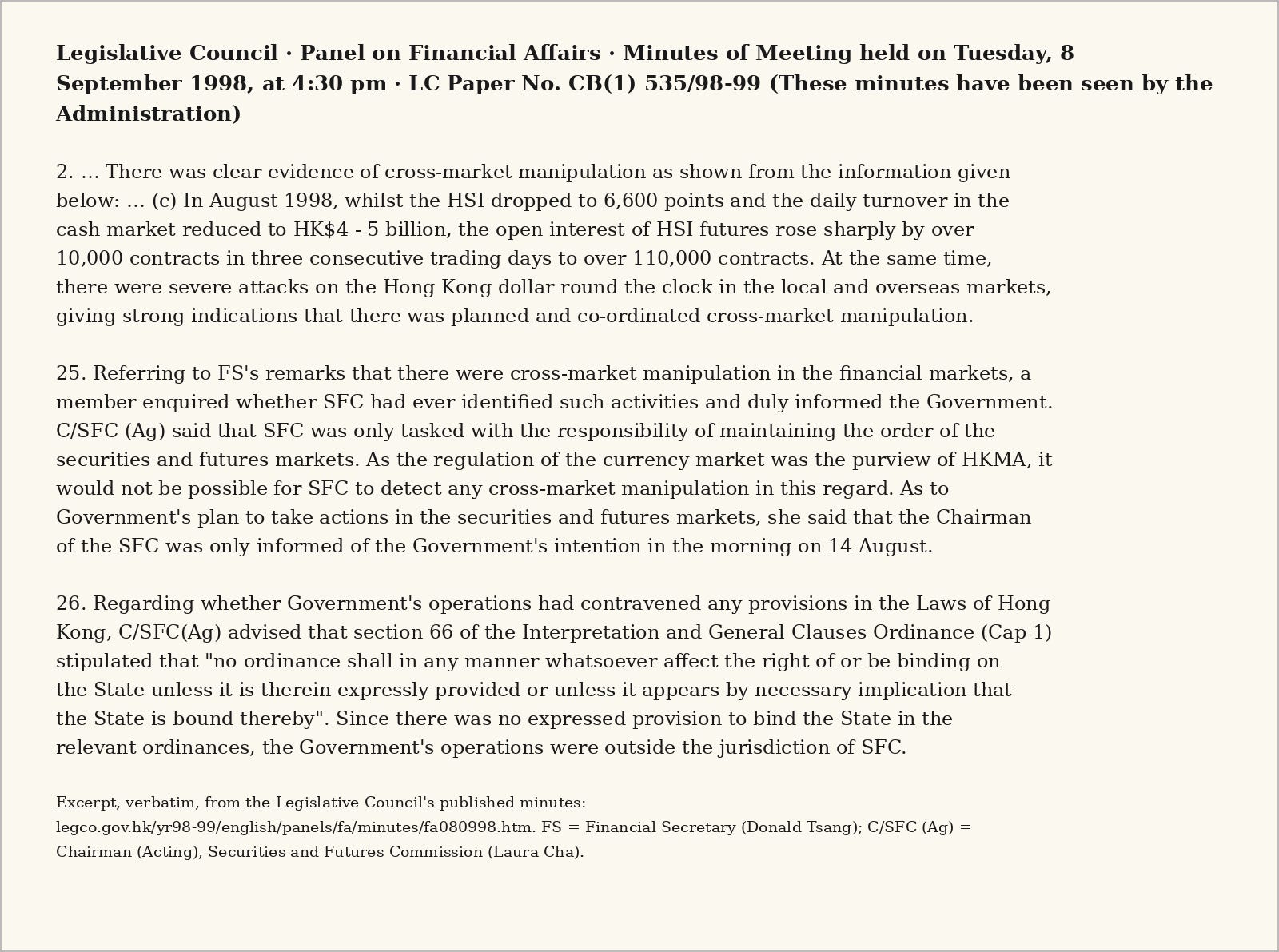
Legislative Council, Panel on Financial Affairs, minutes of September 8, 1998: the Financial Secretary’s account of the operation, and the regulator’s evidence that its chairman was told on the morning of August 14.
Two documents by others add to it, one secret at the time. The Federal Reserve’s confidential briefing book for its meeting of September 29, 1998, dated six days earlier, has a page on Hong Kong. The Authority, it says, “spent an estimated $10-15 billion buying stocks in the second half of August, hoping to ensure that speculators lost money,” and “authorities claimed success over speculators.” The staff hedged twice, with “claimed” and with the “so-called ‘double-play’,” and counted the cost in reserves, from “$97 billion at the end of July” to “less than $80 billion.” There is no lecture, and the words “free market” do not appear on the page.
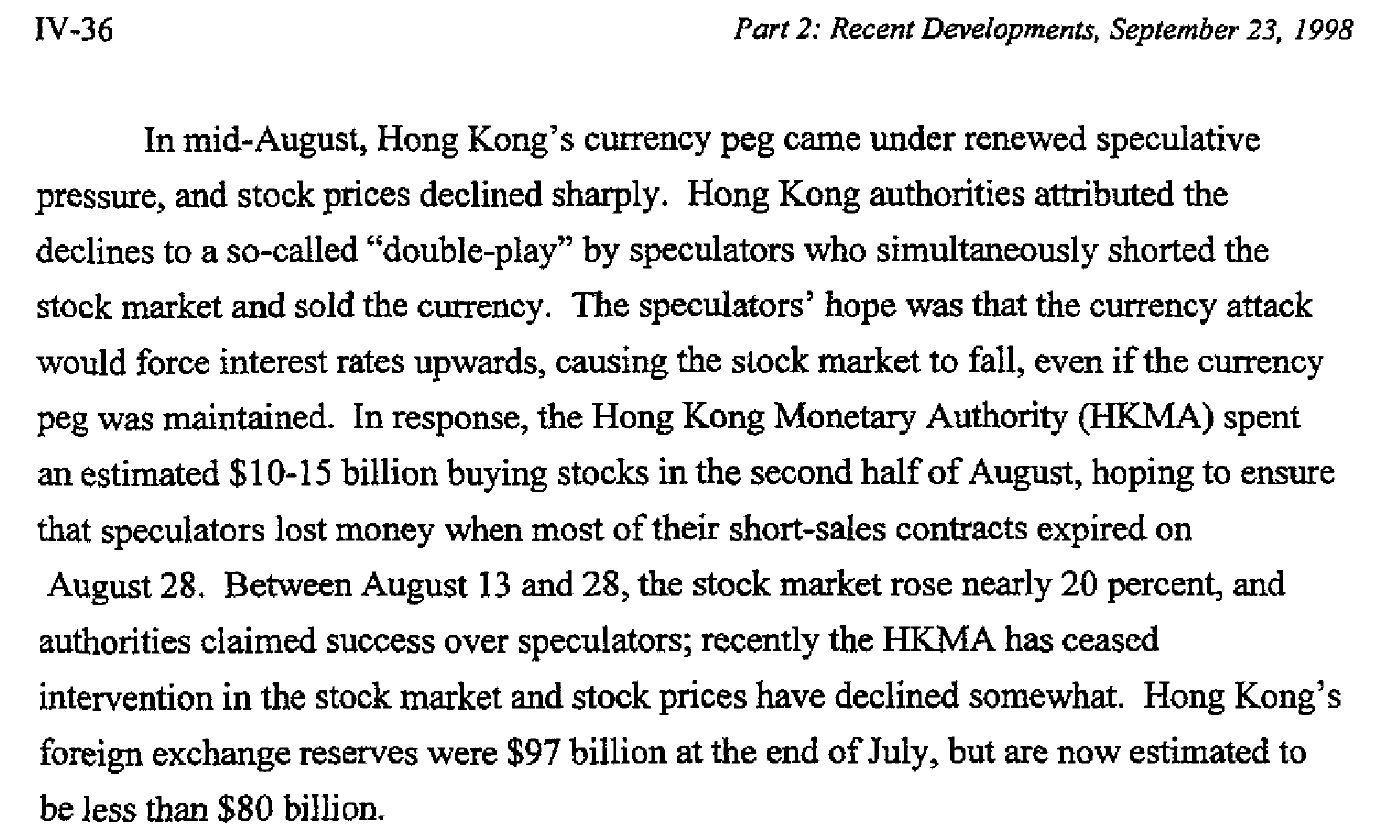
Federal Reserve Board staff, “Recent Developments,” September 23, 1998, prepared for the FOMC meeting of September 29. Released under the Fed’s five-year rule.
The second is the one the funds would have wanted read. In April 2000 the world’s financial regulators, meeting as the Financial Stability Forum, published their inquiry into the hedge funds of 1998. They found that “at end-August, four hedge funds accounted for 50,500 contracts or 49 percent” of the open bets on Hong Kong’s index. And there they stopped, “unable to reach a conclusion,” across the six economies they studied, “on the extent to which manipulation and collusion might have occurred.” Four funds held half the bet against a city of six and a half million people, and the regulators of the world could not say whether they had planned it together. Hong Kong’s government had not waited to find out.
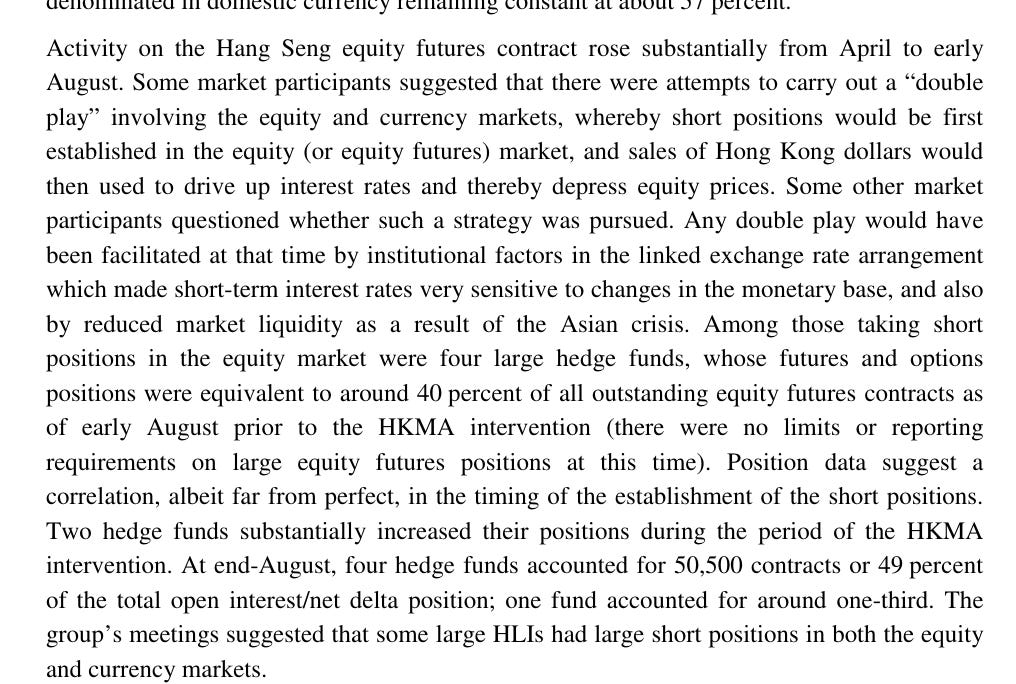
Financial Stability Forum, Report of the Working Group on Highly Leveraged Institutions, April 5, 2000, Annex E: at the end of August four hedge funds held 49 percent of the open interest in Hang Seng futures and options.
In public, Washington was another matter. The State Department’s report on Hong Kong for 1999 put “manipulators” in quotation marks and worried that the intervention “may have affected Hong Kong’s reputation for adherence to free-market mechanisms.” The exit came a year later, and it is the only sale in the series that went to ordinary buyers.
LEDGER · August 1998. Protected: the currency peg, and the depositors and mortgage-holders behind it. Paid: a handful of hedge funds, “in many cases with heavy losses.” Held back: US$15 billion of reserves, moved into thirty-three Hong Kong companies, showing a book profit of HK$35.1 billion at the end of 1998.
The referee
On November 14, 1998, the Legislative Council’s finance panel asked Merton Miller, a Nobel laureate from Chicago, what he thought. A legislator, Emily Lau, put to him the case some were making: “we had made a profit, at least on paper.” The government’s defense by then leaned on New York, where in September the Federal Reserve Bank of New York had called seventeen firms into its boardroom over a failing hedge fund, Long-Term Capital Management, and fourteen had put up the money to save it. “I am more and more sick and tired of hearing about Long Term Capital Management as a justification for what you did,” Miller told them. “It isn’t.” In New York the government had been “a minor traffic cop.” In Hong Kong “the referee was participating in the action,” like the fighter who tells his corner to “keep an eye on the referee because somebody is sure beating the hell out of me.” On the paper profit he gave them a farmyard: “every morning the rooster crows and every morning the sun comes up.” Three officials sat in the room. The minutes record no reply.
Miller’s charge stands whatever the shares did afterward. In Hong Kong the referee bought shares with public money and published the accounts. The New York referee gave the bankers, by the Fed president’s account, “cold coffee and some really terrible sandwiches,” and let them put up the money. Korea in 1997 had been given conditions and the Wall Street fund in 1998 a boardroom; Hong Kong, with reserves of its own, needed neither.
1600 hours
Malaysia had no boardroom to be called into. It had a prime minister who had told the President to his face at Vancouver that the traders “win and we lose,” and a central bank that could not cut interest rates without watching the ringgit fall.
The case for what Malaysia was about to do had already been made, quietly, inside the Fund. The email is timed 9:06 on the morning of Friday, January 30, 1998, and its author, an IMF economist named David Robinson, was replying to a staff argument about a currency board for Indonesia. He had missed the debate, he wrote, and apologized in advance for repeating anyone. Then he did the arithmetic, and the arithmetic he chose was Malaysia’s: three months of 50 percent interest rates “would imply a transfer of about 17 percent of GDP from borrowers to depositors.” He ended with a sentence that sat in the Asia department’s Indonesia file until the file was opened: “if the present situation continues, I would prefer the option of capital controls/ foreign creditors being forced to restructure their debt, which would at least impose some costs on foreigners.”
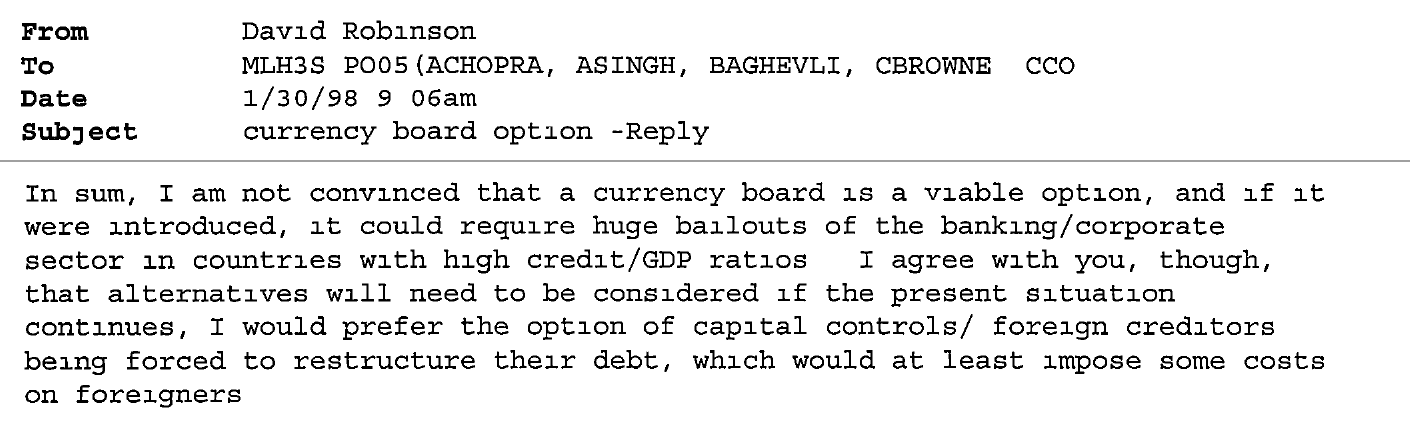
Email, David Robinson to colleagues in the IMF’s Asia and Pacific Department, January 30, 1998, 9:06 a.m., “currency board option -Reply,” from the department’s Indonesia file, declassified.
A capital control is a border post for money: goods and wages and dividends pass through it, and the hot money that came in on a Tuesday to leave on a Friday is held at the gate. Seven months after Robinson’s email, Kuala Lumpur built the gate, and did it like a bank: by press release, at four in the afternoon, two days running. Tuesday, September 1, 1998, embargoed until 1600, a notice headed “Measures to Regain Monetary Independence”: the offshore market in ringgit closed, foreign money in Malaysian shares and bonds held for twelve months, the measures to “be removed should normalisation in the global financial environment take place.” Wednesday, September 2, 1600 again, a second notice, one sentence long: the ringgit “will be quoted at RM3.80 against the US dollar.” The same afternoon the prime minister sacked his deputy, Anwar Ibrahim, who was jailed that month and appeared in court with a black eye he blamed on his jailers. The black eye is in the court record. Weighing the controls is not a verdict on the government that imposed them.
The Fund’s staff later described how it had been done, in what reads like respect for the craft: “three days” to prepare the rules, and “a very well kept secret.” Outside Malaysia the response was “nearly uniformly negative,” and the index makers took the country off the lists the world’s fund managers buy from.
The gate closed on people as well as funds. On August 31, 197,000 investors, nine in ten of them Singaporeans, held Malaysian shares on Singapore’s over-the-counter market, CLOB, which the new rules shut. The discount on those shares went from 9 percent to 49 in three days. Some 24,000 sold everything they held at that discount and, Singapore’s deputy prime minister told his parliament in October, “would have made losses.” “The government cannot protect investors from such risks.” They were the small savers of the richest city in the region, and they paid first.
I watched the controls from the other side of the table, and they left me uneasy. Every banker I spoke to that autumn was against Mahathir, and so was the Fund. On the money, the street was with him. He had said why to the President a year earlier, in the Vancouver memorandum: “When the IMF requires raising interest rates and presses for more access for imports, it creates added burdens that will have political repercussions.” Jakarta showed where that landed, and the Fund’s evaluators later found that the fiscal tightening in Indonesia and Korea “was not warranted.” The question I still cannot answer is what a lender is trying to do when it arrives at a country’s weakest moment and asks it to cut, in the one season when cutting can bring down order in the streets. The long-run case can be right and the timing can still break a government.
Then the verdicts.
September 11, 1998, the press room at IMF headquarters. Stanley Fischer, the Fund’s first deputy managing director, answered a question on Malaysia like a professor marking a paper. The controls were “the attempt that seems to be being made to cut the country off.” They “may, in the short-run, succeed if you have the apparatus to surprise people and catch them, so to speak, but I don’t believe they are helpful over any sustained period.”
Three and a half weeks later, in Kuala Lumpur, the governor of Bank Negara, Ali Abul Hassan, gave a national congress on economic recovery what reads as the reply, in a speech the bank still keeps on its website. “Doing nothing would mean that Malaysia is leaving its destiny in the hands of others.” Before the controls, he said, policy had been run by officials who “blindly believed in the IMF mantra that a high interest rate regime was good for Malaysia.” The banks, he forecast, would swing from a loss to “a profit of RM1.7 billion,” and his last line was the one a governor is paid to say: “We can see the light at the end of the tunnel.”
At the APEC business summit dinner in Kuala Lumpur on November 16, 1998, the Vice President of the United States rose to give a speech the White House said the President would have given himself. “We hear them today - right here, right now - among the brave people of Malaysia,” Gore said of the “calls for ‘reformasi’,” the rallying cry of Mahathir’s opponents in the streets. On the money, the aim was “not to halt or control the flow of capital.” Malaysia’s trade minister told reporters it was “the most disgusting speech I’ve ever heard.” Mahathir, in the audience, was overheard: “I’ve never heard anything so rude.”
Jollied up
Three weeks before that dinner the President had put it differently to Tony Blair. The two records are on the National Archives’ website, under the government’s classification appeal 2013-090, documents 36 and 38. They are the White House notetakers’ records of the President’s telephone calls with Blair on October 14 and October 25, 1998, each headed CONFIDENTIAL with a line through it, each still carrying its blacked-out boxes, and each stamped with the same declassification date, October 14, 2015, seventeen years to the day after the first call. I have not found the lines below quoted on this subject before.
The first call is about the world’s markets. The President, to Blair: “I think it is very, very serious. Much more than what I say in my public remarks, because I have to keep people jollied up here.”
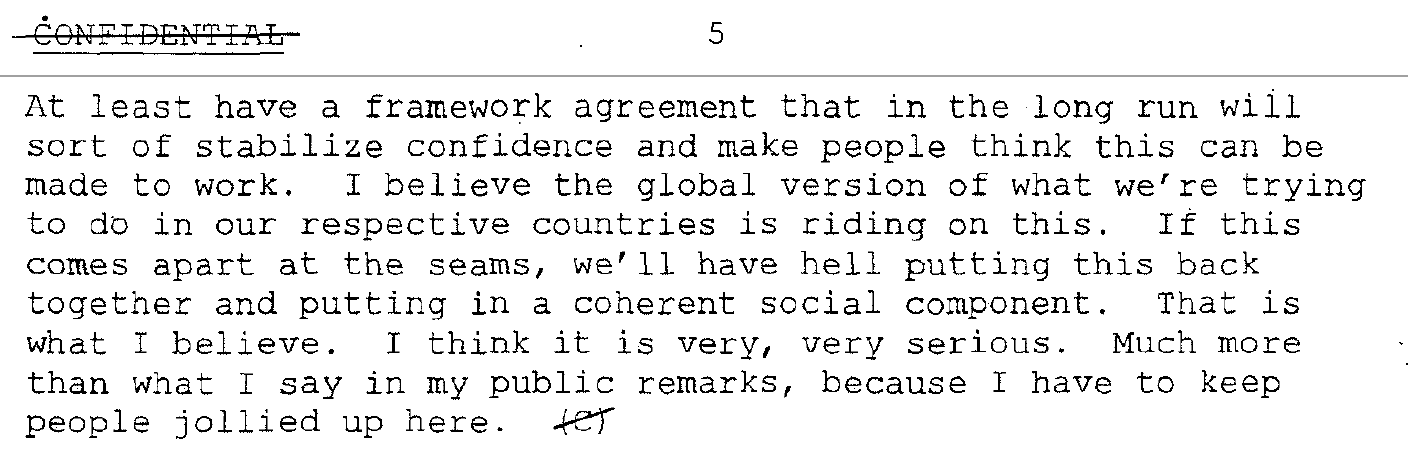
Memorandum of telephone conversation, the President and Prime Minister Blair, October 14, 1998, 2:38–2:58 p.m. EDT, CONFIDENTIAL, declassified October 14, 2015 (ISCAP 2013-090, document 36).
Eleven days later they are drafting a statement for the G-7, and the President is thinking aloud about a world in which “over a trillion dollars a day” changes hands. Blair: “We need prudent rules.” And then the President says what his Vice President will not say in Kuala Lumpur: “Some don’t feel this way, but these capital credit controls for the short term can work -- just like if the market drops more than 10 percent in a day, we can suspend trading. But they don’t work over the long or medium term. Malaysia and Singapore can do this because they have the cash reserves.” Blair: “I agree.”
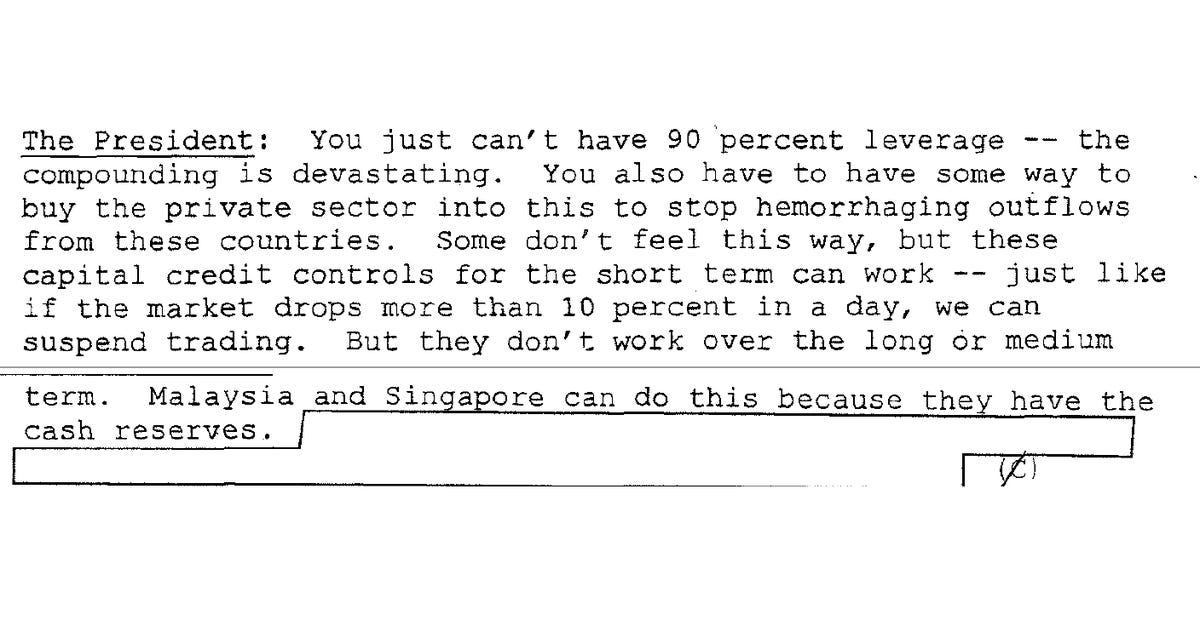
Memorandum of telephone conversation, the President and Prime Minister Blair, October 25, 1998, 2:14–2:42 p.m. EST, CONFIDENTIAL, declassified October 14, 2015 (ISCAP 2013-090, document 38). The redaction boxes are the government’s.
The line carries less than it seems. Nothing about the September notices; Singapore, which had no controls, named alongside Malaysia; short term only. And Fischer had conceded the short run himself: controls “may, in the short-run, succeed.” Set side by side, the two are not opposites. The Fund’s man allowed it grudgingly, as a way to “surprise people and catch them”; the President allowed it as a rule of the market, like suspending trading when prices fall 10 percent in a day, and named the condition: “because they have the cash reserves.” Three weeks later Gore, in Kuala Lumpur, did not allow it at all. A year on, the Fund’s staff wrote that the controls “appear to have been effective in limiting outflows.” The private record is the better guide to one thing, the one that mattered: the tool could work for a while, for a country that could pay for it; both men said so, and the speech in Kuala Lumpur left it out. The next fight over money, whoever starts it, will have a file too.
The winter after
The forecast did not survive the winter. On March 31, 1999, presenting the bank’s annual report, Ali Abul Hassan had to read out the year: the economy down 6.7 percent, 83,865 workers laid off, the banks he had forecast would make RM1.7 billion showing “a pre-tax loss of RM2.3 billion.” Reserves, though, had risen by four and a half billion dollars, and the ringgit had not moved since the day it was fixed. That September the Fund’s board wrote its retreat in the grammar institutions use for retreats: the measures “had initially been viewed with considerable skepticism internationally,” and the directors “commended the authorities for using the breathing space well.” A Fund working paper in 2006 found the controls “neither yielded major benefits nor were costly,” and that the stock market had read them “as favoring firms with stronger political connections.” Malaysia went through the crisis anyway. What it avoided was the program. Whether that trade was worth what the connected firms were expected to collect, the file does not say.
LEDGER · September 1998. Protected: Malaysian borrowers, whose lending rates kept falling once the central bank no longer had to defend the currency; the currency itself, at 3.80, for nearly seven years. Paid: foreigners holding Malaysian shares and bonds, locked in, then, from February, taxed for leaving early; 197,000 CLOB investors, mostly Singaporean savers, locked in, and the 24,000 of them who sold at a discount that reached 49 percent. In the file: a President who said the tool “can work.”
Who finally paid
The two refusals are the exception. Everywhere else the program ran its course, and at the end of it there was a sale. A fire sale is a sale where the seller cannot wait. The sellers were governments that had taken over their banks to stop them falling; the buyers were whoever had cash in a year when nobody had cash. Nobody here is accused of a crime. The question is who had paid for what was sold.
Behind every one of those sales was a loan that should not have been made, or taken, on those terms, and the indictment runs both ways. The lenders knew what they were doing: Part 2 showed the Bank of England’s court noting, in September 1997, that the big trading banks faced “remarkably little risk in terms of loss,” and Korea’s creditors ending the year with a state guarantee at a higher rate. The borrowers knew too. Robinson’s sums started from a Malaysia where private credit stood at “170 percent of GDP”; the Fund’s own December table for Korea assumed a billion dollars of bank debt falling due every day. Neither side had built a guardrail: not on how much short money a bank could bring in through a window like Thailand’s offshore banking facility in Part 1, and not, as the Financial Stability Forum noted in Hong Kong, on the size of a bet against a whole market. The shape of it is older than Asia. Credit is made cheap at the center and lent freely at the edge; the profits on the way up are private, and the losses on the way down are collected from the tax base of the country that borrowed. The people in the room lent and borrowed as if the music would not stop, and the people who were never in the room paid when it did.
In Indonesia the state had issued IDR 650 trillion of bonds to hold up its banks, by the case study the Bank for International Settlements’ institute published in 2004, and the agency that took over the wreckage valued what it held at “26% of the face value.” Twenty-six cents on the rupiah. Half of the biggest private bank went to Farallon Capital, “a U.S. investment firm,” in March 2002; the interest on the rescue bonds alone was put at IDR 60 trillion for that year, “a serious burden to the state budget.” Most of the families whose banks had borrowed the money did not repay it; the state budget carried it. In Korea, 168.7 trillion won of public money went into the banks and the deposit insurer. By June 2026, 72.9 percent had come back; what did not is being repaid from the budget, and the last instalment is next year’s. Korea First Bank, scrubbed clean by the state, went to the American fund Newbridge in a deal agreed in 1999, and six years later to Standard Chartered, which announced it had paid 3.4 trillion won, “US$3.3 billion,” “in cash.” In Thailand fifty-six closed finance companies’ loans were auctioned at an average of 28 cents on the baht, half of the core loans going to international investors at 28 cents and a third to the state’s own asset company at 17. The fund that had propped them up was left holding a loss its central bank puts at over 1.4 trillion baht: a 1997 debt now in its third decade, paid down by a charge on every protected bank deposit in the country.
And the people. In 2002 two economists, Peter Fallon and Robert Lucas, put in tables in the World Bank Research Observer what the crisis had done to workers. Unemployment in Korea went from 2.6 percent to 6.8. In Thailand it went from under one percent to more than five. In Indonesia the share of people below the poverty line rose from 11 percent to nearly 14, and to nearly 20 when the prices families actually paid were used. Those are national totals, and they cannot follow any one dollar, but they show who bore the collapse.
I looked for the four people from Part 1’s last ordinary summer whom Part 2 followed into the collapse. Youn Sung Mook, the X-ray technician who slept in the lobby of the hospital that owed him, and Kim Myung Yun, who sold hats from a car for four dollars each and cleared twenty-five cents on the day a reporter stood with him. Zen Zainudin, the singer on the blue metal bench outside the employment office. Warih Wijayanti, the architect who taught school for $40 a month. The record ends where the reporters left them in 1998.
The ledger of the decade, then. Farallon, Newbridge, Standard Chartered and the bidders in Bangkok bought what was for sale, and some of them sold it on. The record says nothing else of them; they were buyers at an auction. The budgets of three countries paid. Indonesia’s carried an interest bill of IDR 60 trillion in a single year; Thailand’s still carries the charge, in its second decade; Korea’s pays the last instalment on the 1997 public funds in 2027.
Conceived in the rooms above
On Christmas Eve 1997, the day Part 2’s banks agreed in New York to roll over Korea’s loans, the Central Intelligence Agency in Washington finished a two-page assessment that would sit under a CONFIDENTIAL stamp for twelve years. “China so far has been relatively unscathed by the East Asian financial crisis,” it begins. “Beijing’s tight controls on capital flows” head its list of reasons the damage was “sharply limited,” and the same controls, with the country’s balance of payments, made its promise not to devalue “more credible than similar statements made by other East Asian governments before they devalued.”
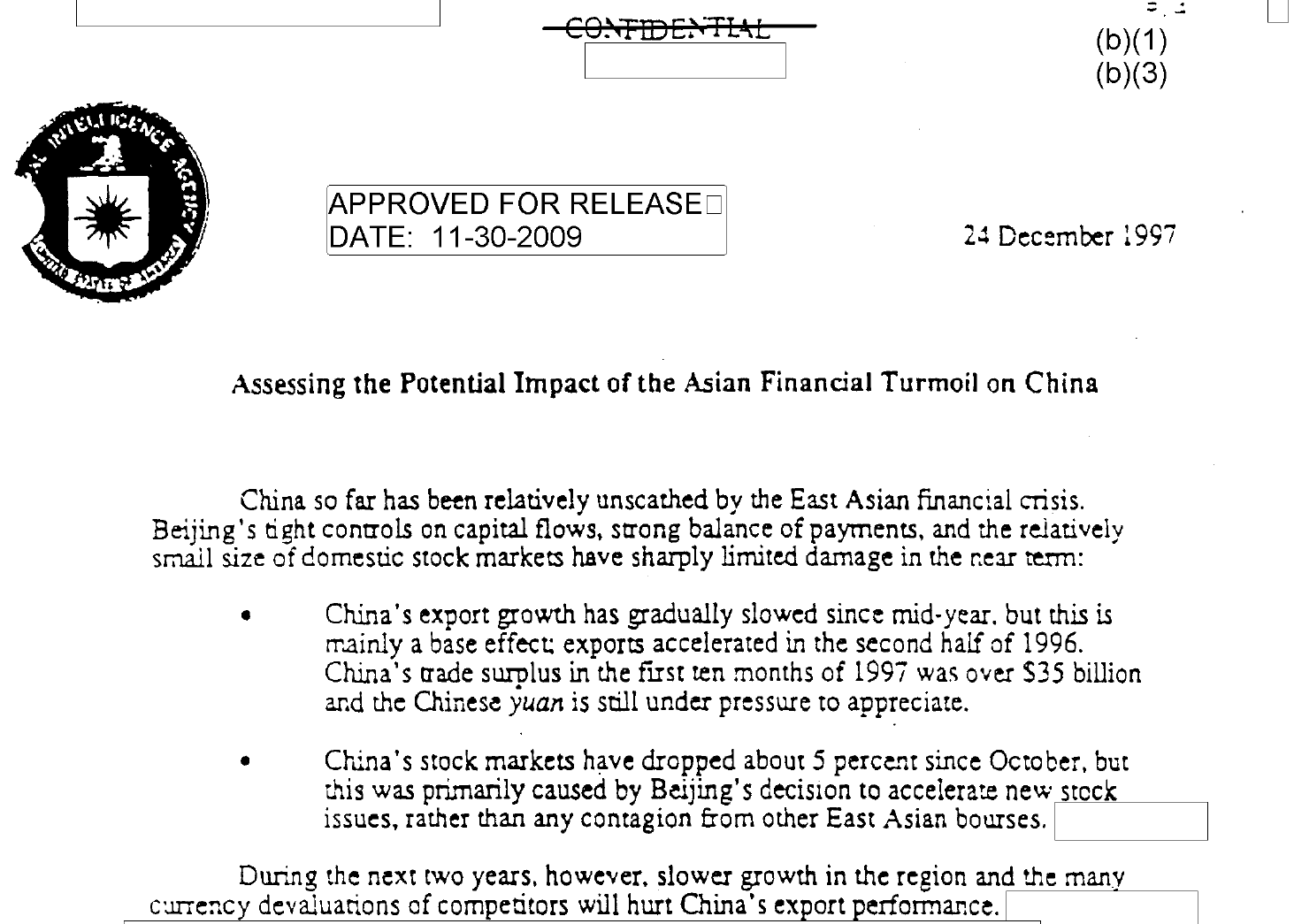
Central Intelligence Agency, “Assessing the Potential Impact of the Asian Financial Turmoil on China,” December 24, 1997, CONFIDENTIAL, approved for release November 30, 2009.
New York’s banks were being talked into staying in a country that had opened its doors; the CIA was telling Washington that the country which had kept them shut was the one that had come through. The next twenty years are the record of what the region did about it.
The idea Washington killed in November 1997 came back as a treaty. In the late summer of that year Japan had proposed an Asian Monetary Fund, a pool of the region’s reserves to lend to its members. Eisuke Sakakibara, who carried the idea, remembered it in 2001 as two months of argument: “Larry Summers was furious,” and “in the end Larry prevailed.” The objection, as he recalled it, was “that it would undermine the International Monetary Fund.” One man’s memory, but the file agrees. A cable listed in Part 2 records Treasury’s man in Tokyo, that November, “concerned with anything outside the IMF,” and eight days later the President’s international economic adviser briefed the press that “the IMF, the International Monetary Fund, ought to be central to any such efforts.” Japan paid anyway. In October 1998 its Ministry of Finance announced US$30 billion for the region, half of it to “take the form of swap arrangements,” and a month later, beside Japan’s prime minister in Tokyo, the President credited “efforts like the Miyazawa Plan.” A year after his Treasury had killed the Asian fund, he was pleased to have the Asian money.
Then the region built what it had been refused, one concession at a time. By 2014 the Chiang Mai swap lines among Asia’s central banks, standing deals to trade currencies, had become a single pool of US$240 billion. The share a member could draw without an IMF program was raised that year, by Bank Negara’s announcement, “from 20% to 30%,” and in 2021 to 40. The BRICS pool signed in Fortaleza in 2014 wrote that year’s split, 30 and 70, into its fifth article. The Fund did not lose the argument of 1997. The people building the rival wrote its name into their treaty.
Except in Beijing. The People’s Bank of China began signing swap lines of its own after the crisis of 2008, in its own currency, and nothing in the published terms refers to the Fund. By the end of 2025 foreign central banks had RMB 94.2 billion outstanding under them, by the bank’s quarterly report. In 2023 Argentina paid the IMF in yuan from Beijing’s line.
Washington reopened its door once the crisis was its own: on October 29, 2008, the Federal Reserve announced swap lines of “up to $30 billion each” for Brazil, Mexico, Korea and Singapore, “fundamentally sound and well managed economies.” Dollars without a program, which Kim Young-sam could not get in nineteen minutes in 1997. The Fed did the same in 2020, and in October 2025 the Treasury signed a swap of up to US$20 billion with Argentina, drawn, by the Congressional Research Service’s account, on the fund a White House aide had been “trying to fudge some on” in January 1998.
A door is where a finance minister goes at eleven at night, reserves running out, and comes back with money. In 1997 there was one, and the people behind it wrote the terms. There are four now. The Fed’s is open for five allies and for others when Washington decides. The Fund’s comes with its program. Beijing’s is in yuan, on Beijing’s terms, and the region’s pool is still 60 percent chained to the Fund.
Which door
And yet. Creditors do sometimes pay now: Ghana’s finance minister told parliament in 2025 of “the 37% haircut on the principal of the Eurobond debt,” one of six such write-downs the Fund’s stocktaking counts since 2020. And on Greece, the Fund’s own evaluation wrote it plainly: delay “provided a window for private creditors to reduce exposures and shift debt into official hands… leaving taxpayers and the official sector on the hook.” The Fund has written down what delay does.
Part 1 asked who holds the paper, when it rolls, and who lends when it stops rolling. Part 2 asked what they want back. The fifth: who has a second door, and what does it cost?
Japan’s line to Bank Negara, signed by the Bank of Japan for the finance ministry, came into force on September 18, 2026, three days after the notice. Up to six billion dollars, from the country whose fund was killed in 1997 to the country that was lectured in 1998. The notice runs to three sentences and a footnote, and gives as its reason “regional financial stability.” Whatever else was said before the signing is in a file that has not opened. Until it does, the rest of us are being jollied up.
In the autumn of 1999, fourteen months after the breakfast at the China Club, the Hong Kong government began selling the shares it had bought in those ten days of August. It packaged them into a fund anyone could buy into, the Tracker Fund of Hong Kong, with a bonus for staying, Chan writes. People lined up to subscribe, an AFP photograph from October 1999 shows. The offer raised HK$33.3 billion, by his account, and “more than 184,000 Hong Kong retail investors” bought in: the public buying, at a discount, what its government had bought to beat the funds. By his figures, the disposals brought HK$140.4 billion plus HK$24.6 billion in dividends on HK$118 billion spent, and the Fund kept HK$51.3 billion of shares. The referee had joined the fight. When it won, the shares went to 184,000 people who had never been in the ring. The bonds Part 1 began with are still rolling.
The file — read it yourself
Hong Kong. Legislative Council, Panel on Financial Affairs, minutes of September 8, 1998 (LC Paper CB(1) 535/98-99) and the special meeting of November 14, 1998 with Professor Miller’s evidence (CB(1)1106/98-99). Joseph Yam, “Intervention true to guiding policy,” South China Morning Post, August 24, 1998, and “Coping with financial turmoil,” Sydney, November 23, 1998, both via the BIS. HKMA, Exchange Fund results for 1998, March 26, 1999. Norman Chan’s recollections, HKMA inSight, September 11 and September 18, 2019; the AFP photograph of the Tracker Fund queue, October 1999, as reproduced by the South China Morning Post, November 12, 2024. Financial Stability Forum, Report of the Working Group on Highly Leveraged Institutions, April 5, 2000, Annex E. IMF, concluding remarks of the 1998 Article IV mission, October 30, 1998. US Department of State, United States–Hong Kong Policy Act Report, 1999. Federal Reserve Board, Greenbook Part 2, September 23, 1998, p. IV-36. William McDonough’s PBS interview, April 17, 2001.
Malaysia. Bank Negara Malaysia, Measures to Regain Monetary Independence, September 1, 1998; Exchange Rate of Ringgit, September 2, 1998; Repatriation of portfolio capital, February 4, 1999; the Governor’s speeches of October 6, 1998 and March 31, 1999. IMF, Stanley Fischer’s press briefing, September 11, 1998; Staff Country Report 99/86, Malaysia: Selected Issues, September 1999; Public Information Notice 99/88, September 8, 1999. Monetary Authority of Singapore, Deputy Prime Minister Lee’s reply to parliamentary questions on CLOB, October 12, 1998. IMF Independent Evaluation Office, The IMF and Recent Capital Account Crises, 2003, executive summary. Vice President Gore’s remarks, Kuala Lumpur, November 16, 1998; the Washington Post, November 17, 1998. The Clinton–Blair telephone memoranda of October 14 and October 25, 1998, ISCAP 2013-090, documents 36 and 38. Johnson, Kochhar, Mitton and Tamirisa, IMF Working Paper 06/51, 2006. The IMF Asia department’s Indonesia file for January 1998 (Robinson email, PDF p. 7) and the Vancouver memorandum of November 24, 1997, both in Part 2’s file.
The bill. Fung, George, Hohl and Ma, Public asset management companies in East Asia: case studies, BIS Financial Stability Institute, 2004. IMF, Staff Country Report 00/21, Thailand: Selected Issues, February 2000, Table 4 and paragraph 73 (a scanned document; printed p. 42). Bank of Thailand, the FIDF. Standard Chartered, RNS of April 15, 2005. Fallon and Lucas, “The Impact of Financial Crises on Labor Markets, Household Incomes, and Poverty,” World Bank Research Observer, 2002, Tables 5 and 7. The Korean, Thai and Indonesian balances today are sourced in Part 2.
The rival. CIA, “Assessing the Potential Impact of the Asian Financial Turmoil on China,” December 24, 1997, CONFIDENTIAL, released November 30, 2009. Eisuke Sakakibara’s PBS interview, May 15, 2001. The Talbott–Haraguchi cable, November 12, 1997 (in Part 2’s file). White House press briefing by Dan Tarullo and Jim Steinberg, November 20, 1997. Bank Negara Malaysia, Enhancement of the Chiang Mai Initiative Multilateralisation, August 7, 2014; Bank of Japan, the amended CMIM, March 31, 2021. Treaty for the Establishment of a BRICS Contingent Reserve Arrangement, Fortaleza, July 15, 2014, as promulgated in Brazil by Decree 8.702 (Portuguese text; the English original was not opened). Japan Ministry of Finance, New Miyazawa Initiative, October 1998. Clinton–Obuchi joint press availability, Tokyo, November 20, 1998. Federal Reserve, press release of October 29, 2008, and March 19, 2020 (the five standing lines are named there). Congressional Research Service, U.S. Financial Support to Argentina (R48780); BCRA, October 20, 2025. People’s Bank of China, Monetary Policy Report, Q4 2025, February 2026 (Chinese). Horn, Parks, Reinhart and Trebesch, NBER Working Paper 31105, on China’s rescue lending. Bank of Japan, September 15, 2026. Argentina’s 2023 yuan payment to the IMF is sourced in Part 2.
Today. IMF, A Stocktaking of the Current International Architecture for Resolving Sovereign Debt Involving Private Sector Creditors, October 2025, Tables 1–2. Ghana, 2025 Budget Speech, March 11, 2025, paragraph 100. IMF, Greece: Ex Post Evaluation of Exceptional Access under the 2010 Stand-By Arrangement, June 2013, paragraph 57.
Standing on shoulders: Paul Blustein’s The Chastening; the Commanding Heights interviews; the Legislative Council’s clerks, who transcribed Professor Miller verbatim.
A note on the records
What this part adds. As far as I can find, the two Clinton–Blair telephone records of October 1998 have not been quoted on this subject before; nor has the CIA’s China assessment of December 24, 1997, been set beside the New York Fed meeting of the same day; nor the Fed staff’s Greenbook page on Hong Kong beside the State Department’s public report. The connections are mine, and readers should weigh them as such. The essay’s claim is narrow: that the private record of the autumn of 1998 was closer to Kuala Lumpur and Hong Kong than the public record was. It does not claim the President endorsed Mahathir, or that the Fund’s staff were wrong about the long run; Fischer’s own short-run concession of September 11 is quoted beside the President’s line, and the distance between them is described as narrow. The President’s phrase was “these capital credit controls,” said of Malaysia and Singapore together, with an explicit limit to the short term; the Fed staff reported that Hong Kong’s “authorities claimed success” and called the double play “so-called”; those hedges are in the text. The Robinson email is a reply in a staff debate about a currency board for Indonesia; its arithmetic is Malaysia’s, and its last sentence is quoted in full. The Wall Street conversation is my own memory of the autumn of 1998; the strategist is not named, the words are as I recall them, and no claim in the essay depends on it. The paragraph on the bankers and the street in Malaysia is likewise my own observation from that autumn; the documented parts of it are Mahathir’s words in the Vancouver memorandum and the IMF evaluators’ finding of 2003.
Norman Chan’s account of August 1998 is a participant’s recollection written twenty-one years later, on the Authority’s own website, and is labeled as such wherever it is used (the 564 points, the HK$79 billion, the HK$118 billion and every Tracker Fund figure are his); the contemporaneous figures come from the Legislative Council minutes, Yam’s 1998 article and speech, and the Exchange Fund’s published results. Sakakibara’s account of the Asian Monetary Fund is likewise a recollection, corroborated on the US position by the Haraguchi cable and the Tarullo briefing. The Clinton–Blair memoranda were prepared by White House notetakers; the redactions are the government’s; both records carry the Interagency Security Classification Appeals Panel’s stamp, with the declassification date of October 14, 2015, on their first pages. The Fund’s Malaysia report is a staff paper; the board’s notice is the institution’s view. The BRICS treaty is read from the Portuguese text promulgated in Brazil; the treaty says the English text is authentic, and I have not opened it. The Fallon–Lucas figures use different national definitions of poverty and unemployment and are reported as their tables print them; the Indonesian 19.9 percent is their re-deflation with household-survey prices. The Thai auction, Indonesian bond and Korean sale figures are the amounts the cited documents state; none is a measure of any buyer’s profit, and no buyer named here is described as doing anything other than purchasing what a government sold. The “second door” figures are reported, dated amounts from the linked releases; they describe funding arrangements and do not assess any country’s condition as of publication. Nothing here is a forecast or a recommendation.
Notes and sources
1. The double play: the mechanics are Yam’s own description (August 24 and November 23, 1998); “four attacks” is his count, the “third and fourth attacks in June and August” following two earlier ones. The “300%” overnight rate is his figure for October 23, 1997 (”almost 300%” in the Financial Secretary’s account to the panel). HK$118 billion, 564 points and HK$79 billion are Chan’s 2019 figures; “about US$15 billion” is Yam’s, the State Department’s, and within the Fed staff’s “$10-15 billion.” The book profit of HK$35.1 billion is from the Exchange Fund results for 1998 (March 26, 1999). Tsang’s “over 110,000 contracts” is open interest, all contracts outstanding, not short positions alone. The funds’ costs are Yam’s Sydney figures (80,000 short contracts; HK$4 billion per 1,000 points; “in excess of HK$30 billion in currency borrowings, at an interest cost of around HK$4 million a day”); “nearly 20 percent” is the Fed staff’s figure for August 13 to 28; the margin surcharge and the fall in open interest from 107,000 to 82,000 contracts are the futures exchange’s evidence to the panel (para. 30); the two funds that added positions during the intervention are the FSF’s finding (Annex E). “Heavy losses” is Yam’s claim; no fund’s accounts for the episode are public. Hang Seng Index futures settle in cash against the index, not by delivery of shares; the August 28 turnover (HK$79 billion) and the “more than 100,000” contracts rolled into September are Chan’s figures. The Sha Tin family is an illustration; the mechanism is Chan’s: one-month HIBOR, “the key benchmark for the funding costs of banks for their mortgages,” stayed “over 10%” for months after October 1997, and the banks “held back the increase in prime rates” for as long as they could.
2. The regulator: the “morning on 14 August” line was given by the SFC’s acting chairman, Laura Cha, to the panel on September 8, 1998 (para. 25); the same minutes record that the operation fell “outside the jurisdiction of SFC” under section 66 of the Interpretation and General Clauses Ordinance (para. 26), and that the exchanges and the clearing house “were not informed of Government’s plan in advance” (para. 18).
3. The FSF’s numbers: “49 percent” and “50,500 contracts” are end-August figures for futures and options together (Annex E, printed pp. 130–131). The group’s “unable to reach a conclusion” is its finding across the six economies it studied (§46), not Hong Kong alone. The Greenbook’s silence on the words “free market” was checked against the page’s text.
4. Miller: the “traffic cop” and “referee” analogy he attributes to a colleague, Professor Chen; Emily Lau’s “at least on paper” was put as the view of “some people,” before the LTCM exchange. Three officials attended; the minutes record no government response to Miller. McDonough’s account gives seventeen firms called in and fourteen that “did it.”
5. Malaysia’s numbers: the RM1.7 billion forecast (”expected to make”) and the RM2.3 billion loss are the Governor’s own figures, five months apart; the March 1999 speech adds that excluding three institutions the system made a pre-tax profit of RM793 million. Reserves (US$21.7 billion to US$26.2 billion), GDP (−6.7 percent) and layoffs (83,865) are from the same speech; the fall in lending rates began before the controls (the maximum base lending rate was already down to 8.9 percent at end-August 1998) and continued after them. The exit levy of February 4, 1999 replaced the twelve-month rule. The Fund’s “effective in limiting outflows” is SCR 99/86, para. 29; “three days,” “very well kept secret” and “nearly uniformly negative” are in its section C. The peg at 3.80 was lifted in July 2005 (background). Anwar Ibrahim’s black eye is from the Washington Post of November 17, 1998. CLOB: the figures (197,000 investors at August 31, 1998, 90 percent Singaporean; 24,000 who sold all their Malaysian shares; the discount widening from 9 percent on August 28 to 49 percent on September 3, averaging 42 percent when trading reopened from September 9 to 15) and the two quoted lines are from Deputy Prime Minister Lee Hsien Loong’s reply to Parliament, October 12, 1998, published by the Monetary Authority of Singapore. “Was not warranted”: the IMF Independent Evaluation Office, 2003, executive summary: “the initial tightening of fiscal policy in Indonesia and Korea was not warranted.” The indictment paragraph: “remarkably little risk in terms of loss” is the Bank of England’s Court minute of September 16, 1997 (Part 2); the state guarantee at a higher rate is Korea’s January 1998 creditor deal (Part 2, note 1); “170 percent of GDP” is Robinson’s email; the billion dollars a day is the assumption in the IMF staff’s Korean reserves table of December 8, 1997 (Part 2, Exhibit E), a projection, not a record; Thailand’s offshore banking facility is in Part 1; the absence of position limits is the FSF’s bracket. The sentence on credit made cheap at the center and losses collected from the tax base is the author’s reading, not a finding of any cited document.
6. Gore’s speech: the text quoted is the prepared text as hosted by Mount Holyoke College; the Washington Post reports the delivered line as “calls for democracy in many languages -- people’s power, doi moi, reformasi. We hear them today -- right here, right now -- among the brave people of Malaysia,” describes reformasi as “the rallying cry for opponents of Prime Minister Mahathir Mohamad,” and attributes Mahathir’s remark to Reuters.
7. The calls: Blair’s “We need prudent rules” and the President’s “over a trillion dollars a day” are on page 6 of the October 25 record. Korea’s sale: Standard Chartered’s price (”Korean Won (KRW) 3.4 trillion (US$3.3 billion), in cash”) is the buyer’s own announcement, which names no seller; Newbridge’s 1999 agreement is background. The Lone Star arbitration over Korea Exchange Bank, and its reported annulment in November 2025, are left out of this part; the file for them is in the research ledger.
8. Indonesia’s figures (IDR 650 trillion; 26 percent in IBRA’s 2000 report; Bank Central Asia, the largest private bank, to Farallon; the IDR 60 trillion estimate) are from the BIS/FSI case study, pp. 8–14, as read from the Yale School of Management’s hosted copy. Thailand’s: IMF SCR 00/21, Table 4 and para. 73, read from the page image for this essay; the 1.4 trillion baht headline is the Bank of Thailand’s own, whose page also gives the 0.46 percent charge on protected deposits; the balance outstanding is sourced in Part 2. Korea’s: 168.7 trillion won and the 72.9 percent recovered by June 2026 are the Financial Services Commission’s figures (July 21, 2026); the last instalment is the FY2027 budget proposal of September 1, 2026, which in the government’s words completes the repayment; both are in Part 2’s file. Unemployment: Part 2 gave Korea’s rise as 2.6 to 7.0 percent (annual averages, from Korea’s SEC filing); Fallon and Lucas’s table gives 6.8.
9. The rival: the Chiang Mai Initiative and its 2010 pooling are background, widely recorded; the load-bearing figures (US$240 billion; 20 to 30 percent) are Bank Negara’s 2014 release; the 40 percent is the Bank of Japan’s 2021 notice. The BRICS split is Article 5(c) and 5(d) of the treaty, read from the Portuguese text promulgated in Brazil. The People’s Bank of China’s swap network dates from 2008–09 in the accounts cited in Part 2; RMB 94.2 billion is its own figure for balances drawn by foreign monetary authorities at end-2025 (Q4 2025 report, section 10). The Miyazawa page on the Ministry of Finance’s site is undated; October 1998 is the initiative’s announced month. The Fed’s 2020 lines are its release of March 19, 2020; the Treasury–Argentina swap is the BCRA’s release of October 20, 2025, its funding source the Congressional Research Service’s. Argentina’s yuan payment to the IMF in 2023 is sourced in Part 2 from press accounts and Yale SOM; it was a bridge, repaid from the IMF’s August 2023 disbursement.
10. Today: the IMF stocktaking’s count is its own (Table 2, six external bond restructurings 2020–2024); the Greece evaluation is quoted from paragraph 57. The Tracker Fund figures (HK$33.3 billion raised; 184,000 investors; HK$140.4 billion proceeds; HK$24.6 billion in dividends; HK$51.3 billion retained; the loyalty bonus, one free unit per twenty held for a year and one per fifteen for two) are Chan’s 2019 figures and are attributed to him in the text; the Exchange Fund’s published profit is the only independent number used for the disposal. The Bank of Japan’s release of September 15, 2026 gives the effective date as September 18.
An excellent review of government intervention against the market madness during the Asian financial crisis. Only the Hong Kong SAR and Malaysia survived the brutal speculative attack during the crisis. Thanks.