


Somewhere this morning, a person leaned toward a silver sphere and let it look into their eye. Nearly eighteen million have taken its certificate of personhood. Digital identity is becoming the precondition for holding anything at all — money, stocks, property. And identity has an issuer. Issuers can revoke.
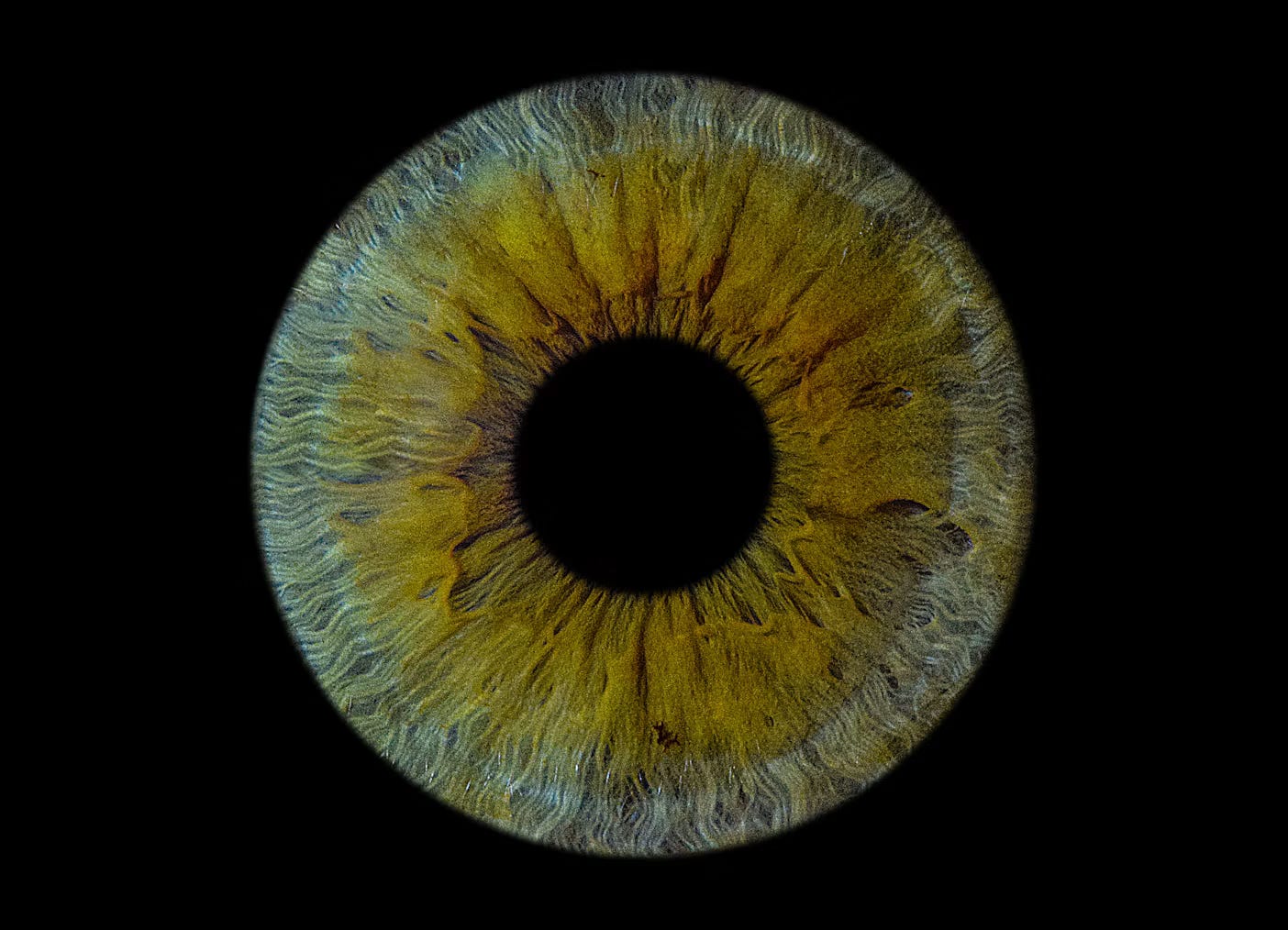
A close up of a yellow eyeball in the dark" by Maria MaximovaPublished on January 4, 2025NIKON CORPORATION, NIKON D5300
The Permission Society · Part V
Somewhere this morning, in a shopping mall on one of four continents, a person leaned toward a silver sphere the size of a bowling ball and let it look into their eye.
The sphere is called an Orb. It photographs the iris — the one pattern on a body that no two people share — turns it into a code and, the company says, deletes the picture. It pays for the look, in a coin of its own minting. What it grants in return is new under the sun: a certificate that its holder is a person. Nearly eighteen million people have taken one. The company posts the count on its homepage the way an exchange posts a price.
Its most famous founder is Sam Altman, whose other company is the reason the certificate is needed. The machines have made persons cheap to fake, so personhood now requires proof. The sales pitch is one honest question: how will anything online know you are real?
Hold the question. It is the key to the decade.
* * *
This series has been walking down a staircase. The token with an author. The money that asks permission. The key above every key. The stock that became a copy, and the ghost market where the copies do not even carry rights. Five essays, and every one of them was about the things you hold.
This step is the turn at the bottom of the stairs. The system is finished reaching for what you own. It is reaching for you.
* * *
Start where the last essay left the machinery. ERC3643 — the token standard the chairman of the SEC named from the podium as the shape of compliant finance — carries a sentence in its specification that is not about money at all. In the flat imperative engineers reserve for laws of nature, it says the receiver of a token “MUST be whitelisted on the Identity Registry and verified (hold the necessary claims on his onchain Identity).”
In plain words: the asset will not enter a nameless hand. Before a token moves, a registry checks that the receiving wallet belongs to a registered identity — stamped with claims, verified, cleared, resident of an approved place — signed by an issuer the system trusts. One of the standard’s own authors compressed the design to six words: “No ONCHAINID, no transfer.” No identity, no property.
Your rights are a maybe. Your identity is a must.
The last essay found the regulator shrugging at what the token owes you — may or may not, twice in two sentences. There is no shrug on the other side of the trade. On the question of who may hold, the word is MUST.
And the institutions have chosen their standard. The depository from the third essay — the keeper of the master key — joined the association that governs ERC3643 in June of 2025. The registry of assets and the registry of persons are becoming departments of one machine.
* * *
The states are building their half, on a schedule you can read. By late this year, every member state of the European Union must offer its citizens a Digital Identity Wallet: the phone as papers. By late next year, the banks must accept it. Notice the verb the directives use. The same regulation gives legal standing to a new object called the “qualified electronic ledger,” so that the registers the wallets answer to have force of law. None of this is hidden. It is directives and deadlines: adopted, in force, dated.
Europe has also fitted the doors that lead out. Send more than a thousand euros from an exchange to a wallet you keep yourself, and the exchange must first make you prove the wallet is yours. The unwatched pocket now comes with a receipt.
* * *
The private side is further along, because it sells convenience instead of compliance. JPMorgan’s blockchain division has demonstrated encrypted “identity attestations” that travel on-chain — verified once, checked by mathematics everywhere, sealed so tightly that even the checker cannot read what they contain. Mastercard now ties self-custody wallets to verified identities with what it calls a soulbound token — “a non-transferable digital asset linked to a users’ self-custody blockchain address to show they’re verified.” Visa, this spring, turned the chip in your bank card into “a secure, intuitive identity credential.”
Study the Mastercard design for a moment. The first asset in the new world that you cannot sell, cannot transfer, and cannot shed is the one that certifies you.
The pitch everywhere is the same, and it is honest: prove yourself once, and everything opens. The engineers hear efficiency. Say it slowly and you hear the other thing.
There is now an issuer of you.
* * *
If you are waiting for the law to defend the nameless, the law has been walking the other way. In June of last year the Supreme Court of the United States said it in nine words: adults “have no First Amendment right to avoid age verification.” Britain’s Online Safety Act demands checks “highly effective” at telling who is a child — and specifies, in the statute, that your own word does not count. Last week the Court declined to pause a Texas law that puts an age gate on the app store itself. Each case is about children, or pornography, or app stores. Each pours the same foundation: the internet, entered by credential.
And the man who built a door without a list is on his way back to court. Roman Storm wrote Tornado Cash, software that let money move without a name attached. Last August a jury convicted him of conspiring to run an unlicensed money business, a crime that carries five years. The counts it could not decide, the government has moved to retry this fall. You do not need an opinion about his software to read the shape of things: identity is required of the holders, and namelessness is becoming a liability for the builders.
* * *
None of this is new under the sun either. For most of the nineteenth century, a French workman could not lawfully take a job without his livret: a booklet, signed by the last employer, presented to the next. The tsars kept internal passports. South Africa built its pass laws. Every such system said the same quiet thing. Work, movement, and property do not attach to the person. They attach to a paper, and the paper has an issuer. Industrial societies spent a century tearing those booklets up. The livret died in 1890. We remember the tearing as progress.
The registry being built now is the booklet again, with three differences. It is checked by machines, not gendarmes. It is fastened to everything at once, not only to the job. And it cannot be forged, lost, or quietly left in a drawer, because it is your own body that signs it.
* * *
Where does it all assemble? The man who runs the world’s largest asset manager wrote the destination to his investors this spring, gently, as a convenience: “Over time, that could allow a single, regulated digital wallet to hold not just payment balances, but a broad range of financial assets. In a single wallet, someone could hold exchange-traded funds (ETFs), digital euros, tokenized bonds, and fractional interests in assets that were once out of reach—from infrastructure to private credit funds.”
Read the inventory once more. Digital euros, in the founder’s own list, between the ETFs and the bonds. One wallet, regulated, holding everything — and attached, necessarily, to one verified you.
* * *
Now the fairness, because every reason on the list is real. The machines really are faking persons by the million. The frauds are real, the children are real, the sanctions are real. I have sat with the people building these registries, and they are decent, and each rule they carry is defensible on its own. The first essay in this series said the rest: no conspiracy is needed. The cage goes up one reasonable check at a time, each one sold as safety, each one true.
But add the checks, because the sum is not a rule. The sum is a registry of persons, fastened to everything they hold, consulted every time anything moves.
* * *
Every asset in the old world shared one property so universal that no one thought to name it. The gold coin did not know who held it. The paper share did not know. The dollar in your pocket does not know you from any other hand it has passed through. Every ransom paid, every border crossed at night, every quiet family escape in history moved through that ignorance. It is the oldest privacy there is: the dumbness of things.
The old assets were blind. The new ones can see.
A token that checks a registry knows its holder the way a door knows a keycard. And property that recognizes its owner is property that can be told to stop recognizing him.
The second essay in this series asked what you will do on the day the money refuses you. Here is the detail I owed you: it will not refuse a stranger. The wallet that fails the check is not anonymous. It is you, precisely — name, iris, attestation — that the system declines. Nothing dramatic happens. An attestation expires. A claim is contested. A list updates overnight somewhere you have never been. And in the morning everything fastened to your identity — the stocks from the fourth essay, the copies from the fifth, the money from the second — pauses at once, politely, pending verification. There will be a desk, afterward. You will stand at it, and the first thing it will ask you to prove is the thing in dispute.
In the old world you could lose your key and still be yourself. You are the key now. And keys are cut, copied, and canceled by the locksmith.
* * *
Say it exactly, so it cannot be waved away. No one has abolished anonymity by decree. The orb is voluntary. The wallets are voluntary. The standards govern regulated assets, not your whole life, and the checks that run today are the mild pair: sanctions and age, fraud and children. The builders are not villains, and this essay accuses none of them. What it says is narrower, and it is the whole series in one sentence: a registry of persons is being fastened to the registry of things, in the open, on a schedule — and when the fastening is done, holding anything will begin with being someone the system agrees exists.
And the person who refuses all of it? Nothing happens to him. No one comes. He simply finds, year by year, fewer doors his no can open.
The first essay asked who can reach in. Six steps down the staircase, the answer has a shape. Whoever issues the identity reaches everything at once.
So do one free thing while it is free. Keep something that does not know your name. A coin. A paper. A key that is metal and nothing else. Not as an investment — as a memory of what property was like when it was blind.
On the day the system asks you to prove that you are you — and it will ask politely, and the reasons will all be good — who signs the answer?
The word in the specification is MUST.
* * *
If someone you know is about to be verified, send them this first.