


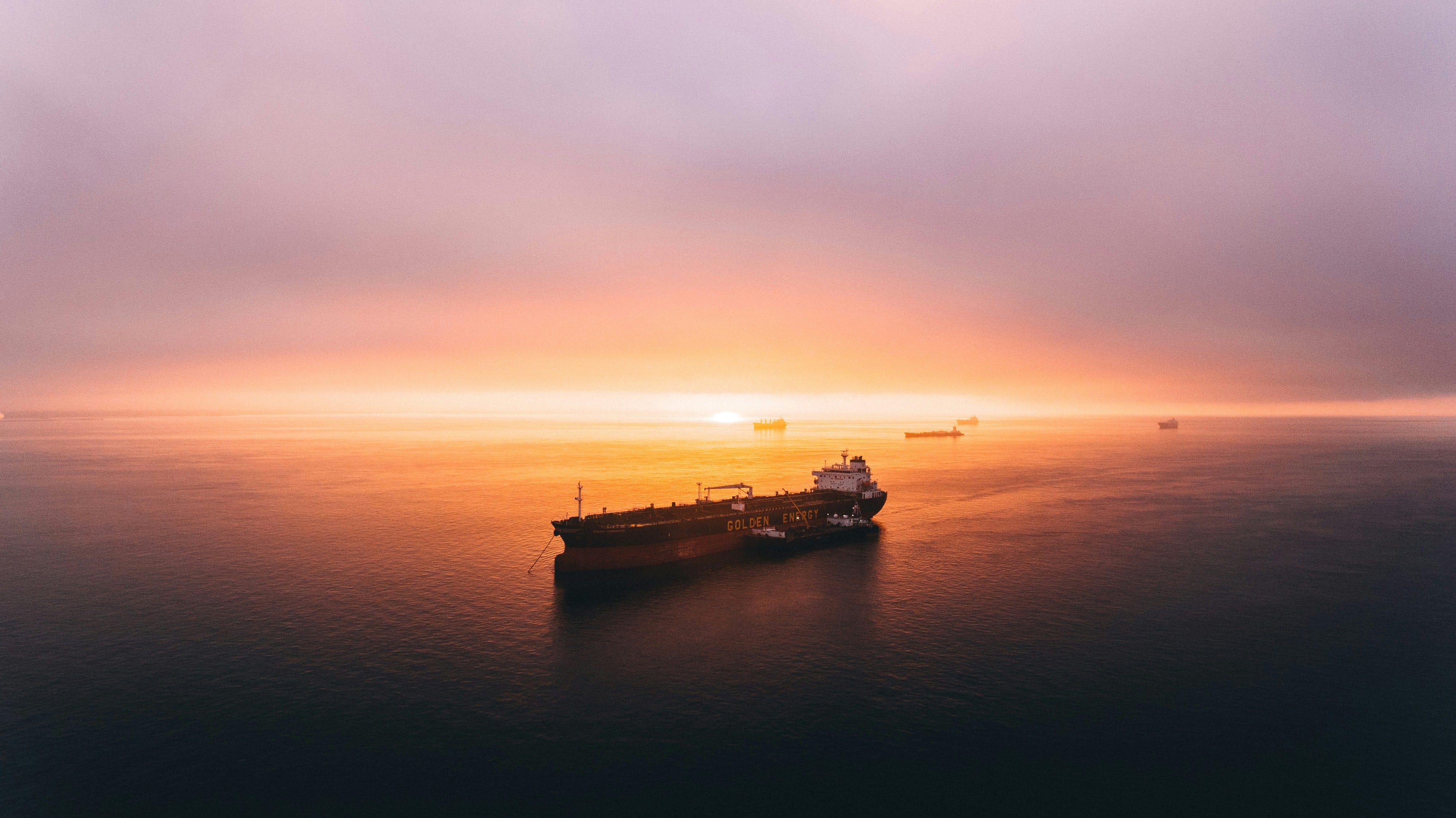
No LNG carrier has entered or left the Gulf since Al Hamra cleared the Strait of Hormuz on July 11; Kpler counts twenty-one waiting behind her, and the ships running dark make even that a floor. I write from the Gulf, where Das Island’s cargoes are the home trade. Oil near $90 has its workarounds — pipelines, trucks, quiet clearances. Liquefied gas has none. The barrel is priced. The winter is not. And the last time a chokepoint closed like this, the workarounds outlived the war.
She loaded at Das Island between July 7 and 9. Inside the Gulf, Kpler counts 21 carriers: thirteen in ballast, five laden, four at berth. Treat the count as a floor, not a census — it excludes Shandong Redwood, whose AIS signal has disappeared, and earlier reporting found several QatarEnergy-controlled carriers already running dark. When the ships that exist stop appearing in the data, the data understates the queue.
Brent is back around $90, which is true and almost beside the point. Oil has workarounds — physical ones. The Saudi East–West pipeline carries crude to the Red Sea. Iraq trucks fuel through Syria. In the war’s temporary openings, Iran reportedly moved some $6 billion of oil toward Asia. Gas has no such geography. Qatar and the UAE account for nearly all of the roughly one-fifth of global LNG trade that normally passes through Hormuz, and every export cargo from those terminals must cross the same narrow water. There is no truck, no mountain pipeline, for a cargo held at minus 162 degrees; there is the strait, or there is nothing.
The winter ledger is already being written. For Italy’s Edison, QatarEnergy’s force majeure now covers 21 cargoes scheduled between April and early September, and contracts linked to the damaged trains may be impaired for much longer. EU storage stood at 51.8% on July 12 — roughly 15.7 percentage points below the 2020–2024 average for the date — after entering the injection season at 28%, below each of the previous three years. In some European stress cases, a cold winter adds as much as 20 bcm of demand. JKM has traded above TTF, and Platts has proposed a JKM–TTF differential assessment effective August 27. When a dislocation earns its own benchmark spread, it has stopped being commercially incidental.
There is an alternative, and it is American. US cargoes can cover what the Gulf is not shipping — at much higher prices, over longer water, into a Europe that has already foreclosed its Russian volumes. Replacement is not relief; it is repricing. Costs of that order do not stay in the energy column — they surface in freight, in fertilizer, in every winter utility bill from Rotterdam to Seoul. Which leaves the plain question for financial markets: is that inflation discounted, or is it, like the winter, still waiting to be priced?
Twice the world watched the Suez Canal close — in 1956 and again in 1967. Neither closure created the supertanker, but both accelerated the economics of larger hulls and Cape routing, and the change endured after the canal reopened. Watch the same grammar now. Iraq has been trucking fuel oil through Syria since April, and Baghdad says its western export diversification should continue after Hormuz reopens. ConocoPhillips has agreed to join BP in redeveloping Kirkuk — a field whose crude historically fed, and may again feed, the route to Baniyas. A toll booth is also infrastructure.
Honesty about the evidence, because the permanence claim is the whole claim. It is strongest where governments are explicitly retaining or building routes: Saudi and Emirati pipeline capacity, Iraq’s stated postwar policy, Iran’s institutionalized clearance system. It is weakest where the exhibit is a new price assessment, or an upstream investment that merely sits near a proposed corridor. I hold the first set as evidence and the second as suggestion.
The strait will reopen; straits do. Al Hamra will lose her title as the last ship out. What Suez teaches is that the routes built while everyone waits do not demobilize. The barrel found its way around the war. The winter is still waiting to learn whether it can say the same.