


The Monsters Are Still Watching
Three thousand years ago a blind poet told two stories that have refused to die. In one, kings sail to burn a wealthy city over pride and trade routes. In the other, a clever man spends ten years getting home past monsters that do not age. Read them in a week of sirens. They are current affairs.
The first was about war: the Iliad. A coalition of kings sails across the sea to destroy a wealthy city called Troy. They do it over a woman, supposedly, but really over pride and trade routes and the grievances powerful men carry like stones in their pockets. The war lasts ten years. The city burns. The victors stand in the ashes, call it glory, and sail home. The people of that region — the ones who didn’t sail from anywhere, because they were already there — are left with the rubble.
The second story is about what happens after — after the heroes try to go home and discover that the sea they crossed so confidently has turned against them. This is the Odyssey. If the Iliad is about the cost of war, the Odyssey is about the cost of winning — and buried inside it, a question no one in power wants to face: what happens when the outsiders who started the fight sail home, and the people who live there are left staring at each other across the wreckage?
I have read the Odyssey three times, and each time I understood less. That’s how you know something is true — it gets harder, not easier, the closer you look. What I’m about to tell you is about Homer. Only Homer. But by the last line, I suspect you’ll be thinking about something else entirely.
———
Something terrible always starts with something brilliant.
Odysseus — king of a small Greek island called Ithaca — has spent ten years fighting the Trojan War. On the way home, he wanders into a cave belonging to a Cyclops — a one-eyed giant — named Polyphemus. The giant has already eaten two of his men.
Odysseus strikes. A sharpened olive stake, heated to a glow, driven into the giant’s single eye. Homer says it hissed — like hot iron plunged into water.
His crew escapes. But then Odysseus, smoke still in his hair, stands at the stern and screams his name across the water. Know who did this to you.
Pride. That old, gorgeous poison — the ghost of Troy still whispering you conquered a city to a man who can’t even conquer the current.
Polyphemus speaks the name to his father. His father is Poseidon — god of the sea, the sovereign force of the waterway.
Poseidon doesn’t send a wave. He does something that will feel familiar to anyone who has watched a regional power respond to an assassination with something quieter than missiles — he closes the sea itself. Not for everyone — but for Odysseus and anyone tied to him, the ocean becomes a locked door.
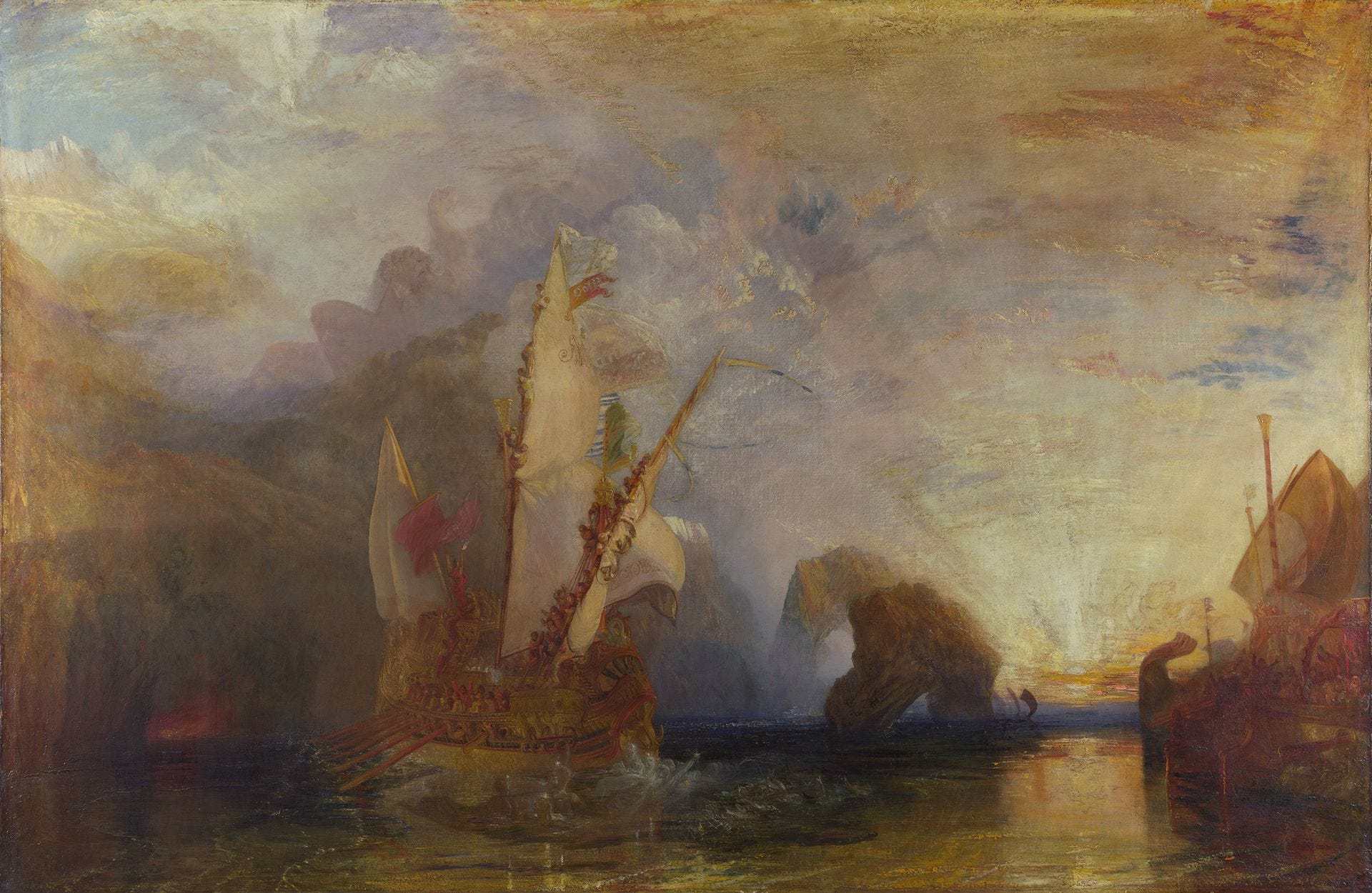
J.M.W. Turner — Ulysses Deriding Polyphemus (1829)
Hold this thread, because it holds the entire story: Odysseus is passing through. He doesn’t live here. He struck, and now he wants to go home. But Poseidon lives here. The sea is his domain. The narrow places are his inheritance. When Odysseus eventually sails away — and he will — Poseidon will still be here. The waterway will still be here. Outsiders always leave. The geography, and whoever calls it home, always stays.
———
Before the Cyclops, before the blood, Odysseus made landfall on the island of the Lotus Eaters — a people who offered his crew a single flower. No violence. No trap. Just a taste. The men who ate it forgot everything — their mission, their families, their reason for sailing.
Think about that. The most lethal weapon against collective will isn’t force — it’s comfort. Markets, appetites, the slow narcotic of having too much to lose. You don’t conquer a coalition. You feed it until it can’t remember why it sailed. Some of Odysseus’s men had to be dragged back to the ships in tears — not because they were prisoners, but because they no longer wanted to be free.
———
Come with me to the strait.
Homer places a monster on each side. Scylla — six serpent heads plucking men off the deck. Charybdis — a mouth in the ocean floor swallowing the sea three times a day. Between them: a channel so tight that swerving from one means drifting into the other.
The intelligence Odysseus receives delivers the math. You cannot fight Scylla. You cannot outrun Charybdis. You can lose six men or lose everything. Choose.
He chooses. Six of his crew — men whose children’s names he knew, men who had survived ten years of war only to die in a narrow channel on the way home — lifted screaming into the air.
But the ship passed through. Odysseus sails on. Scylla and Charybdis remain exactly where they’ve always been. The monsters don’t leave. The strait doesn’t widen. The narrows belong to whatever lives on those cliffs.
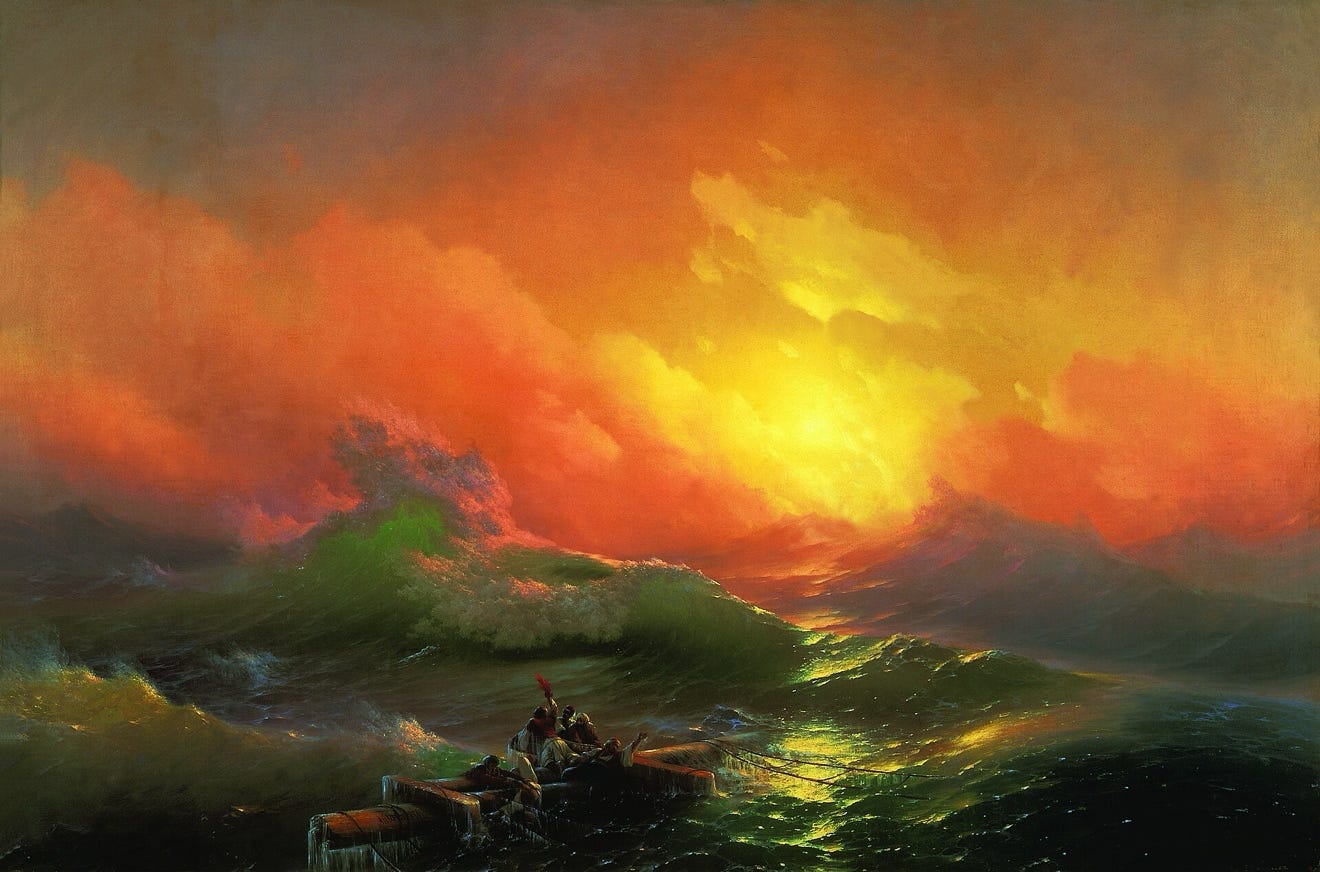
Ivan Aivazovsky — The Ninth Wave (1850)
———
A gatekeeper named Aeolus commands the winds. He helps Odysseus at first — locks the hostile winds in a bag, hands it over, sail home — but when things go wrong, the gatekeeper refuses. I will not help someone the gods have marked. The neutral sovereign steps back when the cost of friendship exceeds the cost of looking away.
Twelve ships sail into a harbor ringed by cliffs. Eleven captains go deep inside. Odysseus keeps his ship near the mouth. The locals — Homer calls them the Laestrygonians — heave boulders from above. Eleven ships shattered. In minutes. Ninety percent of the fleet. Gone.
Odysseus escapes. But the Laestrygonians don’t go anywhere. Whoever lives on those shores will still be there tomorrow, long after the foreign fleet is driftwood and memory.
———
On the island of Thrinacia, Odysseus faces the test that breaks him.
Helios, the Sun God, keeps sacred cattle here — sovereignty made flesh, the kind of thing a people protect not because it is rational but because it touches something holy in their understanding of themselves. The warning from two prophets was the same: Do not touch them.
But the crew is starving. The argument desperate men always make: the resource is right there. The consequences are someone else’s problem.
They kill the cattle. Zeus answers with a thunderbolt that splits the ship. Every crew member drowns. Odysseus alone survives, clinging to wreckage.
Odysseus floats away — he always floats away — but Thrinacia remains. The Sun God remains. The violated sovereignty remains, and its memory is longer than any outsider’s war.
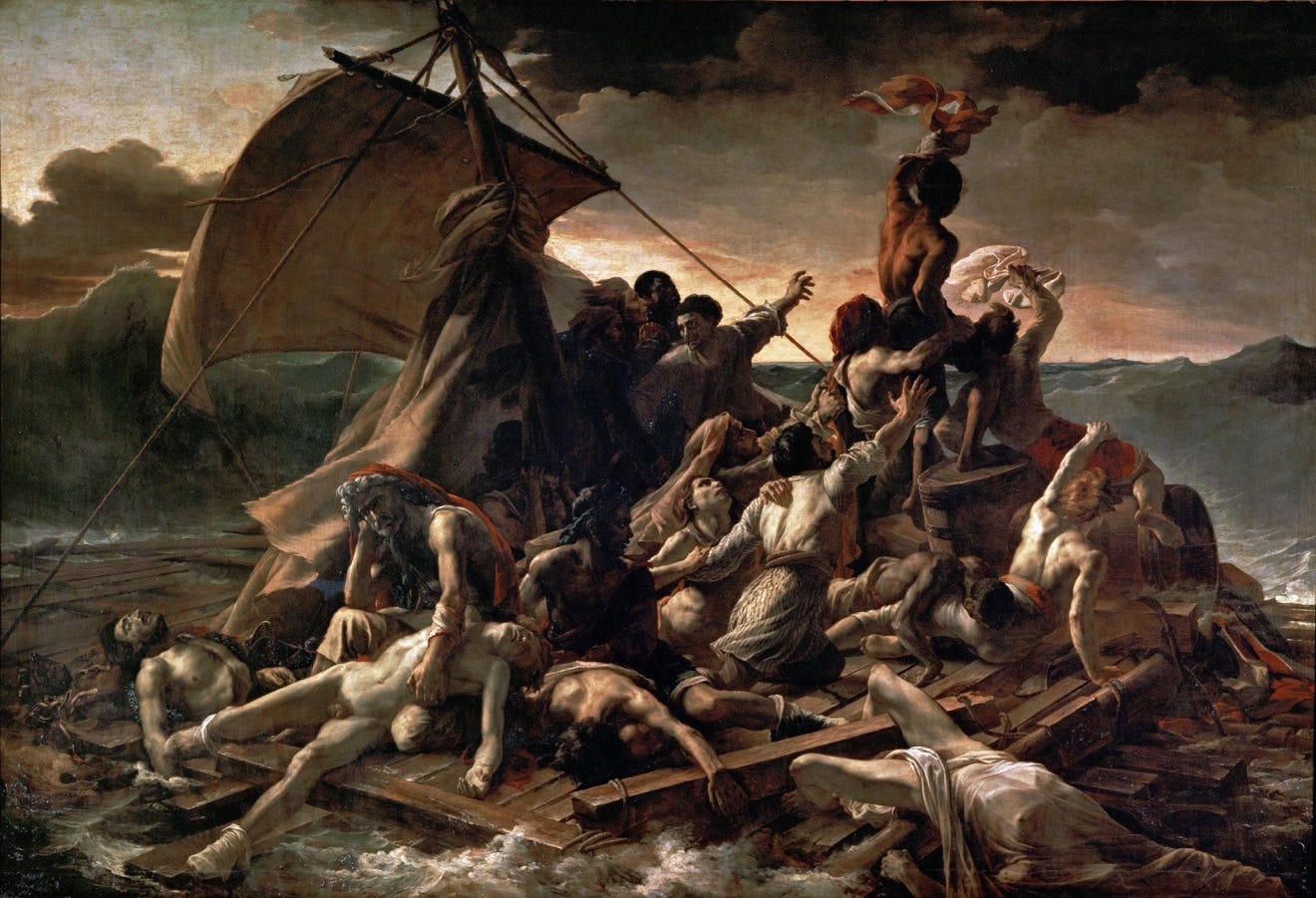
Théodore Géricault — The Raft of the Medusa (1818–19)
———
When Odysseus finally washes up on Ithaca — the island he left twenty years ago to fight a war he thought would last months — he can smell his own land. Thyme on the hills. Wood smoke from a hearth he built with his own hands.
But the palace is no longer his. Over a hundred suitors — men from neighboring kingdoms — have moved in. Not invaders. People who filled the vacuum.
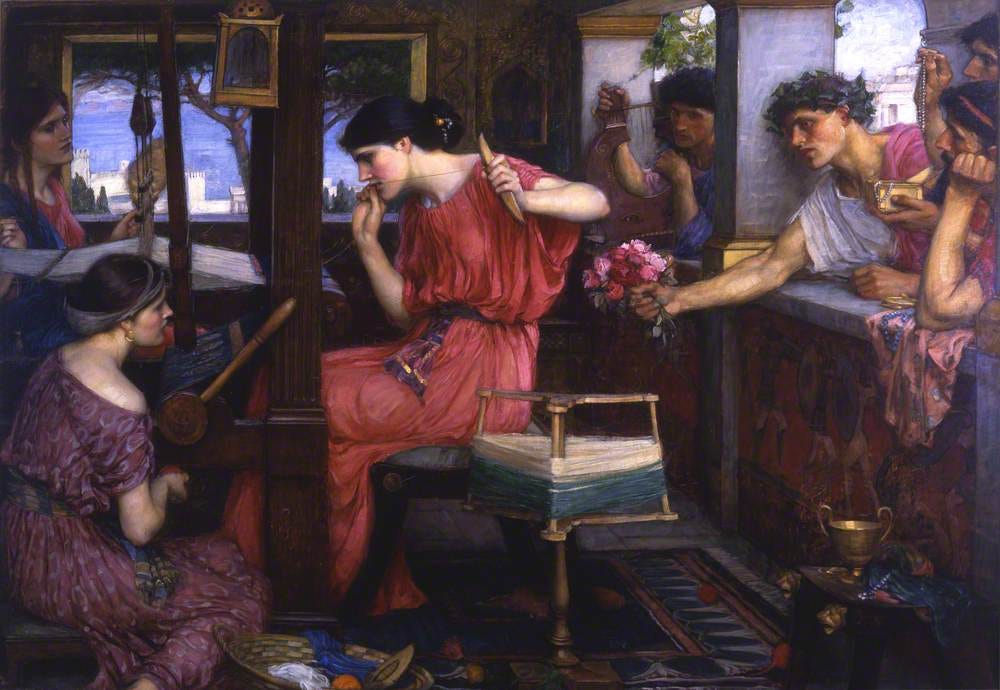
John William Waterhouse — Penelope and the Suitors (1912)
Odysseus takes it back through violence so total that the great hall — the room where his son took his first steps, where Penelope wove and unwove her endless shroud — runs with blood.
After the killing, Odysseus stands in his own hall, surrounded by the dead. He has won. And Homer asks the question beneath every question: now what?
Because the Ithaca he returns to is not the Ithaca he left. Twenty years have rewritten every alliance, every understanding between neighboring islands. But the arrangements that kept the peace — the unspoken truces, the marriages that sealed alliances — those died while Odysseus was away fighting someone else’s war. There is no world to go back to. They are neighbors — and the rules that once governed how neighbors behaved have been burned to the ground by two decades of absence, occupation, and blood.
The families gather. They want vengeance. Ithaca stands on the edge of a war without end — not because anyone wants it, but because the geography demands it and every restraint that held before has been swept away. There is no “going home” for any of them, because they are already home.
It takes Athena — a goddess descending from the sky — to impose peace. Not justice. Not a restoration of anything, because there is nothing left to restore. Just peace — a fragile silence between people who must now invent new rules for a world none of them chose. Rumi wrote that the wound is where the light enters. Homer is less gentle. The wound is just the wound — and what you build around it is your problem.
———
Gods and monsters — that was Homer’s mercy, his way of telling truths too sharp to hold with bare hands.
Odysseus was always passing through. Every island, every strait, every harbor — he came, he caused suffering, and he moved on. But the people who lived on those shores stayed. The geography doesn’t care who won. It only cares who remains.
The question the Odyssey asks has outlived every empire that tried to answer it:
What happens when the narrow places close — and the outsiders who closed them eventually go home?
The neighbors find out. They always find out — but in a world that no longer works the way it did before the fire started. The maps they trusted are useless. And what they build from the wreckage — or what they destroy — has never, not once in three thousand years, been decided by anyone but themselves.
The passage is still narrow. The cargo is still precious.
And the monsters — patient, ancient, indifferent to our plans — are still watching from both shores.
Nazem Alkudsi, CFA, is the founder of @LongArcNews. A former CEO in the Abu Dhabi sovereign wealth ecosystem and four-decade veteran of institutional investing, he writes about capital, power, and civilizational patterns.
Thank you! Your wisdom is divine!