


When the Music Stops · Part 2 of 3

White House memorandum of conversation, November 27, 1997, 2356–0015 EST, Camp David. CONFIDENTIAL, then DECLASSIFIED; the round stamp reads “Dep Sec Has Seen.”
Part 1 was the way up. This is the collapse of 1997–98, Thailand to Korea to Indonesia, told from documents that were secret when they were written and from the streets they were written about. Korea makes the last payment on it next year. Two ledgers run through it: what was protected at the top, and what was paid at the bottom. Every scene here happened twice. Once in public. Once in the file.
At 11:11 on the night of December 8, 1997, an economist at the International Monetary Fund faxed a two-page memo to the head of its Asia department. It was about the money to keep Korea out of default. Borrowing it, the memo said, “would involve a substitution of sovereign debt for private debt.” In plain words: the public would take over what the banks were owed. And that was nothing new, the memo went on, “since such a substitution was already envisaged in the original baseline projection.”
The money had not yet moved. The bill had already been assigned.
Here is what this part of the story shows. The rescue of 1997 was built to make the lenders safe. The banks that had lent the dollars got new loans, a government guarantee and a higher rate. The people who had never borrowed a dollar paid for the collapse: with their jobs, their savings, their wedding rings, and thirty years of taxes. The substitution was not an accident of the crisis. It was in the plan, and the people who wrote the plan wrote it down.
This is the story of how that sentence came to be written. And of the people who were never in the room.
Four minutes to midnight
At 11:56 p.m. on Thanksgiving night, November 27, 1997, the President of the United States telephoned the President of South Korea from Camp David. He called to tell him his country had about a week.
I read the transcript on the State Department’s own website. It was released after a lawsuit. It is stamped CONFIDENTIAL, then DECLASSIFIED, and then, in a round date-stamp from December 1997, Dep Sec Has Seen. As far as I can find, no book or newspaper has quoted it.
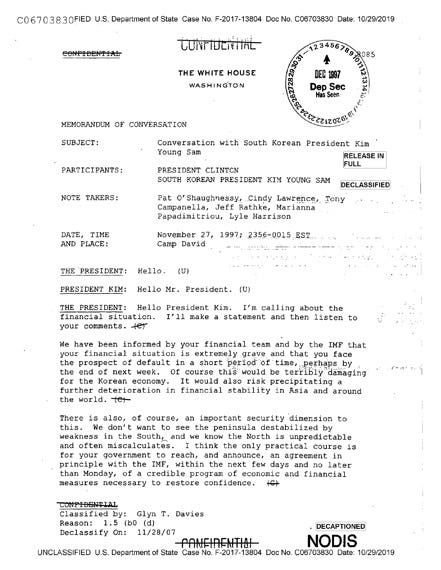
White House memorandum of conversation, Clinton–Kim Young-sam, November 27, 1997, 2356–0015 EST. Released by the State Department in FOIA litigation, October 2019. The circular stamp reads “Dep Sec Has Seen.”
“We have been informed by your financial team and by the IMF that your financial situation is extremely grave,” Clinton begins, “and that you face the prospect of default in a short period of time, perhaps by the end of next week.” Kim’s government had asked Washington and Tokyo for a bridge loan: cash to last three weeks. The answer, from the most powerful man on earth to an ally, is no. It “will not work… the money will all be exhausted in a matter of a few days so we could all lose some money.” The call lasts nineteen minutes. At one point the President asks Kim to speak up. He can barely hear him. Then comes the whole year in one sentence: “We can put together the necessary backing if it is clearly a part of an IMF package.”
The next day he called Tokyo. The cable of that call went out marked NODIS and NOFORN: no distribution, no foreign eyes. Even $20 billion, Clinton said, “would be swamped in three weeks.” Hashimoto drew the real map of power: “President Kim has not given much jurisdiction to his finance minister so it will be between you and me, Mr. Mitsuzuka, Mr. Rubin and Mr. Summers to advance the case.” Five men.
Months later, a different payment failure turns up in the reporting from Seoul. An X-ray technician named Youn Sung Mook, 32, unpaid since February, is sleeping in the lobby of the hospital that closed on him.
The distance between those two records is the subject of this story. Whose promises did the rescue make safer? Whose income was left exposed?
The reserve that could not be spent
It starts, in July, with a number that isn’t there. On the morning of July 2, Thailand lets its currency go. The baht falls from 24.25 to the dollar to 27 and 28 by early trading. That is the number the papers print. The number they can’t print is the overnight interest rate, because there isn’t one. Banks will not lend to each other until someone knows what money is worth. The governor of the central bank later told an inquiry about the spring meeting where the reserves were first thrown into the defense. The New York Times reported his words: “Everyone panicked, and some even cried.”
The big funds did bet against the baht, and they made money. But the academic record shows their combined bet fell from about $5 billion to under $2 billion within July. The people who stayed for the whole year were the ones who could not leave.
The sealed record adds the first twist. Two days before the IMF board approved Thailand’s rescue, Australia’s director filed a statement that “Thailand’s net reserves are about half the published gross reserves.” He proposed that disclosure be delayed until November. (It was not. The forward book, the reserves already promised away in currency contracts, was published within weeks.)
LEDGER · Summer 1997. Protected: trading desks and macro funds, with their profits on the baht, out by August. And the major trading banks with business in South East Asia: by the Bank of England’s own Court minutes of September 16, “remarkably little risk in terms of loss, and quite a few had made money out of volatility.” Paid: fifty-eight suspended finance companies, their depositors, and a vice-president named Kittisak, who traded the BMW for a Mazda and a $120-a-month room.
In Seoul, Youn Sung Mook’s hospital will stop paying him in February. This month, that is seven paychecks away.
Ten days
The mechanism takes one paragraph. A country that has borrowed short-term dollars must borrow them again every few weeks. Bankers call it “rolling over” the loans. When one Asian borrower fails, every lender looks at every similar borrower and quietly declines to renew. Refusing to renew a loan is not an attack. When everyone does it at once, it is. A company can own factories and still lack the dollars it owes on Monday. Its bank can be solvent and still hoard cash for its own creditors.
On Monday, November 17, the Bank of Korea stops defending the won. By Wednesday the won is hitting its daily limit ten minutes after the open. The finance minister has been replaced. His successor tells the press: “There is no need for financial help from the IMF.”
The same Wednesday, the CIA’s National Intelligence Daily, Top Secret, released in 2009, told the President’s people something else. Seoul must roll over “about $6 billion monthly.” The rescue packages Seoul and Tokyo were hinting at “may be insufficient.” The brief measured the danger in the currency it understood: US growth “cut about 1 percentage point,” the US current-account deficit “$45 billion” wider, world trade “reduced by nearly $400 billion a year.” The only workers in its three pages are American: “rising US wages and a taut labor market.”
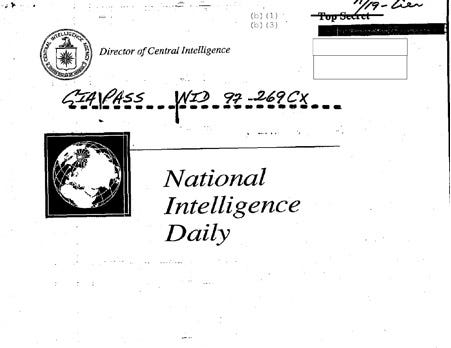
The CIA’s National Intelligence Daily, Wednesday, November 19, 1997: Top Secret struck through, released February 2009.
On the night of the 21st the new minister reads the request out on live television. Six days later comes Thanksgiving, and Camp David.
How is a nation’s economic policy rewritten? In a hotel, quickly. A three-man IMF advance team lands on a Sunday. Korean television counts fourteen Fund staff in all. The mission works around the clock for seventy-two hours. On December 3 Camdessus lands at 7:35 in the morning. The signature comes at 7:25 that evening. Ten days, from the mission’s arrival to a program that commits the world’s eleventh-largest economy to rewrite its banking, labor, corporate and capital-account laws.
That evening the two presidents speak again. The cable of the call has Kim tell Clinton what his country is saying: “the Korean news media is describing today’s negotiations with the IMF as a very shameful one. They think it is very humiliating, almost comparable to Japanese colonial rule. However, I think that there is only one choice.” Again the transcript records the American president asking him to speak up. Clinton asks him to get the three presidential candidates to commit in writing. Kim: “They were rather reluctant.” He would get their signatures anyway.
Dep Sec Has Seen
The board approved Korea on December 4 “in restricted session.” That is a closed meeting, with the debate kept out of even the not-for-public-use minutes. What it was about, I can tell you from a different file: the Asia department’s own crisis file, released in 2019. It holds the December memos, stamped STRICTLY CONFIDENTIAL or SECRET and then DECLASSIFIED. In place of four of them, it holds withdrawal notices: “Korean Loan” (Fischer to the Managing Director, December 2), “Meeting with Executive Directors,” “Indonesia and Korea” and “Korea – Contingency Planning” (all December 9, the last one SECRET). Those four stayed back. What follows is what the Fund let out.
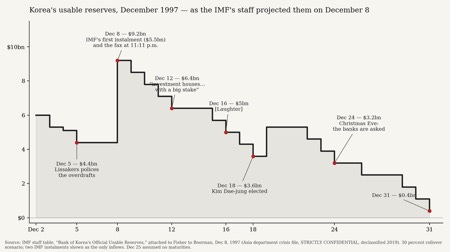
Korea’s usable reserves in December 1997, as the IMF’s staff projected them on December 8, with this chapter’s date-stamps marked. Drawn from the staff table below: the 30 percent rollover scenario, with the Fund’s two instalments as the only money coming in.
December 8 — $9.2 billion, the Fund’s first instalment in. The date-stamps in this chapter are the Fund’s own figures for Korea’s usable reserves, the dollars actually on hand, as its staff projected them that day. A staff economist wrote a memo he headed “Korea: What Can Markets Calculate?” and did what he called “the work of a moment.” Usable reserves had been $6 billion on December 2. If the banks rolled over only 30 percent of what fell due, the table he attached ran day by day to New Year’s Eve: $0.4 billion. The Fund’s two instalments were pencilled in as the only money coming in. There was one day off, December 25, when he assumed no loans would fall due. I found the table on page 140 of the file. It is the most frightening page in this series.
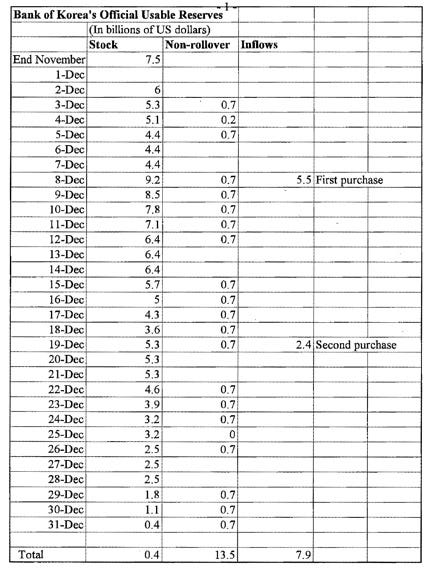
The countdown as the Fund’s staff projected it on December 8: $7.5 billion at end-November, $0.4 billion by New Year’s Eve if only 30 percent of loans were rolled over. A projection under stated assumptions, not a record of what happened. From the Asia department’s crisis file, marked STRICTLY CONFIDENTIAL, declassified 2019.
December 9 — $8.5 billion. In open session, the Dutch director asks whether Korea’s short-term debt is the staff’s $65 billion or the press’s $100 billion. The head of the Asia department answers “probably $65 billion… plus about $50 billion” owed by Korean banks’ overseas branches. The minutes read like a heist discovered in progress. Downstairs, a memo for a two o’clock meeting: reserves “low and hemorrhaging… virtually exhausted by the end of the year.” A colleague had already done the arithmetic. It is the fax this story opened with, sent at 11:11 the night before, with no soft words: borrowing to avert default “would involve a substitution of sovereign debt for private debt. However, this does not involve anything new since such a substitution was already envisaged in the original baseline projection.” The public’s debt for the lenders’ debt was not an afterthought of the rescue. The staff’s own projection had assumed it from the start. In plain words: Korea would borrow from governments to repay the banks. Korea’s taxpayers would then owe the governments. To be fair to the man who wrote it, he was arguing for Korea. The alternative, he wrote, was more adjustment through even higher interest rates, and that “is likely to be costly.” He was choosing the lesser pain. He was also recording who would carry it.
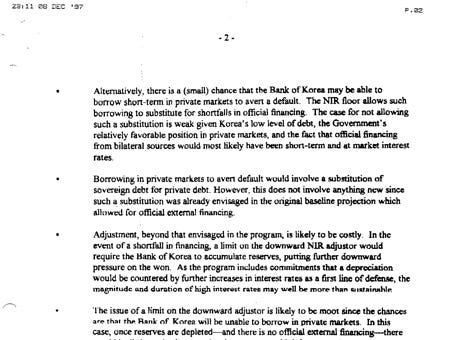
The fax at 11:11 p.m.: “a substitution of sovereign debt for private debt… already envisaged in the original baseline projection” — and, two bullets down, the argument for it: further adjustment “is likely to be costly.” Same file.
December 12 — $6.4 billion. Kim telephones Clinton with the trophy: “I have signatures of all three candidates.” The transcript preserves the American answer to Korea’s plea for more money now. “Some of our people in the Treasury Department and in large investment houses here in America who have a big stake in what is happening in Korea,” Clinton explains, “are afraid that if we provide more money now it will raise doubts in the international financial markets of the adequacy of the current program.” Read it twice. The fear that counted was the fear of the people with a stake.
Five days later the Fund’s first review of Korea, STRICTLY CONFIDENTIAL, carried the sentence that matters more than anything anyone joked about that winter: “Domestic financial markets were virtually paralyzed last week.”Compliance had not brought the dollars. A company whose bank stops lending can have orders to fill and no way to make Friday’s payroll.
In Seoul, the hospital where Youn Sung Mook takes X-rays prepares its March payroll. He will not be paid.
[Laughter]
December 16 — $5 billion. The Federal Reserve met. Its transcript was sealed for five years. The committee was told that “the exchange markets for the won and the baht have disappeared.” The chairman reached for an image, “the tide coming in for the first time in 20 years, and we find all the junk on the shore,” and then a joke: the crisis could turn on a dime, but “it cannot turn on a baht.” The stenographer wrote down what came next: [Laughter]. In public, nothing.
That night, at 9:22 in the Residence, Clinton took a call from Tokyo. Hashimoto had just met the leaders of ASEAN, China and Korea. The transcript has him report “very strong reservations on the part of ASEAN leaders” about the IMF, and “some sentiment for meetings without the Americans present.” Clinton’s reply is the rule of the year in one line: “there is not enough money in U.S. and Japan combined to stop a run on their currencies unless they put their houses in order.”
December 18 — $3.6 billion. Korea elected Kim Dae-jung, the dissident it had once jailed, president of a country with days of dollars left. In his home region of Cholla thousands danced and wept in the streets. That night Clinton called him. The transcript shows the American president coaching the winner on his first words: reaffirm the IMF deal “before the markets close today.” At the Fund, the same week’s minutes record reserves “coming down toward zero.” They also record the American director’s private verdict on Korea’s guarantee to its foreign banks: “the central bank was paying out at the back door to cover all the rollovers.”
December 24 — $3.2 billion. On Christmas Eve the banks were asked. William McDonough, president of the Federal Reserve Bank of New York, called “the major financial institutions of the world” to a room at 33 Liberty Street. It happened “in this very room,” he said there in 2001. He put it to them that no more public money would go into Korea “if the private sector was pulling its money out.” His method, as he described it, was to tell bankers that “there is no public-sector money to solve the problem; the taxpayer is not going to do this.” The same day the Treasury Secretary, Robert Rubin, formerly co-chairman of Goldman Sachs, announced that the G-7 would advance its money “in the context of a significant voluntary extension of the maturities of existing claims by international bank creditors.” The banks agreed to roll over. The won jumped 23 percent in a session. The taxpayer McDonough meant was American. In March, 134 foreign banks swapped $21.8 billion of short-term loans for new one- to three-year paper. The new paper carried Korean government guarantees and margins of 2.25 to 2.75 points over LIBOR, the rate banks charge each other. A promise from Korea’s state, for a fee, to the institutions that had declined to renew. The banks got a promise. The workers got a payment date. Five days after Christmas, the sealed minutes scheduled Korea’s money like an allowance: sixteen dated instalments, out to November 2000. At bank counters across Korea a gold collection began. Wedding rings, baby rings. Seventeen tons in the first week, and by the widely reported final count some 3.5 million people and about 227 tons. The gold went in one door. The guaranteed paper went out the other.
LEDGER · December 1997. Protected: Morgan Stanley Dean Witter, whose foreign-exchange trading revenues “increased 196% in fiscal 1997” on volatility “including Thailand’s baht.” Chase, with $5.4 billion of Korea exposure and “record corporate finance and loan syndication fees” of $1.14 billion. Korea’s creditors, guaranteed by the state for a fee. Paid: 3.5 million people in gold. Unemployment, 2.6 percent to 7.0. Suicides up 42 percent in a single year, the male rate by 45. Koreans named the era after the acronym: IMF price, IMF food,and the one that hurts, IMF papa, a father who has lost his job.
Who would write the rules
The rules had been asked for. Three days before Camp David, at a breakfast in Vancouver, Mahathir told Clinton: “The only ones who have benefited are the traders who have earned $5 billion while we have lost $30 billion. They win and we lose. We need to regulate currency traders.” The memorandum, SECRET, has the President answer that in the United States “currency trading has become a profession.” And then: “I promise I will follow up on this.” Goh Chok Tong confided that Singapore was “quietly buying Indonesian rupiah,” and had to do it quietly “because the public would question the government’s action.” What Washington followed up with is in the cables.

White House memorandum of conversation, Vancouver, November 24, 1997, SECRET, released in full: “They win and we lose.”
Washington also considered what the crisis made possible. On December 12, the day Kim reported the three signatures, a cable went from the State Department to the Seoul embassy “in a specific request from Treasury Deputy Secretary Summers.” Washington wanted Korea, at the WTO’s financial-services deadline in Geneva, to bind the IMF’s conditions into a permanent trade treaty. Its audience: “over fifty of the major international financial institutions — Korea’s key audience — are now in Geneva observing the WTO negotiations.” And it records what happened when the Americans handed Seoul a marked-up version of Korea’s own offer: “Korea angrily returned a copy of our suggestions, noting that this way of providing U.S. ideas offended its national dignity.” A White House email that New Year’s Eve flagged the argument: the crisis “is in fact opportunity to pursue trade liberalization. IMF conditions best leverage we have.”
Canberra read the same package the other way. A minute of Australia’s National Security Committee, March 17, 1998, SECRET AUSTEO, records “Australia’s actions aimed at modifying aspects of the International Monetary Fund (IMF) package likely to threaten social stability.”
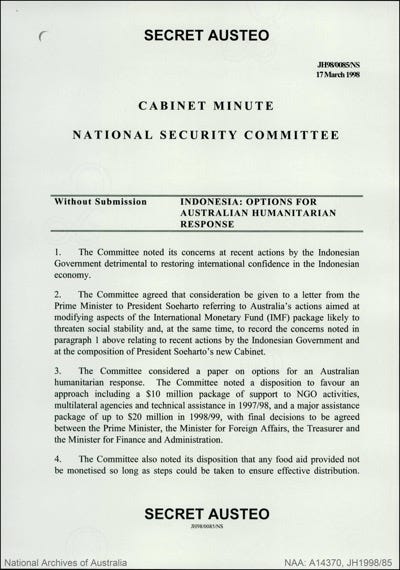
Cabinet Minute, National Security Committee, March 17, 1998, SECRET AUSTEO. National Archives of Australia, A14370, JH1998/85.
London said the quiet part in its own boardroom. On January 21, 1998, the Bank of England’s Court, its board, heard Mervyn King explain why the lenders had lent so cheaply to Korea: “in effect they were lending to the IMF or the G10.” A director, Sir Colin Southgate, answered that there was “a case for refusing to bail them out if they would not open their doors. He approved of the IMF using its leverage to force liberalisation.”
And the system billed for its work. A World Bank folder from February 1998 is titled *Options for FY98 Net Income*. Inside it, the Bank’s acting treasurer tells Wolfensohn that “the U.S. and UK representatives are keen to ensure non-standard pricing” for Korea’s next loan, and recommends he “stand firm.” The approved terms carried a 1.5 percent charge “financed out of loan proceeds.” That is $30 million deducted before Korea saw the money, in a document that lists, among the reforms supported, “the recent legislation legalizing worker layoffs.”
The rescuers were not one mind. They were one system. Its fees, spreads and market access were settled in the same weeks the country receiving the money was drawing it, instalment by instalment.
Their defense is in the file too. Clinton, to the Asian leaders in Vancouver, citing Mexico: “the cost of doing it was far less than the cost of not doing it.” He may have been right. A default in December 1997 would have reached the same hospital and the same sales team first, and faster. The Fund’s economist made the same case in the fax of December 8: financing the shortfall was the lesser pain. The file cannot settle whether a gentler rescue was possible, or whether the banks could have been made to share sooner. It can show who was asked to carry which risk. The banks carried a guaranteed loan at a higher rate. The public carried everything else.
The photograph
The file had seen Indonesia coming. On November 7, a week after the first IMF program, seven American executives had lunch with Talbott in Jakarta. Chase Manhattan’s country officer was among them. They told him that “considerable social unrest is almost certain” around the March presidential selection. They also urged Washington to restore military training for Indonesia’s armed forces. In Vancouver on November 24, in a memorandum marked SECRET, Clinton told Suharto he wanted to support him “with military equipment and training, with the understanding that it will not be used to put down unrest.” And, “as a friend,” that “you will have an incredible legacy when you complete your work.” Suharto asked for an emergency fund, because “if we rely on the IMF alone, we prolong the suffering.” The work was completed for him six months later.

Clinton to Suharto, Vancouver, November 24, 1997, SECRET: “I think you will have an incredible legacy when you complete your work.”
Indonesia’s turn came in January, and it came twice. In public: the rupiah through 10,000. Jakarta’s shelves empty by noon. A Foreign Ministry spokesman insisting the people “keep on moving around, laughing, smiling.” A general declaring the situation “safe and stable” on the day a photographer framed hundreds queueing for cooking oil. In the file, that same January 8, Indonesia’s own representative at the board put a two-page warning into the record, stamped NOT FOR PUBLIC USE. Real interest rates were “punitive.” It was “by no means clear that it is worth throwing the economy into a deep recession in order to prevent further depreciation of the rupiah.” The “welfare of poor people,” if not addressed, “could lead to social and even political unrest.” The board took Indonesia in restricted session. Four months later the unrest arrived.
On January 15 came the signing, and the photograph Part 1 promised: Suharto bent over the paper, Camdessus above him, arms crossed. The file has the second version. At 11:27 that morning, Washington time, Suharto telephoned Clinton: “I believe it appropriate to ask you to make a statement to the world.” Clinton answered, “I will release a statement saying you called me.” Three days earlier, by phone, Hashimoto had told Clinton he had spent “more than 14 minutes” telling Suharto “that he should only say that Indonesia would abide by the IMF agreements and not mention extra things.” He had also described Japan’s own bank rescue that week: thirty trillion yen of public funds; “depositors will be protected in full.” Clinton had called it “a very constructive step.” The banks got a promise. Japan’s depositors got a promise. Indonesia’s poor got a warning, in restricted session. A month later, in the declassified transcript of his February 13 call, Suharto handed Clinton the sentence this series has been building toward: “The Indonesian people see the IMF as a savior too late.”
In Jakarta, a karaoke club called New Mugen closes. A man who sang there for six years starts visiting the employment office. In Seoul, Youn Sung Mook works March without pay, and April.
Seven days
Fuel prices rose at midnight on May 4. Two weeks of unrest followed. A noodle vendor with six children, Yayah Syamsiah, gave the year its line: “Who will listen to us? Ordinary people are crying.” On May 12, at Trisakti University, as the rain cleared toward dusk, security forces shot four students dead. A boy in a white headband told a reporter, “They shot my friend in the back of the neck.” The next evening a US defense attaché cabled what he had heard from a high-ranking Indonesian officer. The report is marked CONFIDENTIAL and “not finally evaluated intelligence.” The troops “were not issued live ammunition but somehow between leaving the barracks and arriving at the demonstration some of them obviously acquired some.” It ended: “It is possible that there are factions within ABRI who are trying to promote chaos.” Jakarta burned. By the 20th, soldiers on a tank beside the stock exchange were waving busloads of students on toward the occupied parliament with a thumbs-up. That Monday night, by the Post’s account, a minister who had to carry the message asked the others, “Please pray to give me the strength to say this to the president.” A scholar summoned to the palace said it plainly: “You should resign.” The man who had ruled for thirty-two years replied, “I’m not going to argue with that.” On the morning of May 21, in under ten minutes, he was gone.
In Seoul, in June, an insurance company lays off seventy-six salesmen. One of them buys a hundred hats.
The bill
Camdessus had promised “a relatively short, but sharp, weakening”. What came was the deepest slump in the region’s modern history. In 2000 the Fund admitted its fiscal targets “were too tight.” Indonesia’s real manufacturing wage fell by about a quarter in 1998.
Now the two ledgers, closed. Protected: the funds, out by August. The trading desks that “made money out of volatility.” The banks that arranged the loans, with their record fees. Korea’s creditors, with a state promise at a higher rate. Indonesia’s best-connected families, relocating to Singapore and Hong Kong while their bank-loan settlements went mostly unhonored; a US embassy cable later put the unpaid share of those loans at “approximately one-third.” Paid:Indonesian taxpayers, who absorbed a bank cleanup costing more than half a year’s national output in public bonds. 3.5 million people in gold. Some twenty-five hundred more Korean suicides than the year before. And four people you met in the last ordinary summer.
Youn Sung Mook, the X-ray technician, sleeping in the lobby of his closed hospital because he could not afford the fare home: “Every aspect of my life has changed.” Kim Myung Yun, 39, ran a sales team at Korea Life until the end of June, when he was laid off with seventy-five others. He had severance, and a plan. He and his brother-in-law bought a hundred hats and sold them from a car, pinned to green mesh with clothespins, on a Seoul pavement. A hat cost four dollars and made a dollar and a half, to be split two ways. On the day the Post’s reporter stood with him, he worked fourteen hours and sold two. After train fare he had cleared about twenty-five cents. Debt had eaten most of the severance and half of a $750 monthly unemployment payment that would stop in December. “I can’t make anything work out.” Zen Zainudin, the singer, on a blue metal bench outside the employment office: “All I can do is try as hard as I can and pray.” Warih Wijayanti, the architect, teaching primary school for $40 a month, down from $135.
None of them mispriced a currency. None of them chose a bank’s funding strategy or earned a fee for arranging anyone’s borrowing. None of them was at Camp David, or in the restricted session, or on the Fed’s line, or among the investment houses with a stake. All of them paid. What the file cannot say is whether any rescue could have spared them. What it says is who was asked to bear which risk. That much is not opinion. It is in the file.
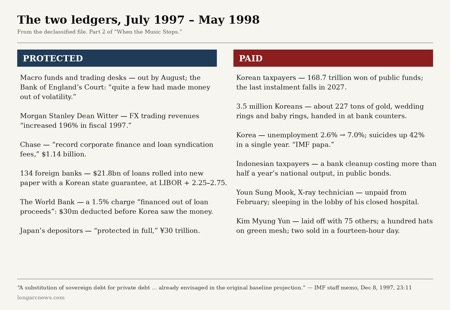
The two ledgers, July 1997 to May 1998: who was protected, and who paid. Every line is sourced in the text above.
The next payment date
This is history, but the bills are not. On September 1, 2026, Korea’s cabinet approved a budget proposal that, in the government’s own words, “completes the repayment of the public funds injected to respond to the 1998 foreign-exchange crisis.” The Financial Services Commission’s count: 168.7 trillion won went in from November 1997. By June 2026, 72.9 percent had come back. The last instalment falls in 2027, thirty years on. In Thailand, the 0.46 percent levy on bank deposits that services the 1997 rescue debt still had some 460 billion baht of principal to clear at the end of August 2026. In Indonesia, the Suharto-era foundation ordered by the Supreme Court in 2015 to repay some Rp 4.4 trillion still carried some $307 million of it in the Finance Ministry’s 2025 accounts, as read for this essay. Three countries, one direction of travel.
To be exact about what was guaranteed and what was paid. The guarantee on the $21.8 billion of rolled-over bank loans was never called; the Korean banks paid the state a fee for it, and by the Fund’s own account the loans were repaid in full by April 2001. The public money was something else: 168.7 trillion won put into banks and the deposit insurer to absorb the losses of the collapse, of which 72.9 percent has come back, and whose last instalment is the one in the 2027 budget. The guarantee protected the lenders from a risk that did not arrive. The public funds paid for the losses that did.
And the doors are the same doors.
The Camp David door. On March 19, 2020, the Federal Reserve opened a $60 billion swap line to the Bank of Korea, one of nine it opened that day as the pandemic hit, as it had first done in the crisis of 2008. It is a different instrument from the loan Korea begged for in 1997, and a different decade. But the substance is the one Kim Young-sam could not get in nineteen minutes: dollars from Washington without a program. The rulebook is unchanged. Five foreign central banks have standing lines; the rest are let in when Washington decides; everyone else posts US Treasury collateral.
The Treasury door. In January 1998 a White House aide wrote that he was “trying to fudge some on the ESF,” the Exchange Stabilization Fund. In October 2025 that fund wrote Argentina a $20 billion swap and bought pesos in the market. Two years earlier, Argentina had paid the IMF in Chinese yuan drawn from a swap line with Beijing. The doctor has a rival now. Beijing’s swap lines have provided more than $170 billion in rescue money, a rival conceived in the rooms above, as Part 3 will show. Which door a finance minister knocks on is now part of every credit decision, and every alliance.
The street. In August 2025 Jakarta’s students were back at the parliament, this time over a housing allowance for legislators of Rp 50 million a month, about ten times the capital’s minimum wage; a motorcycle-taxi driver died under a police vehicle. The president they were protesting to is Prabowo Subianto: Suharto’s son-in-law, the special-forces commander who told an American assistant secretary in November 1997, in a cable marked SECRET, that “the Soeharto era will soon end.” He was dismissed from the army in 1998 amid allegations over the kidnapping of activists, which he has always denied; he was never tried; he was sworn in as president in October 2024. In Seoul, in February 2025, the mint suspended gold bar sales and the vending machines sold out. In 1998 the queue was to hand gold in. In 2025 it was to buy.
Part 1 opened with the AI build-out and the bonds that pay for it. The three questions of 1997 are the same three: who holds the paper, when does it roll, and who is the lender of last resort when it stops rolling. Add the fourth, which is this essay: what do they want in return.
Five things 1997 teaches you to watch, as observation, not advice. Reserves net of forwards, never the headline. The rollover schedule, not the debt total. The interest rate, first casualty of a currency peg. Who the lender of last resort is, and what they want. And every scene happens twice: the file is the information.
You have now read the file, minus the four memos held back. A worker’s overdue wage has a payment date too. When the next rescue is announced, skip the speeches and read the baseline projection. Who pays is usually already in it. Envisaged, in the original.
Part 3: The Counterattack. The territory that refused: Hong Kong’s ten days in August, the $15 billion ambush at the futures expiry, the Malaysian everyone laughed at closing his borders. And an IMF economist’s private email of January 30, 1998, preferring “capital controls” that “would at least impose some costs on foreigners.” Who got paid, and who paid.
The file — read it yourself
The Vancouver memoranda, Nov 24, 1997, SECRET, released in full: Clinton–Suharto and Clinton with the ASEAN leaders; the Deputy Secretary’s Jakarta cables, Nov 7, 1997: Talbott–Suharto (CONFIDENTIAL; Suharto asks for rules and a tax on currency trading, Talbott asks him to stop an Indonesian oil deal with Iran) and the American business lunch; Talbott’s Nov 12 meeting in Tokyo, where the US position on an Asian fund is set down — “concerned with anything outside the IMF, even with ‘linkage’ to IMF conditionality.” All from State Department litigation release F-2017-13804. The Defense Intelligence Agency report on Trisakti, May 13, 1998, via the National Security Archive. Australia’s National Security Committee minute, March 17, 1998, NAA A14370, JH1998/85. The present day: Federal Reserve press release, March 19, 2020; Congressional Research Service, U.S. Financial Support to Argentina (R48780); Al Jazeera, July 17, 2023, and Yale SOM’s account of the yuan payments; IMF, Review of Charges and the Surcharge Policy, October 2024; JAKARTA 006622, Nov 10, 1997, SECRET, released in full, via the National Security Archive; CNN, October 20, 2024; University of Melbourne, Indonesia at Melbourne, on the August 2025 protests; CNBC, March 6, 2025, and the Korea Times, February 2025, on the gold shortage. The Christmas Eve meeting: William McDonough’s own account (PBS interview, April 17, 2001), the Federal Reserve’s history essay (Carson and Clark, 2013), and Treasury statement RR-2131of December 24, 1997; the bankers present are not named in those records. The CIA’s National Intelligence Daily, Special Analyses, “How a Coping Scenario Could Unravel,” Nov 19, 1997 (PASS NID 97-0269CX; Top Secret; released Feb 4, 2009). The presidential calls: Nov 27, 1997, Camp David (State Department release, 2019; also in Clinton Library MDR 2016-1056-M); Nov 28, Clinton–Hashimoto (cable STATE 227100); Dec 3 (cable STATE 230759; also Library item 118553); Dec 12, Dec 16, Dec 18 and Jan 12, 1998 (Clinton Library). The Talbott–Yoo memorandum, Dec 11; the Talbott–Mar’ie cable, Nov 6; the WTO talking-points cable, Dec 12 (STATE 232229). The IMF’s open-session Korea minutes of Dec 9 and Dec 19; the Korea staff paper, EBS/97/222; the first review, EBS/97/237; the Asia department’s Korea crisis file for December 1997 (Lissakers Dec 5, Coorey and Fisher Dec 8, Leddy Dec 9; declassified 2019) and its Indonesia filefor January 1998; BUFF/ED/98/4, the Indonesian statement of Jan 8, 1998; Australia’s Aug 18 statement on Thailand; the Dec 30 allowance schedule. The World Bank Group Archives folders 30489567 (Korea pricing, Feb 1998) and 30488850 (Nov 1997), and Report P-7225-KO. The Bank of England Court minutes for Sept–Dec 1997 and Jan–May 1998. The White House communications file (MDR 2014-0154-M). The Federal Reserve’s Dec 16, 1997 transcript. The National Security Archive’s Indonesia collection.
Standing on shoulders: Blustein and Chandler’s Christmas-rescue reconstruction; Richburg’s “Seven Days in May”; the New York Times’ “Global Contagion”; Mary Jordan’s and Kevin Sullivan’s street reporting.
A note on the records
What this part adds. As far as I can find, these records have not been quoted before: the Camp David transcript of November 27, 1997; the Vancouver memoranda of November 24; the Deputy Secretary’s Jakarta cables of November 1997; the December memos in the Fund’s Asia department file; the CIA’s daily brief of November 19; Australia’s National Security Committee minute of March 17, 1998. The connections are mine, and readers should weigh them as such: the finance minister’s “no need” and the CIA’s “may be insufficient” on the same Wednesday; a White House aide’s “leverage” beside Canberra’s “social stability”; the fax of December 8 beside the room on Christmas Eve. The reserves table is a projection under stated assumptions, not a record of what happened.
The presidential memoranda were prepared by White House notetakers; the IMF minutes are summary records; quotations reproduce the records’ wording, checked against the scans; cable text, printed in capitals in the originals, is set here in ordinary type. CONFIDENTIAL, SECRET and STRICTLY CONFIDENTIAL are the markings on the originals; NOT FOR PUBLIC USE is the IMF’s filing stamp, not a security classification. The Nov 28 call survives as a State Department cable of the White House text, dated Dec 4; it prints no call time. The Dec 11 Yoo memorandum gives Korea’s usable reserve as ten billion dollars in one paragraph and five billion in another. The IMF staff reserve table is a projection under stated assumptions (30 percent rollover, $1 billion a day falling due), not a record of what happened; the “substitution of sovereign debt for private debt” memo frames Korea’s problem as liquidity, not overspending, and argues for financing it. The two 2008 embassy cables are leaked texts published by WikiLeaks; the convictions they describe are confirmed by the Indonesian court reporting linked in the text (the embassy’s bribe figure, $600,000, differs from the court’s $660,000). No individual is described here as guilty of anything a court did not find. The Korean budget line is the government’s own wording, translated; the budget was a proposal at the time of writing. The Supersemar balance for 2025 comes from the Finance Ministry’s audited Treasurer’s statements as read by the research lane, not yet re-opened by the author.
Notes and sources
1. Korea’s creditor deal: 134 banks, $21.8 billion, one- to three-year loans, 2.25–2.75 points over six-month LIBOR, Korean government guarantee — per the IMF’s Korean Crisis and Recovery (ch. 2), the Korea Development Bank’s 2004 SEC prospectus (pp. 76–77) and IMF Country Report 00/11 (p. 31). The guarantee was never exercised; by the IMF volume’s account (ch. 12) the exchanged loans were repaid in full, without default, by April 2001; the guarantee fee was paid by the Korean borrowing banks to the Korean state, not by the foreign creditors. The guarantee fee (about $150 million, 0.2–1.5 percent a year, paid by the banks to the state) is Kim and Byeon’s account in the same IMF volume, written from ministry records. Wall Street bonuses: $11.2 billion for 1997 — New York State Comptroller series. Jaguar’s 72 percent is gross and whole-fund; no full-year figure is an Asia profit. Morgan Stanley Dean Witter and Chase figures are the firms’ own global disclosures (1998 Annual Report, p. 30; 8-K of Jan 21, 1998); neither is an Asia profit figure.
2. The open-session minutes: the “$65 billion plus about $50 billion” exchange (with staff’s caution about possible double counting) and the interest-rate ceiling are on printed pages 3–5 of the Dec 9 minutes. The restricted-session debate of Dec 4 remains unrecorded; EBM/97/115 (Dec 3) contains no Korea discussion.
3. The Korea crisis file (IMF Archives, Asian and Pacific Department Director’s Office Files – Asian Crisis, Box A8-047, file 6): Lissakers to Kwon, Dec 5 (PDF p. 28); Coorey to Neiss, Dec 8 (pp. 135–136); Fisher to Boorman, Dec 8, with table (pp. 138–140); Leddy, Dec 9 (pp. 110–116); all STRICTLY CONFIDENTIAL or SECRET, stamped DECLASSIFIED. Four further memos in the file — “Korean Loan” (Fischer, Dec 2), “Meeting with Executive Directors” (Dec 9), “Indonesia and Korea” (Dec 9) and “Korea – Contingency Planning” (Leddy, Dec 9, SECRET) — remain withdrawn; their withdrawal notices are in the file.
4. “Virtually paralyzed”: Korea first review, EBS/97/237, printed pages 10–12; the staff continued to support the program.
5. Dates the record disputes: Taiwan’s move (mid-October); Korea’s request (announced the night of Nov 21; the IMF’s chronology says the 20th); the won’s limit-down (Nov 19, per the Post; the Bank stopped defending it on the 17th); Trisakti’s first-day toll (five reported, four established); several Washington Post archive pages display one date while their URLs carry the next day.
6. The suicide figures: roughly 6,000 deaths in 1997 to 8,600 in 1998 (≈42 percent) and a 45 percent male-rate increase (Chang et al., 2009; Korean statistics reporting). Unemployment: 2.6 percent (1997) to 7.0 (1998), annual averages, Korea’s SEC filing. Indonesian real manufacturing wages: about −25 percent in 1998, ILO Employment Report 3. These figures have separate populations and measures; their juxtaposition establishes different outcomes, not a traced transfer between individuals. The gold campaign: the Deseret/Reuters report is from its first week (17 tons); the final figures (about 227 tons, some 3.5 million participants) are the widely reported totals.
7. Indonesia’s cleanup cost (56.8 percent of GDP, gross) is the Laeven–Valencia IMF database; the settlements’ performance is the IMF’s 2002 review; elite relocation is contemporaneous reporting and does not establish individual transfers.
8. Who would write the rules: the WTO cable (STATE 232229, Dec 12, 1997, CONFIDENTIAL, declassified; cleared “TREASURY:LSUMMERS”; it says the US asked Korea only to bind “that which it has already agreed to do”); the Blinken email (Dec 31, 1997, unclassified) and Jan 6, 1998 memorandum (CONFIDENTIAL); the foreign-ownership ceilings in EBS/97/222. The World Bank’s pricing: folder 30489567 (”Options for FY98 Net Income,” Feb 24–27, 1998) — Wheeler to Wolfensohn, Feb 26; Won to Aiyer, Feb 25; the Feb 17 pricing note (Directors’ proposals had ranged to “LIBOR+500bps”); Report P-7225-KO (Mar 19, 1998). The Bank’s stated reason for the pricing was its own risk-bearing capital, not profit; the words about earnings are its own, describing the December loan. Severino’s Nov 24 letter is in folder 30488850; Fischer’s Jan 7 memo is cited from the Clinton Library release.
9. Participant-recalled dialogue (the Madjid–Suharto exchange) is printed as attributed recollection. The Clinton–Suharto lines are from the declassified telephone records.
10. The bills today: FSC release of July 21, 2026, and the Ministry of Planning and Budget’s FY2027 proposal (Sept 1, 2026); Bank of Thailand FIDF status table, Aug 31, 2026, corroborated by the Public Debt Management Office and a Bangkok Post report of 478.177 billion baht at March 31, 2026 (an 18 billion baht transfer intervened); The Nation, Nov 6, 2025, for the levy and the six-versus-ten-year expectation; detik.com and ANTARA (2018) for Supersemar; LKBUN 2025, pp. 165 and 489–490, for the 2025 balance. The live wires are reported, dated figures from the linked sources and illustrate funding arrangements without assessing the countries involved as of publication. Nothing here is a forecast or a recommendation.