


THE VALVE, II
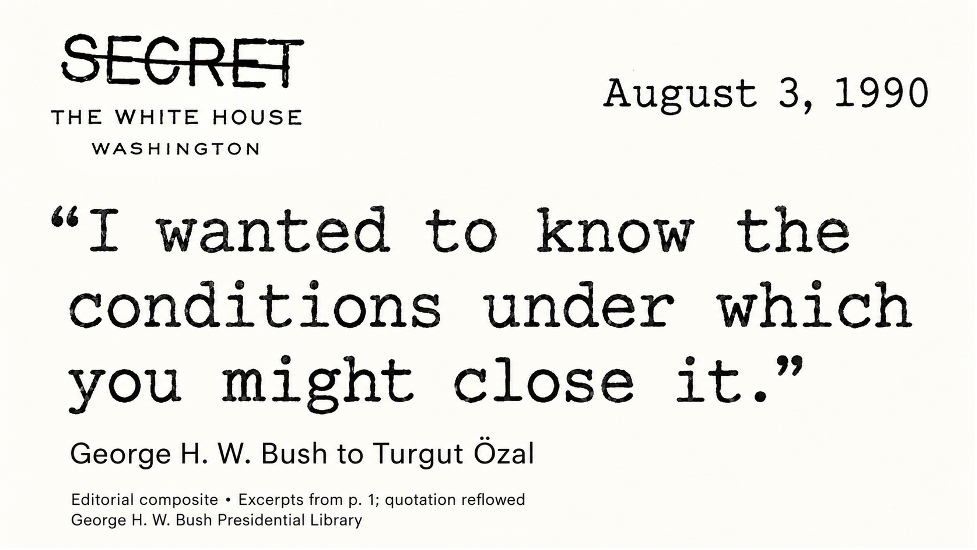
Bush asks Özal about closing the pipeline, 3 August 1990. Editorial composite; quotation reflowed.
Source: George H. W. Bush Presidential Library, telephone memorandum, p. 1.
At 1:58 in the afternoon on 3 August 1990, George H. W. Bush called Turgut Özal from the Oval Office. Iraq had invaded Kuwait the day before. Bush had already spoken to King Fahd about the Saudi pipeline. Now he wanted to know what Turkey would do about the line carrying Iraqi oil to the Mediterranean.
“I wanted to know the conditions under which you might close it.”1
Baghdad had signed for that line seventeen years earlier to loosen Syria’s hold over its exports. The oil would cross a different border, reach a different stretch of coast. Now the American president was asking the government at that coast what it would take to stop it.
Two days later, Özal told Bush that an Iraqi envoy had asked him to keep the pipeline open. He had said Turkey would have to obey the United Nations.
“I did not say we wouldn’t close it.”1
Özal wanted a binding UN decision. He pressed for strong sanctions, knowing Turkey’s trade and pipeline income would suffer. On 6 August, the Security Council adopted resolution 661. Turkey reported the line shut as of the following day. Its foreign minister later told parliament how it had happened: Turkey stopped loading at Yumurtalık, informed Baghdad, and “thereupon Iraq stopped pumping”.1
The decision travelled inland from the sea.
For years, Baghdad had built towards other coasts to escape the Syrian valve. There was a price for each escape, agreed while the oil was expected to flow. One of those bargains contained a promise about the years when it did not.
The price appears on a sheet sent to the World Bank in July 1973. A petroleum consultant had compared tanker journeys to Europe from the Gulf with journeys from the eastern Mediterranean. Under his assumptions, the shorter Mediterranean routes saved between 36 and 60 cents a barrel in freight.2
The map offered Baghdad a reason to go north. Syria supplied another. Its January agreement had raised the all-in transit cost to 41 cents a barrel. On 27 August, Iraq signed for a Turkish line with a stated transport charge of 35 cents. The two arrangements were not identical, but Turkey offered another coast and another government to negotiate with.2
Turkey undertook to keep the oil moving and to load and export it as Iraq required. Iraq undertook to ship “not less than fifteen million metric tons” a year. Except in cases of force majeure, it would pay for that minimum even if fewer tonnes arrived.2
Before there was oil in the line, there was a promise to pay for its absence.
Iraq was also building south. Its strategic line connected the northern fields with the Gulf. In January 1976, the American mission in Baghdad reported the Iraqi press’s announcement of the first Gulf cargo of northern crude. The mission expected Baghdad to press Syria to renegotiate transit fees.3
On 9 April, Iraq cut off oil to Syria.
A supply agreement for 50,000 barrels a day had expired; price and transit fees remained unsettled. Thirteen days after the cutoff, the President’s Daily Brief told Gerald Ford that Damascus was being forced to seek crude elsewhere. An American cable had already reported a Syrian mission seeking Saudi supplies for the Homs refinery via Sidon and Baniyas. The country with the Mediterranean terminal was looking for oil to bring into it.4
Syria still had the river. Withholding Euphrates water, Ford’s analysts thought, “would be the most obvious and effective way” to press Iraq to resume deliveries. They had no indication that Damascus had done so.4
The new southern route had given Baghdad more room to act, though the analysts also considered other motives for the cutoff, including Syria’s policy in Lebanon. Then the Turkish route arrived. Süleyman Demirel attended ceremonies at Kirkuk and the Turkish terminal in January 1977. On the CIA’s map for the president, the addition was labelled simply “New pipeline”. A May cable reported an announcement that the first shipment would load on the 25th.4,5
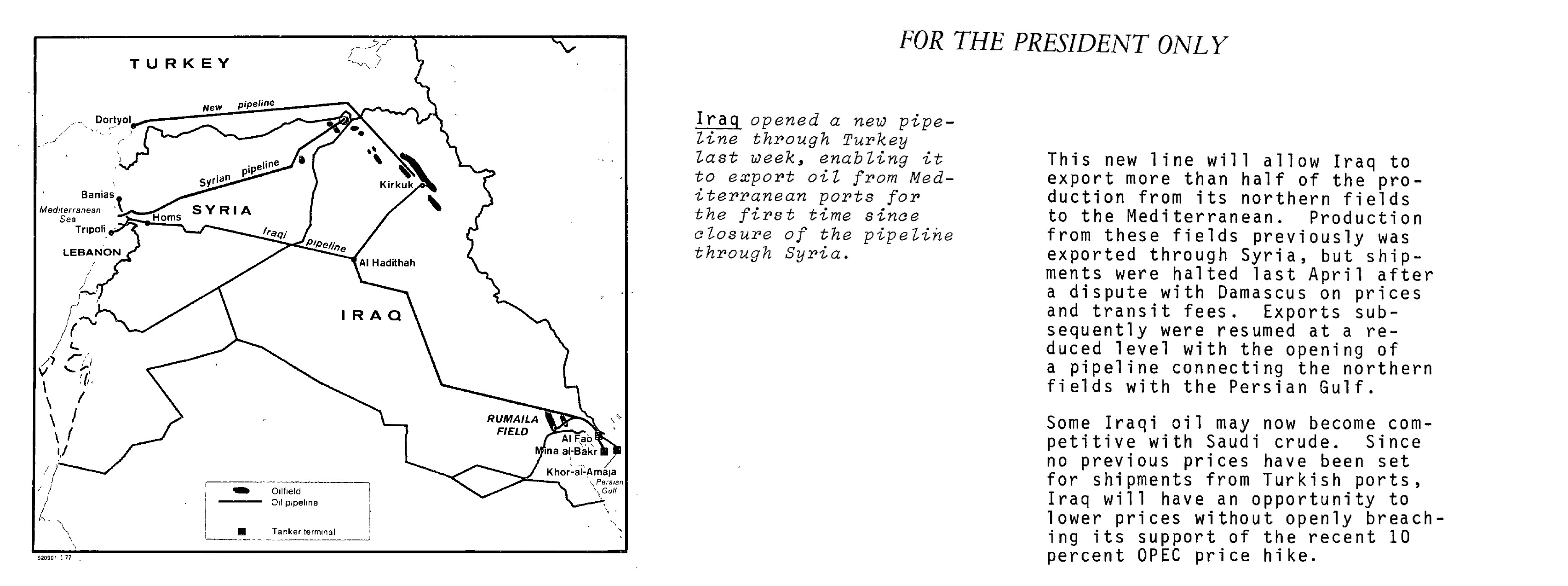
A second Mediterranean outlet. The CIA’s map and briefing item, 15 January 1977. Two cropped leaves from the same President’s Daily Brief; full references in the image credits.
By March 1978, the American mission was reporting Iraq opening and closing the new line. Turkish sources read the interruptions as pressure over unpaid oil bills. Baghdad could make the oil stop too.6
And it still wanted Syria. American cables reported an agreement on 9 February 1979 and reopening on the 24th. The mission explained why a line running at a fraction of its capacity could matter: “Another export outlet, and the flexibility it provides, is of greater overall importance than the amount of oil flowing through it.”7
Iraq lost its Gulf outlet early in the war with Iran. In April 1982, while receiving Iranian crude, Syria closed the line to Baniyas. The CIA called it “a measure Damascus had taken several times in the past”. This time the line had been carrying about 45 per cent of Iraq’s exports, and the Gulf could no longer take the displaced oil.8
Turkey was left with the burden: capacity of about 700,000 barrels a day for a country that had exported more than three million before the war. The agency projected a $6 billion revenue loss from the Syrian closure in 1982. In its table, zeros appeared against routes that had carried millions of barrels.8
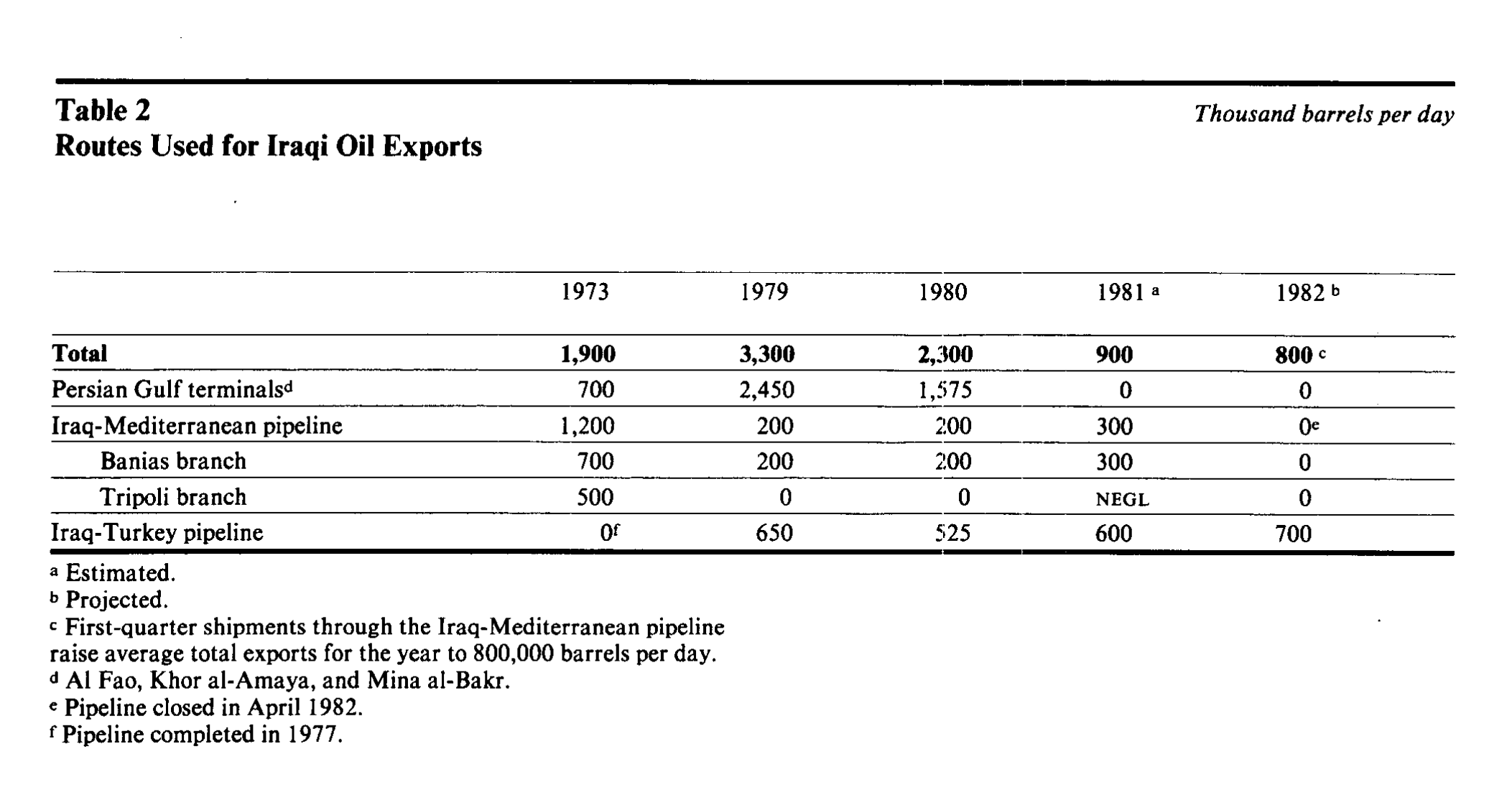
The routes narrow. CIA, “Iraq: Alternative Trade Routes”, September 1982, Table 2, thousand barrels a day. The 1981 column is estimated and 1982 projected.
Reopening Syria looked simple on the map. In the diplomatic files it ran through other wars. A British briefing for Margaret Thatcher’s February 1983 meeting with King Hussein said: “We see no chance of Syrians re-opening pipeline. This would be the most effective way of bringing Iran to negotiating table.” In Washington that November, Robert McFarlane weighed the relief to Iraq against the risk of putting Saudi Arabia further in Syria’s debt and weakening American efforts in Lebanon.9
On 20 December, Donald Rumsfeld met Saddam Hussein in Baghdad as Reagan’s envoy. They discussed a line across Jordan to Aqaba. Saddam wanted both the Jordanian and Saudi projects. Rumsfeld agreed, the cable recorded, “that one did not want to be dependent on only one route”.10
The next morning, in King Hussein’s suite at Claridge’s in London, the king asked whether his pipeline had come up. Rumsfeld described Baghdad’s fear of an Israeli attack. Iraq remained interested, especially if the arrangements could make the line “a complicated target”.10
Iraq and Jordan might agree on every mile of pipe, every cent of tariff, and still leave Israel outside the bargain. The loans would remain after an attack. Baghdad wanted to know who would carry them.
At a meeting with Bechtel, the State Department’s James Placke said: “Ultimately, we cannot be the guarantors of the behavior of another government.” In July 1984, Iraq sought relief from interest on the construction loans if Israel attacked. By September, the CIA judged that Baghdad’s leaders appeared willing to build only if the United States and the West would “assume all risks”.11
Iraq had promised Turkey income if the barrels fell short. At Aqaba, it wanted protection if the route itself failed.
There were offers, each with conditions attached. The Export-Import Bank approved a commitment in June 1984 to guarantee financing of up to 85 per cent of the $570 million requested. Shimon Peres’s November 1985 letter offered to negotiate guarantees against unprovoked Israeli action. The terms remained to be agreed.11,12
In a memorandum to Attorney General Edwin Meese, Robert Wallach wrote that financier Bruce Rappaport had said Israel would receive $65–70 million a year for ten years, with some money going to the Labor Party. Rappaport denied offering party money or telling Wallach such a payment was contemplated. Independent Counsel James McKay later found no witness or document confirming that a payment to the party had been authorised, offered or promised. He treated the allegation as hearsay; the evidence was insufficient to prove a Foreign Corrupt Practices Act offence by Meese beyond reasonable doubt. No charge was brought.12
As the papers accumulated, Iraq’s other routes advanced and the oil market weakened. Baghdad’s interest ebbed. Israeli risk was a major obstacle among several. The Aqaba pipeline was never built.12
It kept returning on paper. Jordan and Iraq signed principles in 2013 and revived the project in 2019. In April 2022, Iraq’s oil ministry said no contract had been awarded. Later that month, a report attributed opposition to Basra tribal figures who feared the line would carry oil to Israel.13
While Aqaba was still being negotiated, Iraq was enlarging its route through Turkey. In July 1985, the two governments agreed a second line and raised the guaranteed minimum to 35 million tonnes a year, subject to force majeure and the agreement’s adjustments. The Saudi route began operating that year. The CIA wrote the next May that much of Iraq’s expansion programme was “hostage to Saudi willingness to provide access to the Red Sea”.14
These were the routes Bush was asking about in August 1990. The war for which Iraq had needed them was over. Iraq’s invasion of Kuwait had turned access to the sea into part of the sanctions against it.
By 30 August, Özal was telling Bush about a border meeting over trade and unpaid accounts. Iraq owed Turkey $741 million for pipeline exports, he said, and had offered “say, $2 billion”. He called the excess a $1.3 billion bribe. The call records no payment or agreement to reopen the line.1
Saudi Arabia later told the UN that it had “disconnected and blocked both ends” of its line immediately after the invasion. Iraq dated the halt to 13 August. The governments disagreed over when the oil stopped. It did not resume.14,15
Oil returned to Ceyhan in December 1996 under Oil-for-Food. The UN authorised the exports and provided for Turkey’s pipeline charges to be paid from the proceeds. By April 2003, the escrow account had paid Turkey $1.2 billion under the programme.15
On 4 June 2001, Riyadh told the Secretary-General that the pipeline, pumps, tanks and terminal would revert in their entirety to the Saudi government. Iraq called it unlawful confiscation. Baghdad’s investment was still there, on Saudi soil, carrying no Iraqi exports.15
By then, the old Syrian route was running again.
Eighteen years after Damascus closed it, the two governments had found a use for each other’s predicament. Under a protocol negotiated in May 2000, the Iraq Survey Group later reported, Syria bought crude at roughly six dollars below the authorised price. Sixty per cent of the proceeds went to trade, 40 per cent to a cash account. The arrangement let Iraq earn outside the UN programme and Syria obtain discounted oil.16
British intelligence noted the reopening on 23 November. The next day, an American cable from Ankara anticipated Turkey’s response: the Syrian line would compete directly with its own, and Turkey would likely seek more relief for sanctions losses.17
Colin Powell left Damascus in February 2001 saying Bashar al-Assad intended to bring the pipeline under UN control. They had returned to the point three times. “The ultimate test of seriousness,” Powell said, “is when we see something happen.”18
The oil kept moving outside the programme. Tony Blair proposed pressure to close the line in December 2001. The following May, the State Department said it was the wrong time for proposed Syria sanctions legislation. In the Survey Group’s later accounting, Iraq received $2.814 billion under the Syrian protocol in 2000–03, a total that included tanker-truck deliveries as well as the pipeline.16,18
On 9 April 2003, a State Department task force report described pipeline installations burning near K-3 at Haditha, the junction of the reversible strategic line. Destruction of the station, it said, would prevent southern oil reaching the pipelines through Turkey and Syria. In May, Ruba Husari reported a North Oil Company survey saying K-3 had been destroyed by bombardment in the first week of April. Twelve staff had been killed, according to the survey.19
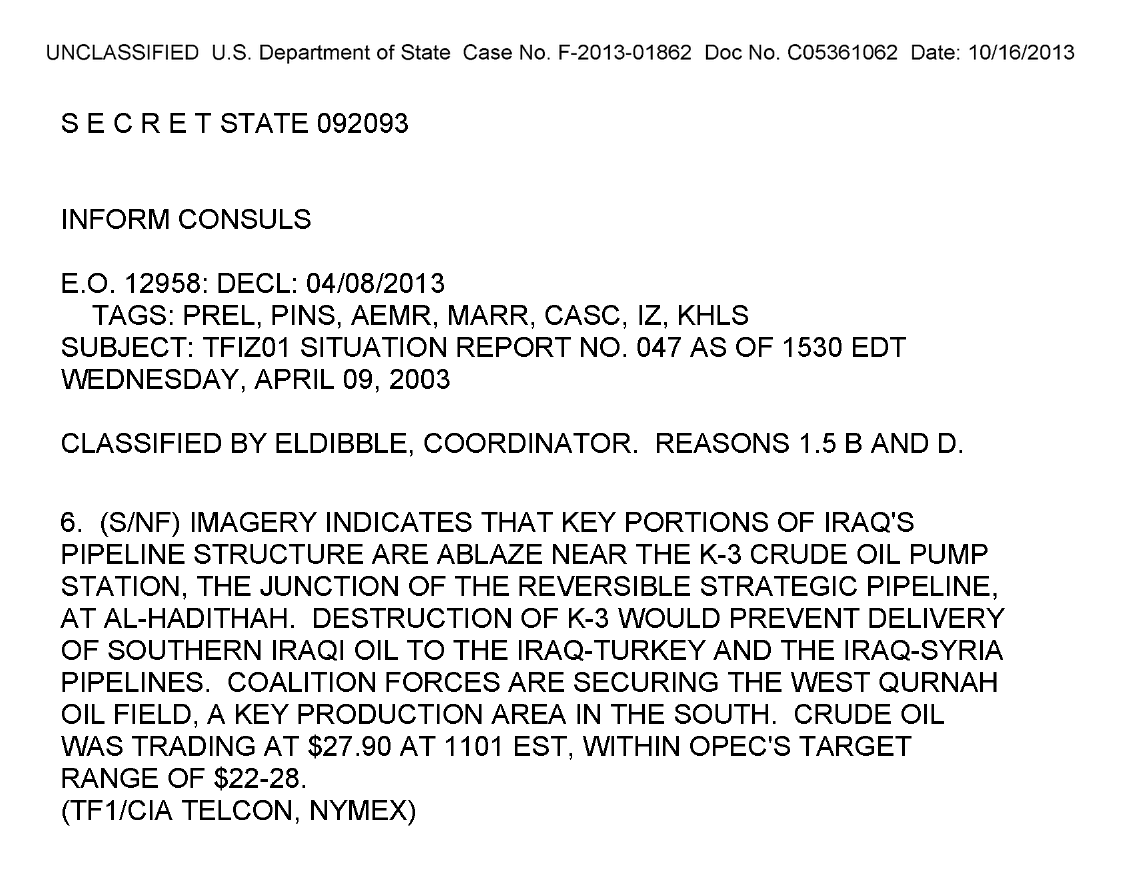
Near K-3, April 2003. State Department situation report no. 047: the subject block and paragraph 6, assembled from pages 2–3. The report describes imagery and the possible effect of destruction.
Rumsfeld, who had discussed Iraq’s need for another outlet with Saddam twenty years earlier, was now secretary of defense. Asked about the Syrian line on 15 April, he said: “We do not have perfect knowledge. We do know that they were instructed to shut it down, and they have told us that they have.” A Syrian industry source had already reported pumping stopped by 1 April. The surviving accounts do not settle the sequence. The written instruction has not been located.19
The next day, PBS quoted Syrian foreign-ministry spokeswoman Buthaina Shaaban: “We lived without the Iraqi pipeline for 20 years. We can live without it for 20 years. It’s not a problem.”19
The line stayed closed. A preliminary agreement with a Russian contractor did not restore service. In 2009, an Iraqi ministry spokesman said the company had failed to do the work. In the American energy agency’s 2021 table, Kirkuk–Baniyas was still marked “Not operating”.19
In May 2014, the Kurdistan Regional Government began loading its own crude at Ceyhan independently of SOMO, Baghdad’s oil-marketing company. Turkey loaded the oil despite Baghdad’s instructions. Iraq took the dispute to arbitration.20
The award came on 13 February 2023. The tribunal found Turkey had breached its obligations and awarded Iraq almost $2 billion before interest.20
But the same agreement also contained Iraq’s promise about volume. Turkey won about $527 million on its counterclaims. Nearly $349 million concerned minimum-throughput charges, the shortfall between the oil Iraq had undertaken to send and the oil it had sent. The tribunal allowed exceptions, including force majeure for the war period from March 2003 to July 2007.20
The old agreement could make Turkey answer for loading oil against Baghdad’s wishes and make Iraq answer for oil that never arrived.
There was older money in the award too. Unpaid 1990 transport invoices and a tariff-band adjustment accounted for about $129 million, with interest running from 1 January 1991. These were charges for services supplied, not payment for the idle years of the embargo. Accounts from the year of Bush and Özal’s calls had reached the tribunal more than three decades later.20,21
After the set-offs, the award specified $1.471 billion to Iraq, subject to interest adjustments.20
On 25 March 2023, Turkey halted flows. The last Kurdish cargo had loaded the previous day. An April trade report linked Ankara’s delay to demands for assurances over a second arbitration. The line stayed shut for thirty months, reopening on 27 September 2025.21
They were still arguing over the interest. By September 2026, Iraq’s expert put the net amount owed to Iraq at $565 million; Turkey’s expert put it at $912 million owed the other way. In a recommendation to the federal court in Washington, a magistrate judge rejected Turkey’s principal method and read the award as requiring payment to Iraq. He declined to endorse a final sum.21
During the March 2026 disruption in the Strait of Hormuz, Iraq had only a few days of crude storage available, the International Energy Agency reported. Baghdad announced shut-ins at Rumaila, West Qurna-2 and Maysan amounting to nearly 1.5 million barrels a day. When the tanks fill, the wells have to stop.22
The Turkish route resumed later that month. The agency put flows at about 80,000 barrels a day in March, rising to 190,000 in June. It could relieve only part of the pressure.22
Syria offered a way through again. On 1 April, according to the Syrian Petroleum Company, the first Iraqi fuel-oil consignments crossed at al-Tanf and reached the refinery tanks at Baniyas for shipment. They came by road. By late September, a company official was describing a thousand to twelve hundred tanker trucks a day.23
New memoranda proposed rebuilding the pipeline. June and July announcements covered rehabilitation and technical and financial studies, with Chevron, UCC Holding and TI Capital named in the July consortium arrangements. Two million barrels a day was the proposed scale. The trucks were moving; the new pipeline remained in memoranda and studies.23
A Syrian Petroleum Company official said transit fees would bring foreign currency to the treasury. IMF staff separately listed fuel transit fees among one-off revenues, without identifying income from this corridor. Neither account disclosed what Syria charged for the Iraqi corridor per tonne or truck.23
In Turkey, the agreement that began in 1973 had reached its end. Ankara’s notice terminated the old framework on 27 July 2026. Five days later, the companies signed a one-year replacement.24
Turkey’s public account allocated 750,000 barrels a day of capacity to SOMO and North Oil Company. SOMO called 750,000 a minimum export quantity. It was a familiar number: the tribunal had described the former 35-million-tonne annual minimum as roughly equivalent to that daily volume. Whether the new agreement carried forward the obligation to pay was not disclosed.24
Iraq’s oil minister said the temporary arrangement would last until a wider framework covering oil, electricity and water resources was complete. The published statements supplied no formula for exchanging oil for water.24
In August, SOMO reported about 127,000 barrels a day exported through Ceyhan, roughly a sixth of the quantity in the announcements.24
Under the new agreement, must Baghdad pay when the barrels do not come?
Source notes
These notes identify the sources and the limits of the evidence. A primary document establishes what its author recorded; an intelligence judgment, diplomatic report or company statement does not by itself establish the underlying event. Evidence labels distinguish documented wording, reported claims, estimates and interpretation.
Descriptions and quotations from eight NARA cables rely on research transcriptions that have not been independently compared with the archival copies: Damascus 2361 (19 April 1976); Baghdad 89 (27 January 1976), 887 (24 May 1977), 469 (4 March 1978), 2311 (6 November 1978), 374 (15 February 1979) and 440 (25 February 1979); and Adana 2 (6 January 1977). The archive links are provided with the citations.
1. August 1990.
REPORTED CLAIM for the conversations, VERIFIED FACT for the Turkish note. Minutes of the NSC meeting of 2 August 1990, pp. 8–10: “That’s why closing the pipeline is important.” Bush–Özal telcons of 3 August, 5 August and 30 August 1990, George H. W. Bush Library via the National Archives catalog: “the conditions under which you might close it”; the Iraqi envoy’s plea and “I did not say we wouldn’t close it”; Özal’s report on 30 August that Iraq owed Turkey $741 million for oil exports through the pipeline and had offered, “say, $2 billion”; “That would be a $1.3 billion bribe!” was Özal’s description of the rounded excess (p. 2). The call records an offer reported after a border meeting, not a payment, an acceptance or an explicit agreement to reopen the pipeline. Bozer to the Grand National Assembly, 12 August 1990, printed p. 431 (PDF p. 19): a decision to halt loading at Yumurtalık, conveyed to Iraq, “Müteakiben Irak, ham petrol pompalamasını durdurmuştur”; our translation. Turkey’s note to the UN, S/21514, 14 August 1990: “Measures taken by Turkey as of 7 August 1990… (d) The oil pipeline between Turkey and Iraq has been shut down.” The CIA’s weekly of 10 August 1990 put the two lines at “nearly 60 percent and 30 percent” of exports. No gazetted Turkish closure decree was found in the Resmî Gazete issues of 5–16 August 1990; the implementing instrument was not located in that search.
2. The 1973 arithmetic.
MODELED ESTIMATE for the freight differential: Petroleum Economics Ltd (W. L. Newton) to T. W. Berrie, 27 July 1973, “Alternative Bases for Assessing the Cost of Kirkuk Crude Oil Delivered to Turkey in 1980 at 1973 Constant Prices”, World Bank Group Archives folder 30045540, 250,000-dwt tanker at Worldscale 65, crude $5.00 f.o.b. Gulf; rows (v) and (ii) give 36 and 60 cents a barrel. REPORTED CLAIM for Syria’s rate: World Bank report 419a-IRQ, 9 October 1974, para. 24, the January 1973 agreement raising transit cost “from US$0.23 per barrel… to US$0.41 per barrel” all-in. VERIFIED FACT for the treaty: Crude Oil Pipeline Agreement, Ankara, 27 August 1973, Resmî Gazete 15268 (17 June 1975), facsimile at pp. 466–470 of the Energy Charter collection: Article 7, 0.35 US dollars a barrel (page image; the PDF’s text layer misreads it as 0.36); Article 11, “not less than fifteen million metric tons” and the payment floor save force majeure; Article 12(1), Turkey’s undertaking to take all required measures for continuous flow, terminal loading, and ensuring and facilitating exports in accordance with Iraq’s requirements; Article 22, twenty years. The table first compares freight from the Persian Gulf and the eastern Mediterranean to European destinations to estimate the eastern Mediterranean price premium. Row (v) uses a Cape/Suez voyage to north-western Europe; row (ii) a Cape/Cape voyage to south-western Europe. Section C then adds freight from the eastern Mediterranean to Turkey. This is a conditional model of 1980 delivered costs in constant 1973 dollars. The letter expected SUMED to set a differential of about 50 cents a barrel. These estimates do not establish a universal ceiling on transit charges.
3. The strategic line and the expected squeeze.
REPORTED CLAIM. Baghdad 89, 27 January 1976, Wiley: the line inaugurated on 20 December 1975, the first Gulf cargo of northern crude announced by the Iraqi press on 8 January, and “we would expect them to press Syrians for renegotiation of oil transit fees”. This was a forecast of pressure over fees. The later cutoff does not by itself establish Iraq’s motive or prove that the predicted renegotiation occurred.
4. The cut-off of April 1976.
REPORTED CLAIM, two chains. President’s Daily Brief, 22 April 1976, printed pp. 4–5 / PDF pp. 7–8 (CIA-RDP79T00936A013300010020-7, released 2016): “Iraq cut off oil to Syria on April 9”; the lapsed agreement; the 50,000 barrels a day, read on the page image (the mirror’s text layer misreads it as 90,000); the Euphrates cut “last spring” and the sentence that withholding water “would be the most obvious and effective way” to press Iraq (Iraq–Syria item, final paragraph); the next sentence reports no indication that Damascus had taken that action. Damascus 2361, 19 April 1976, Murphy: the economy minister’s account on 17 April of the Riyadh mission for Saudi crude via Sidon and Baniyas, “this follows April 9 or 10 cut”. The PDB’s reading of Iraq’s motives (price, fees, Lebanon) is the agency’s.
5. The Turkish opening.
REPORTED CLAIM for the ceremonies and cost: Adana 2, 6 January 1977, Demirel at Kirkuk on 3 January and at Gölovası on the 4th, “some $900 million”, 35 million tons a year. President’s Daily Brief, 15 January 1977, map leaf and p. 5 (CIA-RDP79T00024A000400050004-1). REPORTED CLAIM for the first shipment, a forecast and a year: Baghdad 887, 24 May 1977, reporting a Baghdad newspaper’s notice that the first shipment would take place on 25 May, and BOTAŞ, 2015 annual report, p. 14, “the first tanker was loaded in 1977”.
6. Iraq working the Turkish tap.
REPORTED CLAIM. Baghdad 469, 4 March 1978, Peck: “opening and closing as their mood changes” (”according to our sources”); the “signaling dissatisfaction” over arrears is the Turks’ reading as the cable gives it. Baghdad 2311, 6 November 1978, Peck, “Iraqi-Syrian rapprochement: the pipeline question”: “pipelines can be closed for political (Syrian) or other (Turkish) reasons”; a second Mediterranean line as “additional strategic insurance”. An Interests Section’s analysis, not an Iraqi statement.
7. The 1979 reopening.
REPORTED CLAIM, one chain each. Baghdad 374, 15 February 1979: agreement signed 9 February; 8 million tons a year by a Syrian embassy source “for a pipe designed to carry 60 million tons per year and presently able to carry 50 million”; “Another export outlet, and the flexibility it provides…”. Baghdad 440, 25 February 1979: “opened on schedule Feb 24”; an Iraqi source’s 12 million tons. CIA/NFAC memorandum, “Iraqi-Syrian Rapprochement”, 30 May 1979: “about one-quarter capacity”, “stands to gain about $21 million annually”, “flexible and secure routes”. The $122 million for 1975 is the World Bank’s: Report 1975a-SYR, vol. III, 22 February 1980, p. 270, para. 2.56 ($0.41 a barrel on Baniyas oil, $0.30 on Tripoli oil; $135 million with royalties); the CIA’s weekly of 12 October 1978 gives $138 million and 41 cents. The 1979 route split is Table 2 of the September 1982 paper in note 8.
8. April 1982 and the agency’s table.
REPORTED CLAIM. CIA, Directorate of Intelligence, “Iraq: Alternative Trade Routes”, NESA 82-10508, September 1982, information as of 13 August 1982, released 2 September 2008: the key judgments (printed p. iii / PDF p. 4: “a measure Damascus had taken several times in the past”; “restricted solely to the pipeline through Turkey… only about 700,000 barrels a day. Before the war, Iraq exported over 3 million barrels per day”), the “about 45 percent” at closure, the $6 billion estimate for 1982 and the $16 million a day, “Without such alternatives, Iran has a stranglehold over Iraq’s economy” (printed p. 8 / PDF p. 13, Oil Pipelines, opening paragraph) and Table 2, “Routes Used for Iraqi Oil Exports” (same page), whose 1981 column is estimated and 1982 projected. The agency’s July 1982 paper on oil vulnerability dates the Syrian closure to March; the other sources reviewed, including this paper’s own footnote, say April. The Iranian crude to Syria is the NSC paper’s figure (note 9).
9. How Washington and London read it.
REPORTED CLAIM. FCO points for the Prime Minister’s lunch with King Hussein, February 1983, PREM 19/1296, full-file PDF p. 271, Syria, para. 4: “We see no chance of Syrians re-opening pipeline. This would be the most effective way of bringing Iran to negotiating table.” These are prepared briefing points, not a record of words spoken by Thatcher. NSC Energy Briefing Book, “Iraqi Oil Export Options”, November 1983, paras. 4, 5, 12 and 14 (Reagan Library, PDF pp. 75–82): “Two of Iraq’s three prewar oil export routes have been severed, reducing annual revenue by almost three-fourths”; “only one oil export route”; Syria “receiving oil from Iran worth $1.8 billion annually”; the paper, not this essay, characterises the closure as “a move to support Iran”. McFarlane, memorandum for the President on the National Security Planning Group meeting, 5 November 1983, Reagan Library folder 91306-036: the Syrian-pipeline option and the two sentences quoted. INTERPRETATION: McFarlane’s memorandum records competing policy considerations, including Lebanon; it does not by itself establish every action Washington took or a final decision against reopening the line. No American reopening effort was located in the files reviewed; the DCI’s talking points of 27 September 1983 (CIA-RDP85M00363R001102600010-5) confirm the agency’s view of Iraq’s dependence on the Turkish line.
10. Rumsfeld in Baghdad and London.
REPORTED CLAIM, the cables’ own paraphrase of what was said. London 27572, 21 December 1983, National Security Archive EBB 82 doc. 31, para. 19, on the meeting of 20 December: “IN FACT, BOTH PIPELINES WERE IMPORTANT AND IRAQ WANTED TO DEVELOP BOTH. RUMSFELD AGREED THAT ONE DID NOT WANT TO BE DEPENDENT ON ONLY ONE ROUTE.” State 363058, 23 December 1983, doc. 34, para. 4, the King’s suite at Claridge’s on the morning of 21 December: Hussein asked whether a Jordan pipeline had been discussed; Rumsfeld’s answer, as the cable reports it, is that the idea “HAD ORIGINALLY BEEN DISMISSED OUT OF FEAR OF AN ISRAELI THREAT” and that “BAGHDAD IS STILL INTERESTED, ESPECIALLY IF THE PIPELINE INVOLVES ARRANGEMENTS WHICH WOULD MAKE IT ‘A COMPLICATED TARGET’ FOR ISRAEL”. The words are Rumsfeld’s account of Baghdad’s position, not the King’s. Both cables are in upper case; the essay lowers them.
11. Guarantors, Exim and force majeure.
REPORTED CLAIM. NSC Threat Situation Summary for Iran–Iraq, 2 April 1984, Reagan Library R36-048, summarising a State Department meeting with Bechtel at which James Placke said: “Ultimately, we cannot be the guarantors of the behavior of another government.” The Iraqi insistence on American involvement is also in the No.10 records of Thatcher’s talks with King Hussein on 16 February and 17 May 1984 (PREM 19/1296) and Julian Amery’s note of a talk with Saddam on 21 August 1984 (PREM 19/1284, “still hitches over securing an Israeli guarantee”). Exim’s commitment of 19 June 1984 (up to 85 per cent of $570 million) and Iraq’s demand of 8 July 1984 for a force-majeure clause “in the event of Israeli aggression against the pipeline” are as stated in McKay’s report, pp. 590–591, which is a prosecutor’s narrative drawn from the parties’ files. CIA, Directorate of Intelligence, “Iraq: Stalled Jordan Oil Pipeline”, NESA M 84-10263, 12 September 1984: “dim” (summary), the loan condition, “bleak” and “only if the US and the West are willing to assume all risks” (Outlook, printed p. 4 / PDF p. 6). The paper also says the Iraqis were “playing off the pipeline proposals against each other”, which is the agency’s reading of a negotiation it was not party to. McKay also records conditional OPIC and Citibank participation that depended on a viable recovery or salvage package (pp. 673–678, 692–694). The report describes Iraq’s declining interest as Saudi and Turkish alternatives advanced and oil-market conditions weakened (pp. 643–644, 734–736, 811). The Israeli security question was a major obstacle, not an established sole cause of failure.
12. The Washington coda.
REPORTED CLAIM, carried at the Independent Counsel’s level. James C. McKay, Report of Independent Counsel In re Edwin Meese III, 5 July 1988, released 18 July 1988: Wallach’s memoranda of 25 September 1985 and the sentence “a portion of those funds will go directly to Labor” (pp. 43–44); the Counsel’s hearsay assessment and “no witness or document available to the independent counsel has provided any confirmation” (pp. 128–129); “insufficient for a trier of fact to conclude beyond a reasonable doubt that Mr. Meese’s actions in connection with the Aqaba pipeline project violated the Foreign Corrupt Practices Act” (p. 129); “The Aqaba pipeline was never built” (pp. 49, 577). The Peres letter of assurance (20 November 1985), reproduced at pp. 787–788, offered guarantees still to be agreed, expected reciprocal environmental assurances and reserved further discussion before committing the government. McKay distinguishes it from a firmer earlier draft (p. 786). The draft directive on a $375 million escrow remained a proposal (pp. 795–811). Rappaport’s own comments on the report are in the same archive item. The report’s appendix, pp. 270–271 (PDF pp. 274–275), records his denial of offering money to a political party or telling Wallach that such a payment was contemplated. No charge was brought.
13. Aqaba’s echoes.
REPORTED CLAIM. Petra, 16 April 2013: the “agreement of principles”, one million barrels a day, build-own-operate-transfer. Jordan’s Ministry of Energy, 2 February 2019 and its project sheet. Iraqi Ministry of Oil, statement of 17 April 2022: no contract awarded, cost not above $8.5 billion, 200,000 barrels a day minimum, Haditha–Aqaba “the realistic option” because of Syria’s “political instability” and Turkey’s “legal problem”; our translation. ISCI, 25 April 2022: “the gate of normalisation and theft of wealth” and the warning about oil “to Israel”; our translation. Plans and positions, none of them a construction contract. The renewed proposals do not establish that one unchanged Israeli objection caused each later failure to proceed.
14. The other two doors.
VERIFIED FACT for the treaty text: Supplementary Agreement signed at Baghdad on 30 July 1985, approved by Law 3265 of 4 March 1986 (TBMM statutes vol. 69, pp. 399–401): the two-line system expanded to 70.9 million tons a year; a guaranteed minimum of 35 million tons, payable “mücbir sebep halleri hariç”; 75 US cents a barrel to 35 million tons, falling by band to 43 cents at 70.9. REPORTED CLAIM for the Saudi line: Iraq’s letter to the Secretary-General, 12 September 2000, S/2000/869: pumping from 1 November 1985, first IPSA-2 tanker 19 September 1989, halted 13 August 1990, 876 million barrels in all; the CIA’s weekly of 21 June 1985 and Oil & Gas Journal date the first stage to September 1985. CIA, “Iraq: Rebuilding the Oil Export System”, May 1986, p. iv: “hostage to Saudi willingness to provide access to the Red Sea.” The second Turkish line’s August 1987 start is in BOTAŞ’s 2013 report, p. 12, and the CIA’s November 1988 assessment. The minimum-payment provision described here belongs to the Turkish agreement. The cited Saudi records establish access dependence and later shutdown; they do not establish an equivalent Saudi payment floor.
15. Oil-for-Food and the Saudi seizure.
VERIFIED FACT for the texts. Resolution 986 (1995), para. 2: Iraqi oil “to meet the pipeline tariff charges, verified as reasonable by the independent inspection agents… through the Kirkuk-Yumurtalik pipeline”; the first tanker loaded at Ceyhan on 16 December 1996 by Turkey’s own submission to the UNECE (TRANS/WP.5/2002/1/Add.1, p. 18); $1.2 billion paid to Turkey from the escrow by 30 April 2003 (S/2003/576, Annex I). Saudi Arabia’s letter, S/2001/567, 4 June 2001: “disconnected and blocked both ends of the Iraqi crude-oil pipeline immediately after the invasion”; the line “will revert in its entirety to the Government of Saudi Arabia with effect from the date of this letter.” Iraq’s reply, S/2001/588: “unlawful confiscation”, “act of brigandage”. The Turkish planning office’s table shows the line idle from 1991 to 1995.
16. The 2000 protocol.
VERIFIED as to the published report’s wording; REPORTED as to the underlying transactions. Iraq Survey Group, Comprehensive Report, vol. I, Regime Finance and Procurement, GPO edition, printed pp. 25–27: negotiations in Baghdad “from 27 to 29 May 2000”; crude sold at “roughly $6 less than the authorized price”; 60 per cent assigned to a SOMO account at the Commercial Bank of Syria for Iraqi imports and 40 per cent as a cash share. ISG describes the cash route as unclear, with accounts and transfers involving Syria and Lebanon; it does not establish one exclusive Beirut channel (pp. 26, 41–42). Annex A, p. 156, prints the signature line “25 Suffar 1421 A.H., equivalent to 29 March 2000”. That conflicts with the exhibit’s own May negotiation dates and the Independent Inquiry Committee’s 29 May caption. The complete signed Arabic closing page was not recovered, so the discrepancy remains unresolved. Figure 11 gives Syrian protocol earnings for 2000–2003 of $2,814 million; Annex E, pp. 217–218, describes the Syrian figures as actual SOMO collections. The protocol covered crude and products moving by pipeline and tanker truck: this is not a pipeline-only revenue total. Figure 17, p. 218, gives Turkey $710 million over the same years. Paul Volcker’s committee counted $3.13 billion of sales under the protocol, and the State Department cited SOMO’s estimate of $3.4 billion to July 2003 (Dibble, 27 July 2005). These accounts share SOMO source material but use different measures and periods; they are neither independent totals nor amounts to add together. The ISG and IIC translations also differ over whether the 40 per cent cash account was in or outside Syria (ISG p. 155; IIC vol. II, p. 240).
17. “Has just re-opened.”
REPORTED CLAIM, contemporary assessments and later reporting of the timing. JIC assessment, “Iraq: Regional Rapprochement”, 23 November 2000: “closed for 20 years, has just re-opened.” Ankara 7734, 24 November 2000, State FOIA reading room, released in full, para. 6: “DIRECT COMPETITION TO THE TURKISH-IRAQI PIPELINE… ARTICLE 50 RELIEF”. Saybolt’s November 2000 report of “rumors” is Dibble’s account (note 16). The JIC’s “20 years” is loose; the line had been shut since April 1982. Ankara’s paragraph 6 predicts that Turkey was likely to renew its Article 50 request; it does not record that response taking place.
18. The American valve.
VERIFIED FACT for the transcript: Powell, briefing aboard aircraft en route Brussels, 26 February 2001, Washington File reproduction (not compared with an official State-hosted copy): “we went back to this point with the President three times”; “the ultimate test of seriousness is when we see something happen.” REPORTED CLAIM for the rest. Blair’s paper for Bush, “The War Against Terrorism: The Second Phase”, 4 December 2001: “We apply real pressure on Syria to stop the flow of Iraqi oil by closing the oil pipeline.” State Department letter of 24 May 2002 on the Syria Accountability Act, reprinted in the House International Relations Committee hearing of 18 September 2002: “we do not believe this is the right time for legislative initiatives”. The same British file holds the JIC’s July 2001 judgment that Syria was “the largest component of illicit trade” and a Foreign Office director’s admission to the French in February 2002 that Britain “would be unlikely ever to cut off the oil flowing through the Syrian pipeline”. The available flow figures include estimates of 180,000–250,000 b/d in March 2002 (MEES via GAO-02-625).
19. K-3 and the shutdown.
REPORTED CLAIM, each item one chain, describing different objects. State 92093, Iraq task force situation report no. 047, 9 April 2003, drafted by E. L. Dibble, released in full on 16 October 2013, para. 6 on PDF p. 3, source line “TF1/CIA TELCON”: imagery indicating pipeline infrastructure ablaze near K-3, followed by the conditional assessment that destruction of the station would prevent southern Iraqi oil reaching both the Turkish and Syrian pipelines. The cable supplies contemporaneous U.S. government reporting; the underlying imagery is not attached. Energy Intelligence, 1 May 2003, Ruba Husari: the North Oil Company’s survey, K3 “heavily bombarded and destroyed in the first week of April, leaving 12 dead among NOC staff”. Oil & Gas Journal, 15 April 2003: Reuters’ Syrian industry source, pumping “had stopped” by 1 April. Rumsfeld and Myers at the Pentagon: DoD briefing transcript, 15 April 2003, reproduced by GlobalSecurity from DefenseLINK, first pipeline exchange; also reported by AP via CBS News, 16 April 2003. The quoted passage appears in both. The reproduction was not compared with an official Defense Department-hosted copy. Buthaina Shaaban as reported by PBS NewsHour, 16 April 2003, in the article’s pipeline-shutdown passage: her statement begins “We lived without the Iraqi pipeline for 20 years.” This is a contemporary press quotation. No written closure order was located in the files reviewed. State 92093 does not identify the cause of the fire, a strike unit, an instruction to shut the line or the precise time pumping stopped. Aftermath: Oil & Gas Journal, 24 April 2009, an Iraqi ministry spokesman on the Russian contractor; EIA, Background Reference: Iraq, 29 March 2021, Table 1, “Not operating”.
20. The Kurdish door and the award.
VERIFIED FACT for the award’s text, the tribunal’s findings as findings. KRG statement on first oil sales, 23 May 2014. Final Award, ICC case 20273, 13 February 2023, as filed in the District of Columbia (ECF 1-2, 277 pp.): breach by loading at Ceyhan against Iraqi instructions since 21 May 2014 (dispositive para. (b)); compensation $1,997,976,023.50 (e); set-offs of $67,607,024.62 and $281,337,301.50 for minimum-throughput fees (h, i), $128,676,675.27 for 1990 transport charges (j, k), consisting of $58 million in unpaid invoices and a $70,676,675.27 tariff adjustment on oil actually transported and smaller items (l–n), $526,585,537.45 in all; net $1,471,390,486.05 “subject to appropriate adjustments for interest” (o); interest “from 1 January of the year following which the amount was incurred” (p–q); force majeure 1 March 2003 to 31 July 2007 (g); Workpaper 3 at p. 221, shortfalls in every year 2003–2013, 1,415,004.918 tons shipped in 2006 against 35 million, 241,633,751.045 tons in all, a physical shortfall rather than a finding that every missing tonne was payable; the suspension argument rejected at pp. 164–165; the gloss “roughly equivalent to 750,000 barrels per day” at p. 220. MODELED ESTIMATE for two historical payment averages, not directly comparable tariffs: the Kurdish door’s $8.30 a barrel is $139,397,296 of tariff and $129,303,354 of concession payments against 32,307,382 barrels in Deloitte’s review of the KRG’s first quarter of 2023, Schedule 1, an independent review rather than an audit, excluding NOC oil and including surplus refined heavy fuel; the treaty line’s $1.40 is TL 1,576,399 thousand over 194,084 thousand barrels in the Turkish Court of Accounts’ 2019 audit of BOTAŞ, Table 9, converted at that year’s average rate. The comparison spans Q1 2023 and the full year 2019, combines different payment categories and uses different coverage. It does not establish a sixfold difference between equivalent tariffs. Interest on the 1990 amounts runs from 1 January 1991; these are charges on oil actually transported in 1990, not an award for the closure itself.
21. The halt and the courts.
REPORTED CLAIM for the reasons, VERIFIED FACT for the dates and the rulings. Argus Crude, issue 23-70, 11 April 2023, p. 34: the last KRG cargo (Mareta) on 24 March; Ankara “holding off pending assurances about a second arbitration case”. The KRG’s own account dates the halt to 25 March 2023 (MNR, 5 June 2025). Deniz Yavuzyılmaz (CHP, Zonguldak) in the TBMM’s State Economic Enterprises Commission, 24 June 2025, on TPAO’s 2021–22 accounts (commission record 78309, tbmm.gov.tr), our translation; a question put, not an answer given. Restart on 27 September 2025: Gulf Keystone, information document of 17 February 2026 and the KRG Prime Minister’s office. Cour d’appel de Paris, 10 March 2026, RG 23/08160: partial annulment refused. Report and Recommendation, D.D.C. 1:23-cv-00978, 23 September 2026: “the Court declines to endorse a discrete number that Turkey must pay Iraq at this time”; the experts’ $565,201,053.67 and $912,372,148 (p. 3). The magistrate rejected Turkey’s principal interest method and read the award as requiring a net payment to Iraq, while requiring a new calculation consistent with his findings (pp. 4–8, 12–15). The competing expert sums were not endorsed. This account is confined to the recommendation of 23 September 2026; it does not establish its subsequent adoption or a final judgment amount.
22. March 2026.
MODELED ESTIMATE for the flows, REPORTED CLAIM for the rest. IEA, Oil Market Report, 12 March 2026: “relies almost entirely on the Strait of Hormuz”, “only a few days of available crude storage”, the shut-ins announced on 2 March at Rumaila (700,000 b/d), West Qurna-2 (450,000) and Maysan (325,000). The Turkish line’s 80,000, 140,000 and 190,000 barrels a day are the IEA’s monthly tracking in its April, May and July reports; the Oxford Institute’s effective capacity of 400,000–500,000 b/d is in its Insight 181. Basra’s August loadings and the escorts: SOMO’s August export report and the IEA’s September overview (”US military escorts protecting flows through Hormuz”). The April report, pp. 15 and 19, records an early-March halt caused by security concerns and Ceyhan loadings recommencing on 26 March. The March monthly estimate therefore includes an interruption.
23. The road to Baniyas.
REPORTED CLAIM, Syrian official statements and one agency estimate. SANA, 1 April 2026, the Syrian Petroleum Company’s announcement: the first consignments at the Baniyas refinery tanks “from the al-Tanf border crossing”, the first convoys entering that day. Reuters via Pipeline & Gas Journal, 31 March 2026: about 650,000 tons a month for April–June to four traders at $155–170 a ton below reference. Ahmad Qabbaji to al-Wehda, 27 September 2026: “حوالي ألف إلى ألف ومئتي صهريج يومياً”, and gasoline carried “مقابل أجور ترانزيت”; our translation. The fuel-oil truck count is the official’s estimate, subject to operating conditions. The explicit fee passage concerns gasoline entering Iraq, not the charge for Iraqi fuel oil travelling out. IMF staff visit to Syria, 4 August 2026: one-off revenues “including from telecom license and fuel transit fees”. This is a preliminary staff fiscal category, without a tariff, collecting agency or Iraq-specific allocation. US Embassy Baghdad, joint statement of 16 June 2026: a memorandum with TI Capital “to rehabilitate the Kirkuk-Baniyas Pipeline”. SANA, 18 July 2026: the two memoranda of 17 July, one between Syria and Iraq for Haditha–Baniyas rehabilitation, historically linked to Kirkuk–Baniyas, and one with Chevron, UCC Holding and TI Capital for technical and financial studies and an execution framework; “about two million barrels” a day in prospect. These announcements do not establish financial close, construction or operating capacity. Vortexa estimated seaborne exports off Baniyas near 130,000 barrels a day in June. The fee per tonne, its collecting or retaining institution, and an executed pipeline contract were not located in the public material reviewed. Anadolu, 4 April 2026, direct interview with Safwan Sheikh Ahmad, institutional communications director of the Syrian Petroleum Company: he said transit fees would bring foreign currency to the state treasury. This was his expectation of income, not an audited receipt or a disclosed tariff.
24. The treaty’s end and the one-year agreement.
VERIFIED FACT for the instruments, REPORTED CLAIM for the terms. Presidential Decision 10113, Resmî Gazete 32962, 21 July 2025: the 1973 agreement and its 1976, 1981, 1986 and 2011 instruments terminated with effect from 27 July 2026. Turkish Energy Ministry, 1 August 2026: “boru hattı günlük kapasitesinin 750 bin varillik kısmı SOMO/NOC şirketlerine tahsis edildi”; SOMO, 2 August 2026: “الكمية الادنى لتصدير النفط 750 الف برميل يوميا”; BOTAŞ, 3 August 2026, with the minister on Hormuz and refinery supply. The executed agreement was not located in the published material reviewed, so its tariff, shortfall-payment terms and exceptions remain unknown. SOMO’s August 2026 export report: 1,759,667 barrels of Kirkuk crude and 2,173,016 of Kurdistan Region crude through Ceyhan, 3,932,683 in all, about 127,000 a day; BOTAŞ’s own transport ledger shows 4,720,000 barrels transported in the month, a different measure. INTERPRETATION: 750,000 barrels a day echoes the award’s approximate conversion of the former 35-million-ton minimum at p. 220. The matching quantity does not establish that the new agreement preserves the former payment obligation. The water mechanism and the framework: SOMO, 2 August 2026, the oil minister on a one-year term “لحين إكمال اتفاقية اطارية تشمل العديد من القطاعات بضمنها ‘النفط، والكهرباء، والموارد المائية’” (our translation: until a framework agreement covering many sectors including oil, electricity and water resources is complete); Turkish MFA, 2 November 2025 and the joint press conference; UNSUPPORTED for any pricing of water against oil; no such formula was found in the published texts reviewed.
Image credits
Hero image: AI-assisted editorial composite based on page 1 of the Bush–Özal telephone memorandum of 3 August 1990. Lettering re-created and quotation reflowed; wording and date checked against the scan. Source: George H. W. Bush Presidential Library, National Archives.
The CIA map image joins two leaves of the President’s Daily Brief of 15 January 1977 (CIA-RDP79T00024A000400050004-1, declassified in part 19 July 2016): the agency’s map (cartographic number 620901 1-77) and the item under “FOR THE PRESIDENT ONLY” on page 5; nothing on either leaf has been altered beyond cropping. The table is Table 2 of the CIA’s “Iraq: Alternative Trade Routes”, September 1982, page 8 (CIA-RDP06T00412R000201030001-4, released 2 September 2008). The cable extract is State 92093 of 9 April 2003 (C05361062, released in full 16 October 2013): the classification and subject block from page 2 placed above paragraph 6 from page 3. All three are US government works in the public domain, rendered from the originals.