


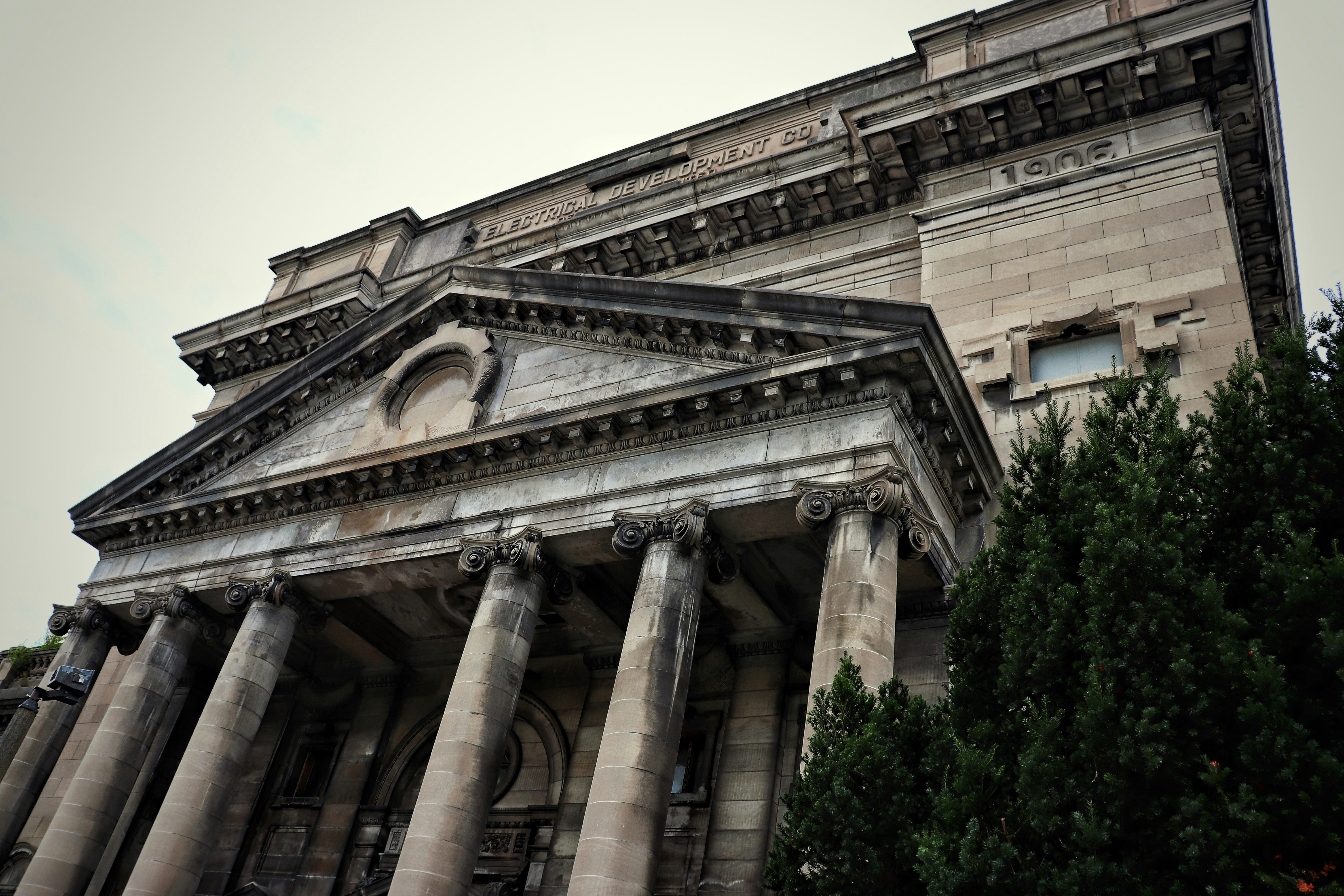
The temple of power — Electrical Development Co., 1906 (by Ankit Patel)
Picture the first aluminium works at Niagara Falls in 1895, its pot-lines wired straight to the turbines of the new Adams station. Aluminium is, in a sense, congealed electricity: it takes something like fourteen kilowatt-hours to make a single kilogram, and in 1895 electricity could not yet travel. So the industry did. Within a few years the falls had gathered a whole cluster around them: Acheson baking carborundum, the carbide furnaces feeding the new acetylene trade, electrochemical works that could exist nowhere else. The power sat still, and the factories came to it.
None of this was new. Long before the dynamo, the textile masters of New England had done the same at the fall line — Slater on the Blackstone in 1793, then the great mills at Lowell in the 1820s — because a waterwheel cannot be shipped. The law is older than electricity itself: the load goes to the power, because the power will not go to the load.
That law came back this week.
On Wednesday, a transmission line faltered in northern Virginia, and the data centers clustered there did something instructive. Their protection systems chose, in milliseconds, to leave the grid and run on their own generators. More than three gigawatts of demand vanished at once, sending a voltage disturbance across the PJM grid from Washington to Chicago.
Three gigawatts is the appetite of a small country.
The politics moved within days. New York has frozen every new data center above fifty megawatts. The White House has widened a pledge — some two hundred signatories, twenty-three governors, eighty percent of American power — that the operators of these machines, not the households around them, will pay for what they draw. The consensus calls this a problem of building faster. It is something heavier: the moment the grid, and the public’s patience with it, became the binding constraint on artificial intelligence.
We have been here before, at national scale. In the late 1930s the United States poured concrete across the Columbia: Bonneville, then Grand Coulee, whose turbines came alive in 1941. The aluminium smelters followed the public power west. Alcoa signed its contract in December 1939, and by the war the cheap federal current out of Grand Coulee was making the metal for something close to a third of America’s warplanes. The state built the river’s power and then decided who was worthy of it. The Ratepayer pledge is that same conversation, ninety years on, in gentler clothes: who deserves the electrons, and who pays to keep them flowing.
So the compute is doing exactly what the smelters did. OpenAI is pouring 3.2 gigawatts of concrete in Georgia; the AMD–Anthropic deal carries up to two more. The frontier labs are becoming utilities in all but name, with gas turbines and small reactors behind the meter, campuses sited on top of the electrons and built to ask no one’s leave. We were told the scarce thing would be the chip. It turns out to be a wall you can plug into without a fight.
But the aluminium story has a last chapter.
The worn light switch in lamplight (by Steve A Johnson)
In December 2000, as the Western power market caught fire, Kaiser idled its Mead smelter outside Spokane and did something the engineers of 1895 would have found unthinkable: it stopped making aluminium and sold its cheap contracted electricity back to Bonneville, because the power had become worth more than the metal — some $52 million of it in a single month. The smelter had spent a century as a captive load. In one winter it learned it was really a power trader that happened to make metal.
A hyperscale data center is that same creature: a vast interruptible load sitting on long, cheap power contracts. Today it computes, because compute is the most valuable thing it can do with a gigawatt. But the day the market pays more for the watt than the model can earn from it — a cold season for AI, a hot enough grid — the Mead logic returns, and the campus we all helped wire discovers it can make more money switched off. Wednesday was a rehearsal. No one ordered those campuses off the grid; their own machinery decided, in milliseconds, that leaving was the better trade.
The value has already migrated to geography: powered land, interconnection rights, the merchant-power curve, the premium on a site that has stepped off the shared grid. The next thing to reprice is the option buried in every one of these deals — the right to stop. We are being asked to build the grid around tenants who are, by their nature, free to leave, or to stay plugged in and sell our own power back to us.
The load has found its river.
Who prices the right to stop?