


The Tenant of Record
A $4.25 billion bond document raises a quieter question about the AI build-out: who is good for the rent?
Most maps of the AI build-out begin with the chip. Units shipped, revenue booked, margin held.
The map that decides whether any of it gets built begins with a sentence in a bond document naming who is good for the rent.
On 9 June 2026, Beacon Point DC LLC closed $4.25 billion of senior secured notes due in 2042. The coupon was 6.129 per cent, the notes priced at 165 basis points over US Treasuries, and Moody’s rated them Baa2. Two months earlier, the same developer, Hut 8, had financed another project called River Bend, which S&P and Fitch rated BBB−. Beacon Point arrived one equivalent notch higher and 20 basis points tighter.
The two projects are not identical and a single spread comparison proves nothing on its own. But Beacon Point’s financing documents identify a fact that River Bend’s do not: the tenant behind the first 352 megawatts is rated AA− or better.
On 28 July, the Financial Times reported, citing five people familiar with the arrangement, that the tenant is Nvidia. Reuters could not independently verify it, and neither company responded to requests for comment. That belongs in the centre of the story rather than the margin, because everything downstream of it is conditional.
The notes finance the first phase of a six-hall campus on 521 acres in Nueces County, Texas. Hut 8 says the site has secured 1,000 megawatts of utility capacity, with initial energisation expected in the first quarter of 2027. On 20 July, a second 352-megawatt leasewent to the same tenant, so two fifteen-year leases now cover 704 megawatts with a combined base-term contract value of $19.6 billion.
The figure quoted everywhere is $50.2 billion. That one assumes every renewal option is exercised.
The headline is the option value. The obligation is $19.6 billion.
If the FT’s account is right, Nvidia may sublease that capacity to the neocloud operators who buy its GPUs. The chip company would then be supplying the machines and standing behind the building that houses them.
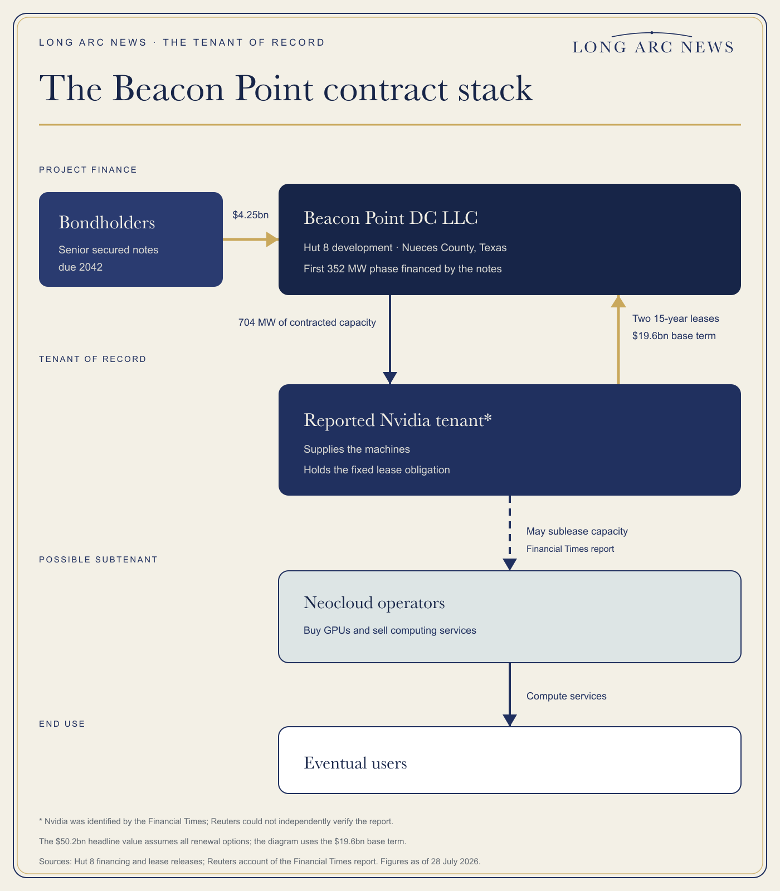
The Beacon Point contract stack.
Which is why the more revealing instrument has stopped being earnings.
S&P cut Oracle to BBB− on 9 July, one notch above speculative grade, outlook stable. In the financial year to 31 May, Oracle reported $55.7 billion of capital expenditure against free cash flow of minus $23.7 billion, and raised $43 billion of debt and $5 billion of equity to close the distance. Remaining performance obligations reached $638 billion. The backlog is real. So is the funding gap required to deliver it.
By 22 July, Oracle’s five-year credit-default swap had reached 212 basis points, Axios reported, with more highly rated technology names edging wider behind it.
Equity asks how large the AI market becomes.
Credit asks who holds the obligation if the timing is wrong.
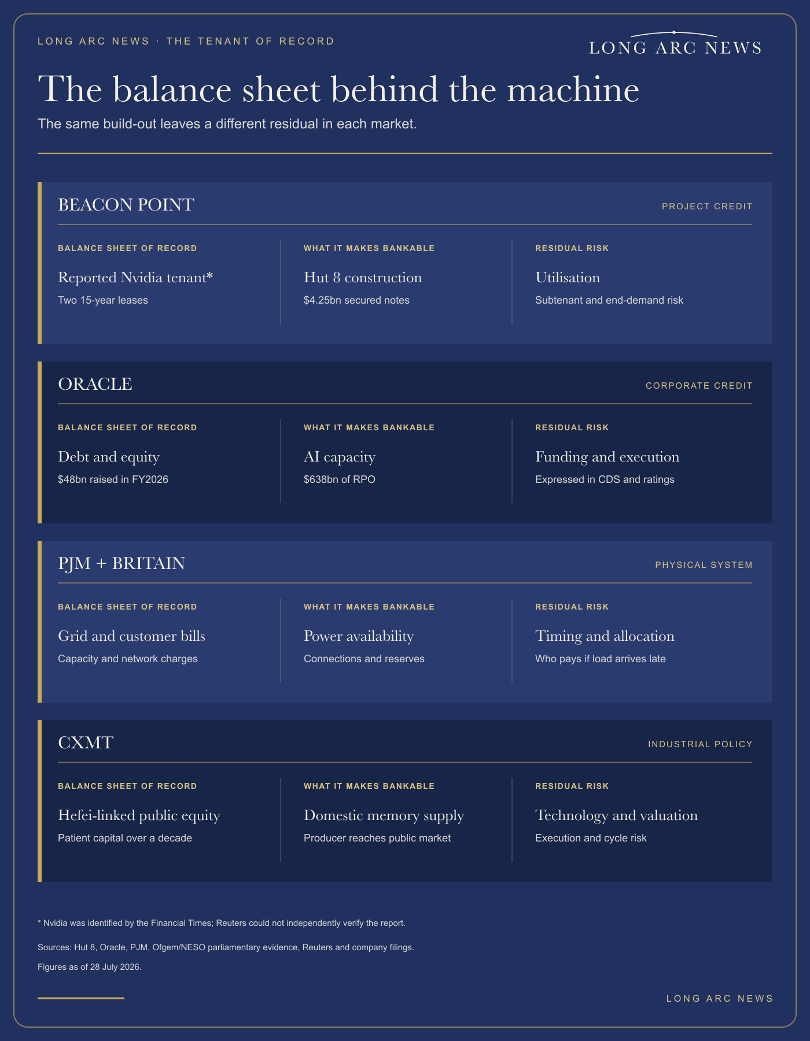
The balance sheet behind the machine.
The bond document eventually meets the physical world, and the physical world is slower.
Evidence submitted to Parliament in February, drawing on Ofgem and the National Energy System Operator, identified around 140 British data-centre projects seeking roughly 50 gigawatts of grid access. Seventy-one of them, about 20 gigawatts, reported a final investment decision. Britain’s peak demand last winter was around 45 gigawatts.
A connection queue is not a construction forecast. The distance between 50 gigawatts requested and 20 carrying an investment decision is the signal, not the 50.
In Scotland, Action to Protect Rural Scotland has been reading the planning portals, and its tally, which should be read as an interested party’s count, runs to 4.75 to 5.25 gigawatts of proposed demand in planning or pre-planning, before a separate one-gigawatt proposal at Irvine. Scotland’s winter peak demand is around four gigawatts.
One project near Auchtertool in Fife makes the scale tangible: a £5 billion, 600-megawatt campus, with developer-commissioned analysis estimating about 120 permanent skilled jobs at full build-out. The planning application sits with Fife Council as 26/01243/PPP. On 15 June, a related screening file reached Scottish Ministers under the project’s codename, Cato: whether a campus of that scale requires an environmental impact assessment at all. A third-party objection entered the file the same day.
Five billion pounds.
Six hundred megawatts.
One hundred and twenty permanent jobs.
Northern Scotland, meanwhile, already has power it cannot always move. A Montel analysis estimated that more than 8.8 terawatt-hours of available wind generation there was curtailed in 2025, around 39 per cent of the region’s available wind output, because transmission capacity was insufficient at the key boundaries. The wires exist. There are not enough of them in the right places.
In the United States, the same constraint arrives as a capacity auction. PJM’s auction for the 2028–29 delivery year, published on 14 July, cleared 138,317.8 megawatts at the $325-per-megawatt-day cap. Cleared megawatts multiplied by price came to $16.4 billion, though PJM cautions that this is not the final cost to customers, since some load is self-supplied or bilaterally hedged. Even counting capacity committed outside the auction, the system finished 6,831.3 megawatts below its reliability requirement. New generation and uprates contributed 524.7 megawatts.
Monitoring Analytics, PJM’s independent market monitor, estimated that data centres accounted for $6.3 billion of the auction value, which is the monitor’s attribution rather than PJM’s.
A capped price, a shortfall that persists, and a bill that has to settle somewhere.
In Hefei, a different balance sheet is doing the same work by another route.
On 27 July, CXMT listed on Shanghai’s STAR Market at ¥8.66 a share. It closed at ¥49.00, up 466 per cent, having touched ¥55.03, with a closing market capitalisation of about ¥3.3 trillion, above ICBC’s. Only 6.73 per cent of the enlarged share capital was freely tradable at listing, which helps explain why a small float could produce a move of that size.
Reuters reported that an investment vehicle under Hefei’s economic and technology development zone founded CXMT in 2016 with ¥10 million. Hefei government-linked investors now hold 36.8 per cent, the largest shareholder group, worth about ¥213 billion at the IPO price and roughly ¥1.2 trillion of quoted equity at the first-day close. That is not a return calculation on ¥10 million, since CXMT completed nine private rounds and most of its shares were locked up. It is still an extraordinary public mark on patient industrial capital.
The same day, The Information reported that China had begun manufacturing domestically developed immersion deep-ultraviolet lithography machines. Reuters’ account had an unnamed state-backed producer expected to deliver about five machines this year and roughly 20 in 2027 to SMIC, Hua Hong and CXMT, with the systems still lagging on performance and reliability and requiring further testing.
Production is not validation.
ASML sold 131 argon-fluoride immersion systems in 2025. Five Chinese machines do not move that balance. ASML’s New York shares still fell 5.8 per cent on 27 July, having traded as much as 8.2 per cent lower.
The market was not repricing five machines. It was repricing the existence of a second door.
Read at the right altitude, Texas and Hefei are one sentence. In both, the capital that made the capacity possible sits upstream of whoever will eventually pay to use it.
Underneath the sentence the instruments differ, and the difference is where the risk goes to live. In Texas, the reported tenant’s balance sheet supports demand through a long lease, and a lease leaves the tenant holding a fixed obligation. In Hefei, public equity carried a producer through years of losses to the public market, and equity can wait through a cycle but absorbs technology, execution and valuation risk while it waits.
One party has promised to pay. The other has agreed to wait.
There is an older American version of this.
In 1998, Lucent agreed to lend Winstar up to $2 billion for equipment and services. By April 2001, Lucent had advanced about $600 million and stopped. Winstar filed for Chapter 11 on 18 April.
Lucent’s vendor loan is not Nvidia’s reported lease, and neither resembles Hefei’s equity. What survives the difference is the question: where does end-demand risk sit when the supplier’s balance sheet helps make the capacity fundable?
For now it sits in several places at once, each with a price attached.
In project bonds, as the distance between a counterparty rated AA− and one that is not. In Oracle’s CDS, where doubt about capital expenditure and execution can be traded outright. In electricity, where the claim arrives long before the machine does, as a place in Britain’s grid queue or a capacity charge in PJM. In Hefei, as the paper value of equity that waited a decade to be marked.
A fifteen-year lease crosses several generations of computing hardware. The shell can be adapted. The power connection is harder to move.
The obligation does not adapt at all.
A long lease makes demand look settled.
When the balance sheet standing behind the machine is not the balance sheet using it, what is actually being sold?