


On December 12, 2025, a snowstorm buried Shanxi’s solar panels. For eight daylight hours the province’s spot power price sat pinned at its ceiling of 1.5 yuan a kilowatt-hour. In the spring of 2026, in other provinces, the same machinery cleared at zero. On some days, below zero.
Zero to 1.5 yuan. The same commodity, the same country, one winter apart. Hold on to that spread.
China calls 2026 the first year of spot power trading. Prices now clear every 15 minutes, 96 answers a day to a question the state once answered annually. The State Council’s February timetable calls for spot markets everywhere by 2027 and one national market by 2030. The volume is already real: 6.64 trillion kilowatt-hours, about 64 percent of all consumption, traded through markets in 2025. Wind and solar now stand at nearly half of installed capacity.
The comfortable Western reading is that Beijing is finally liberalizing, a generation late. I read it differently. The state is not giving up control of prices; it is changing instruments. What the administered tariff once did with a number, the spot market now does with a signal. And the signal has a destination. It points industry west, toward the stranded electrons.
Why the rule is coming
The instinct China is abandoning is older than the People’s Republic by two thousand years. In 54 BC the official Geng Shouchang persuaded Emperor Xuan of Han to establish the ever-normal granary, the changpingcang: buy grain when it is cheap, sell it when it is dear, and never let an essential commodity tell the people the truth about scarcity. Dynasties fell; the granaries outlived them. Smoothing the price of essential things is close to a definition of Chinese statecraft. That is the weight of what changed in 2026. For the first time with something this essential, the state has decided to let the price speak.
For four decades electricity in China was a number set in an office, a subsidy to industry hidden in plain sight. Wind and solar farms were paid a fixed, coal-linked price whenever they produced, whether or not anyone needed the power at that hour. At half the fleet, that arrangement broke in three places at once. Wasted generation climbed in exactly the provinces that built the most. The support bill grew with every gigawatt. And the guaranteed price kept telling investors to build the same midday solar into provinces already drowning in it. Document 136, issued in February 2025, ended guaranteed purchase for new wind and solar. The spot market is the deeper admission: the state no longer claims to know what a kilowatt-hour is worth. The weather knows. Beijing has decided to let the price say so.
I carry a memory that colors my reading. In the late 1990s I sat on the power privatization committee of a Gulf state, working on moving a wholly state-owned grid and its plants into mixed private and government hands. What stays with me is how little of the argument was about ownership and how much was about the hour: who carries the cost of the peak, who pays for the plant that runs twelve days a year. Only later did I see whose seat I was sitting in. A committee smoothing the price of an essential thing is the granary by another name, in another desert. We never truly solved it. We priced around it. China has decided to price it directly.
The cost, in any case, does not disappear. It moves.
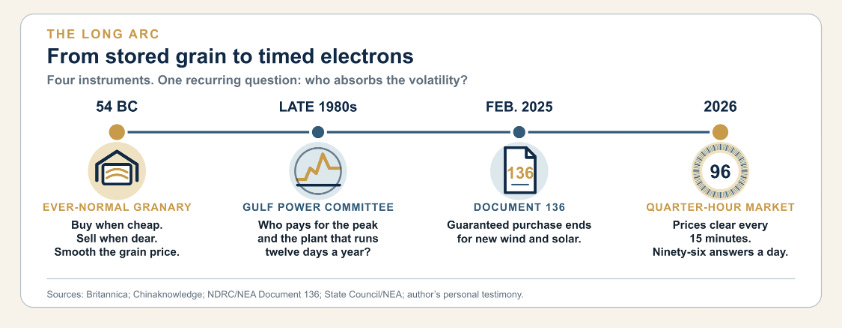
Figure 1. From stored grain to timed electrons. The instrument changes; the governing question remains: who absorbs volatility?
The side effects
Follow the bill. In Liaoning in March 2026, average spot prices fell more than 20 percent from a year earlier. Final bills barely moved. The difference is the system operation fee, the charge that pays coal, storage and renewable compensation to keep the grid steady. Industry data reported by Caixin puts it above 15 percent of commercial bills in the first quarter of 2026, up from roughly 8 percent, and past 25 percent in some regions. The electron is getting cheap. Reliability is getting dear.
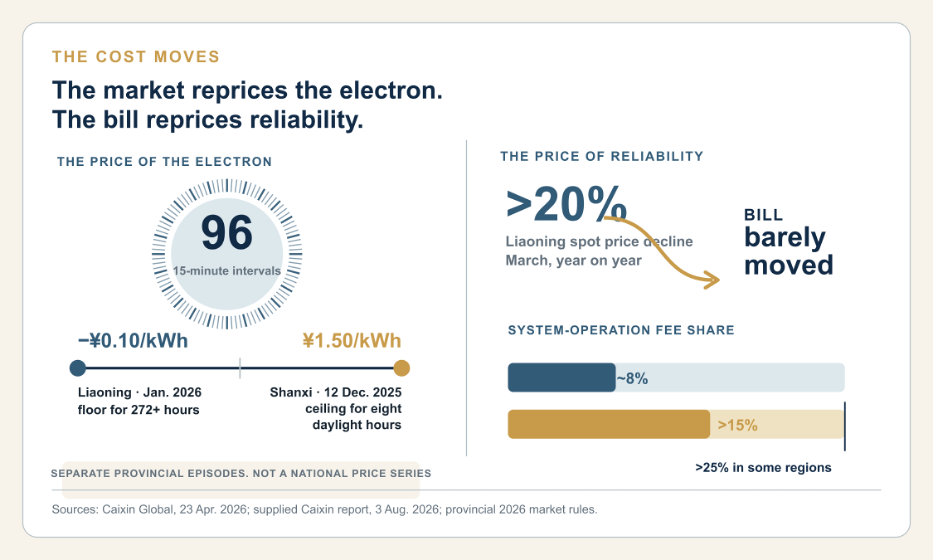
Figure 2. The cost moves. Provincial spot-price extremes do not translate cleanly into lower final bills as system-operation fees grow.
Follow the middlemen. Retailers who locked customers into cheap fixed contracts met early-summer heat and higher gas prices instead. Guangxi retailers lost a reported 370 million yuan in two months; Anhui’s more than 100 million in a quarter. The country’s roughly 3,000 power retailers are heading into consolidation. Buying low and selling on a margin is no longer a business.
Follow the investors. In Xinjiang, solar developers bid the new support price down to 0.15 yuan, then watched, per one executive at a top-five state generator, 40 to 50 percent of their output go to waste while new approvals stalled. The next auction repriced solar 73 percent higher. Both directions carry one message: the system now pays for flexibility and charges for its absence.
And follow the clock. Fourteen regions are cancelling government-set peak and off-peak windows. The state no longer decides when electricity is expensive. Somewhere in a Foshan workshop, an energy manager now checks a price every 15 minutes, the way his father checked the sky.
We have seen this movie before, once, by accident. Texas, February 2021. Winter Storm Uri froze generation, ERCOT’s spot price sat at its ceiling of 9,000 dollars a megawatt-hour for days, and retailers who passed spot prices straight to customers, Griddy most famously, died within weeks. Shanxi’s ceiling and Guangxi’s dead retailers are the same physics in a different jurisdiction. The difference is intent. Texas learned the price of firmness by catastrophe. Beijing is trying to learn it on schedule, at more than twenty times ERCOT’s consumption. The real test is whether volatility can be dosed, administered in controlled quantities like everything else. My expectation, held loosely: the first hard winter will tempt Beijing to put the granary back, and the reform will be measured by whether it resists.
One group is absent from the spot ledger: households. Residential tariffs remain administered and low. The volatility lands on factories and traders. That is a social choice with a limit, because every yuan of system fee is a tax on the competitiveness of the manufacturers the economy leans on.
The collision with AI
China’s fastest-growing load is compute. The energy administration puts data center consumption at 170 terawatt-hours in 2025, under 2 percent of demand but growing near 40 percent a year, and its head expects roughly 800 terawatt-hours by 2030. New data centers at the national hub nodes must already source 80 percent of their power from renewables, a requirement formalized in 2025.
Read at the right altitude, the power reform and the AI buildout are one policy. The stranded electrons are in the west; Xinjiang’s lost 40 to 50 percent is less waste than unpriced inventory. The compute demand is born in the east. “East Data, West Computing” tried to close that gap by decree. Spot pricing closes it by arithmetic. Alibaba’s data center chief reckons that siting a gigawatt-scale facility in a low-price region rather than on the developed coast saves some 5 billion yuan a year in electricity. Make the cheap hour and the cheap province visible, and the load moves itself.
It is starting to. In May 2026, three telecom data center clusters entered Guangdong’s spot market as virtual power plants, shifting computing work toward the cheap hours. At Ulanqab in Inner Mongolia, an operator already schedules AI training into midday solar and backup into night wind, freeing 30 percent of capacity as flexible load. Ninety-nine direct green-supply projects, about 34 gigawatts, were approved by end-April 2026, and some report prices near 0.36 yuan, roughly half eastern industrial averages.
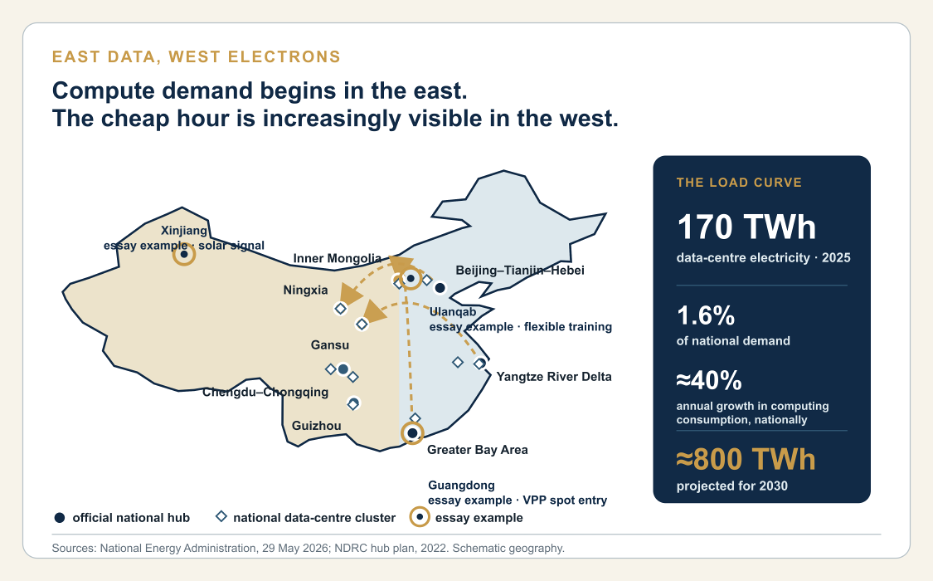
Figure 3. East data, west electrons. National hub nodes make the geographic gap between power supply and compute demand visible.
The contrast with America is the strategic point. The United States answers AI’s power constraint by building firm generation, gas turbines queued for years. China is running the opposite experiment: teaching the load to be flexible instead of forcing the supply to be firm. A training run is the rare industrial process that can, in principle, follow the sun, as smelters once followed off-peak hydropower.
State the gap plainly. Consensus believes chips decide the AI race. These signals say cheap hours help decide where the marginal model gets trained. China is trying to turn that hourly spread into industrial policy.
The counter-case is serious, and Chinese grid engineers make it themselves. Flexibility barely pays yet; the income from shifting workloads rarely covers the risk an interruption poses to a training run, and inference cannot follow the sun at all. Data centers in the northwest reach only 30 percent of planned load by their fifth year. And incumbency resists: Mingyang’s completed direct line to an Alibaba cluster in Zhangjiakou has waited months for grid connection. The wire exists; the permission does not.
The practical ledger
For an investor, the mechanism translates into watchable positions. These are observations, not advice. The repricing lands first on whoever earns the spread: grid-scale storage and the software behind virtual power plants, assets paid precisely for the hours between zero and 1.5 yuan. Coal plants are being revalued from fuel burners into standby capacity; national capacity payments began in 2024 and rise to at least half of fixed-cost recovery from 2026, steadier cash flow than the death-of-coal consensus implies.
For renewable developers, the profit signal is no longer how much gets installed but what the support auctions clear at; watch them, auction by auction. Among data-center operators, watch western siting with green contracts against coastal fleets locked into rising system fees. For exporters facing Europe’s carbon border levy, traceable green power is a margin input; the transmission-rights channel BASF used in June 2026 to pull Anhui power into Guangdong is the template.
The dials to watch: the system-fee share of industrial bills, the count of negative-price hours, auction prices, transmission-rights volumes, and the pace of retailer exits. And a marker for this log, so it can be graded: by the end of 2027, the State Council’s spot deadline, the system operation fee will be the fastest-growing line on a Chinese industrial power bill, its share nearer a quarter of the bill than a tenth. If that proves wrong, the thesis is wrong.
For thirty years the question in Chinese industry was what a kilowatt-hour costs. There is no longer one answer. There are 96 a day, and in one winter they ran from zero to 1.5 yuan. The largest AI buildout in the world is about to live inside that spread.
When the weather sets the price of the hour, what does owning the machine still purchase?
Great read. I particularly love the comparison. Strong piece!