


Between 1964 and 1973 the United States flew a secret war over neutral Laos: two million tons of ordnance, 270 million cluster submunitions, some 80 million of which did not explode. They are still killing. In 1995 a boy digging bamboo shoots lost his hand to a bombie older than he was.
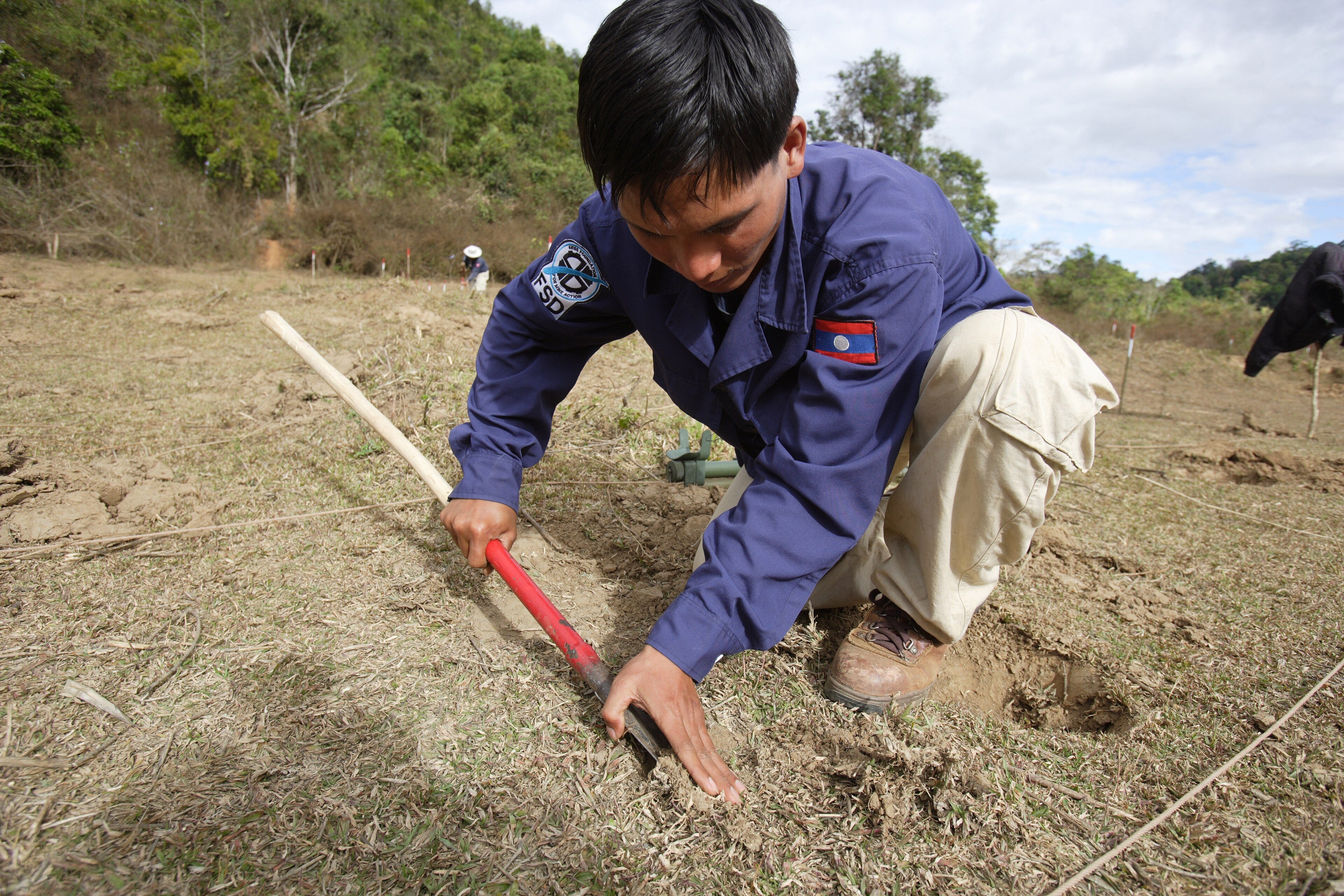
A clearance worker with a metal detector in southern Laos. Two million items of unexploded ordnance have been recovered since 1996. Eighty million remain. (Photo: Jim Holmes / AusAID, via Wikimedia Commons, CC BY 2.0)
The boy was eight years old. The morning he remembers happened in the rainy season of nineteen ninety-five, on a slope in Xieng Khouang Province, two hours from the provincial capital, on the kind of path villagers had been walking before there was a village. He had gone out with a small basket and a knife to look for bamboo shoots. His mother needed them for the evening soup. The shoots that come up after the rains are tender. A child can find them. A child knows the places.
He found one. He dug. The bombie was buried not deep, perhaps the length of a forearm beneath the topsoil. When his blade reached it, the bombie did what it had been built to do. It killed the men around it. It blew the metal upward and outward and into whatever was nearest. What was nearest was his left hand.
He survived because a farmer working a nearby field heard the explosion and ran. The boy was carried to a clinic. The hand could not be saved. He learned to write with his right hand. He used a prosthetic. He grew up, went to school, came back to his province, started an organisation called the Quality of Life Association, helping other survivors. When the American president visited Laos in September of two thousand sixteen, the man who had been the boy met him at the rehabilitation centre in Vientiane. They spoke. The president listened.
The bombie that had taken his hand had been older than he was. It had been dropped on his province in the late 1960s or the early 1970s, during a war that had not been declared, by a country that was not at war with his, in pursuit of an enemy that had not been from his country either. The boy was born more than a decade after the bombing stopped. The weapon that found him had been waiting.
* * *
The figures behind that morning belong to a particular accounting. Between 1964 and 1973, the United States dropped approximately 2 million tons of ordnance on Laos in 580,000 sorties: one planeload every eight minutes for nine years. This was more than the Americans dropped on Germany and Japan combined in the Second World War. The country it fell on had under 3 million people. It was the most heavily bombed country in history, per capita, and had not declared the war.
A substantial fraction were cluster bombs. Each casing released several hundred submunitions, baseball-sized bomblets the villagers called bombies. 270 million bombies fell. About 30 percent failed to detonate. 80 million remained in the soil when the bombing stopped. The provinces of Xieng Khouang, Savannakhet, and Sekong are the most heavily contaminated. They lie along the trail that ran from Hanoi through eastern Laos into the south of Vietnam.
Clearance organisations have removed over 2 million items of unexploded ordnance since 1996, more than a million of them submunitions. In a cleared field the small red flags stand wherever a bombie was found. Casualties have declined. In 2025, 25 Laotians were killed or wounded in 15 accidents. 67 percent of the recent victims were children. The work, at its present pace, will continue beyond the lifetime of any technician currently doing it.
* * *
The country has been clearing those submunitions for thirty years, and in the same period it has accepted a different kind of presence on its soil. In December 2021 a railway opened between Vientiane and the Chinese border at Boten, 414 kilometres through the mountains, six billion dollars, of which Laos owes most. A joint Lao-Chinese company operates it; the Chinese partner holds 70 percent. In September 2020 Laos transferred majority equity and a 25-year operating concession over its electricity transmission grid to a Chinese state utility subsidiary. The Lao national debt at the end of 2024 was 15.9 billion dollars, exceeding the country’s gross domestic product. China has deferred over 2 billion dollars of debt service. Bicycles still outnumber cars in Vientiane at dawn, and the river still rises in June.
It would be wrong to call this a predation. It would also be wrong to call it a friendship between equals. The arrangement is what the smaller country can negotiate when the larger is the only one offering large capital at scale, and the smaller has no domestic mechanism through which the terms can be openly contested. Sovereign capital flows toward the country with no institution able to refuse.
* * *
The absence of that mechanism has a history. On the second of December nineteen seventy-five, months after the fall of Saigon, the Pathet Lao formally took power in Vientiane. The monarchy was abolished. The king, Sisavang Vatthana, was permitted to remain in Luang Prabang for a year as an honorary advisor. In March of nineteen seventy-seven he was arrested with his queen and crown prince, transported north to a re-education camp known as Camp One, near Sam Neua, in Houaphanh Province.
The camp sat in the highlands above Sam Neua, high in the mountains, where the May rains come late and the nights hold cold. The shelters were bamboo. Rations were rice measured by hand into a tin bowl, two bowls a day, perhaps two hundred grams between them. The king was seventy. He had been raised in a Buddhist court that taught acceptance of impermanence, educated in France in the science of governance. Neither training had prepared him for the silence of a bamboo shelter at five in the morning. In May nineteen seventy-eight he sat in his shelter and watched his son weaken and die. He died eleven days later, of starvation. The queen survived another three years. They were buried in unmarked graves outside the camp’s perimeter. The Lao government did not acknowledge the death until 1989, when the party’s general secretary, in France, attributed it to old age.
His name had meant light. He had been the king.
There was no parliamentary inquiry. There was no opposition press to ask where the king had been buried. The system that had liberated Laos from one occupation did not contain within itself the mechanisms through which it could question what it was now doing to its own.
* * *
The Hmong had taken a different path. During the bombing years they had been the ground force of the war the Americans had not declared, recruited and trained at Long Tieng, a base in northern Laos that in the early 1970s was the largest installation the American Central Intelligence Agency operated outside the United States. Vang Pao led 30,000 to 60,000 Hmong fighters. Casualties have been estimated at 30,000 to 40,000 killed, more than one in ten of the Hmong population at the time.
When the Pathet Lao came to power, the Hmong who had fought against them fled with their families. The Americans evacuated some by air from Long Tieng in May nineteen seventy-five. Others walked through the forest into Thailand. Under the 1980 Refugee Act, the United States resettled 100,000 Hmong refugees. There are now around 327,000 Hmong Americans, concentrated in California, Minnesota, and Wisconsin.
Vang Pao died in a hospital in Clovis, California, on the sixth of January, two thousand eleven, aged eighty-one. Tens of thousands came to his funeral in Fresno. On the funeral’s opening day, the United States Army denied the family’s request to bury him at Arlington National Cemetery. Arlington required service in the United States Armed Forces. The general had fought for the Central Intelligence Agency. He had not, in the formal sense, been an American soldier. The friendship had been real, and so was the use that ran through it. The eventual welcome had been real. So had the denial of the final recognition. All four belong to the record. In the years since, I have come back to that denial often.
* * *
To return to the bombing is to enter a more difficult question. It did not begin as an irrational act. By 1964, the trail through eastern Laos was the principal supply route through which the North Vietnamese army moved men and weapons into the war in the south, in violation of the 1962 Geneva Accords on Lao neutrality, with material assistance from the Soviet Union and China. The American calculation was that the trail must be interdicted, the Pathet Lao contained, and only an air war could do both without American ground troops in Laos. The calculation was wrong. It was not, when made, an act of disregard for the country beneath the bombs.
What followed, between 1964 and 1973, was the longest sustained aerial bombardment in history. The targeting was directed by the American ambassador in Vientiane, William Sullivan, who ran the air war from the embassy because the country whose airspace it used did not officially exist as a combatant. The Lao government had been told to behave as a neutral. The North Vietnamese were told nothing.
In 1970, Fred Branfman, an American educational advisor living in Laos and fluent in Lao, began interviewing the refugees who had fled the Plain of Jars to camps near Vientiane. He asked them to write down what they remembered. He asked them to draw what they remembered. One of them said we lived in holes all the time. Another said they died like animals die in the forest. Branfman published the testimonies in a book in 1972. The Senate read it.
The instruments by which the bombing was exposed were instruments internal to the country that conducted it. Senator Stuart Symington of Missouri, who had been the first Secretary of the Air Force under Truman, chaired the Senate Foreign Relations subcommittee hearings that brought the secret war into the public record in October 1969. The staff report came in April 1971. Daniel Ellsberg released the Pentagon Papers to the New York Times two months later, was indicted under the Espionage Act, and saw the charges dismissed when it emerged that the executive branch had been wiretapping him and had broken into his psychiatrist’s office. I came to these names later, in the middle of my own working life.
Three years before this, on the fourth of April nineteen sixty-seven, Martin Luther King had stood at the pulpit of Riverside Church in Manhattan and named his own government the greatest purveyor of violence in the world today. Veterans returned to testify before Congress against the war they had fought. A young naval officer named John Kerry, at twenty-seven, asked the Senate how one asks a man to be the last man to die for a mistake.
These were not foreign critics. They were the country’s own institutions performing the function for which they were designed. The country that conducted the bombing was the country in which the bombing could be questioned aloud and halted. The Vientiane Agreement was signed on the twenty-first of February nineteen seventy-three. It did not hold. The last bombs of Operation Barrel Roll fell on the seventeenth of April. Thoummy Silamphan was not yet born. The submunition that would take his hand was already waiting for him in the soil.
* * *
A chain runs through what has been described. Bombing displaced peasants who had nowhere to go but the Pathet Lao. The Pathet Lao took power and asked the Vietnamese to stay. The Vietnamese stayed for a generation, until in the late 1980s Hanoi could no longer afford the patronage. The Lao party turned to Beijing. A railway came. A grid changed hands. A debt accumulated that exceeded the economy that owed it. Each link, once forged, made the next nearly impossible to refuse.
* * *
It is tempting to call what happened to Laos an accident of geography. A trail ran through it, the bombing followed the trail, and from the bombing came everything afterwards. This is true and incomplete. Small countries in neighbourhoods on fire cannot remain insulated from the fire, however carefully their diplomats word the declarations of neutrality. The fire is used by the friends. The fire is used by the foes. The friends supply the trail. The foes interdict it. The friends arm the proxies. The foes bomb them. The friends offer evacuation when the war is lost. The foes offer re-education when it is won. Decades later, the friends return with rehabilitation centres and clearance teams. The foes return with railways and loans. The cumulative effect on the country beneath the fire is the same. What is rearranged from outside cannot be put back together from inside.
I have watched fires of this kind in my own region. What contains such a fire, when it is contained, is the institutions inside the countries tending it that allow argument about what is being done. The bombing of Laos was halted because the American Senate could hold hearings, because an analyst could leak the papers, because veterans could testify against the war they had fought in, because a clergyman could stand at a pulpit and name his own government. The institutions that allow this kind of argument are not equally available everywhere. The pattern is not Asian, nor Cold War. The fire is still moving through neighbourhoods, and the small countries in those neighbourhoods are still finding themselves used by friends and foes, paying with their soil and with their children’s hands for wars they did not declare.
* * *
I was fifteen the autumn the Iran-Iraq War began, twenty-three the summer it ended. I watched it on the television in my family’s apartment in Abu Dhabi, between studies, on the evening news, on the news of people whose buildings had been apartments the day before and were now something else. The older adults at the family table talked about the human toll, about both sides stopping at nothing. They used the phrase the next step. The next step always came. First the chemical weapons, then the tanker war, and eventually the cities began firing missiles at each other’s cities. Halabja came on the sixteenth of March nineteen eighty-eight. What I understood across those eight years, and have not forgotten, is that when fire breaks out in a neighbourhood the small countries cannot remain insulated, however clever, wealthy, or well-governed. Forty years later, the unexploded ordnance from the Iran-Iraq War is still being cleared from the soil of western Iran. Fifty years after the last bomb fell on Laos, the unexploded submunitions from the war it did not declare are still being cleared from the soil of Xieng Khouang.
The third country in this series is Thailand. Thailand was also used. It accepted the basing rights, the airfields, the bargain in exchange for the privilege of being on the right side of the line. It survived differently. The institutions and accidents that made its path different are the subject of the next essay.
The boy in Xieng Khouang is now a man with one hand. He runs an organisation that helps other people with the bodies they were given by the wars that arrived in countries that had not declared them. He met the American president on a morning in September and told him what had happened. The president listened. The soil he had been born on still held the rest of his morning.