The Grain That Never Came
Bengal, 1943, and the Architecture of Starvation

Bengal, 1943, and the Architecture of Starvation
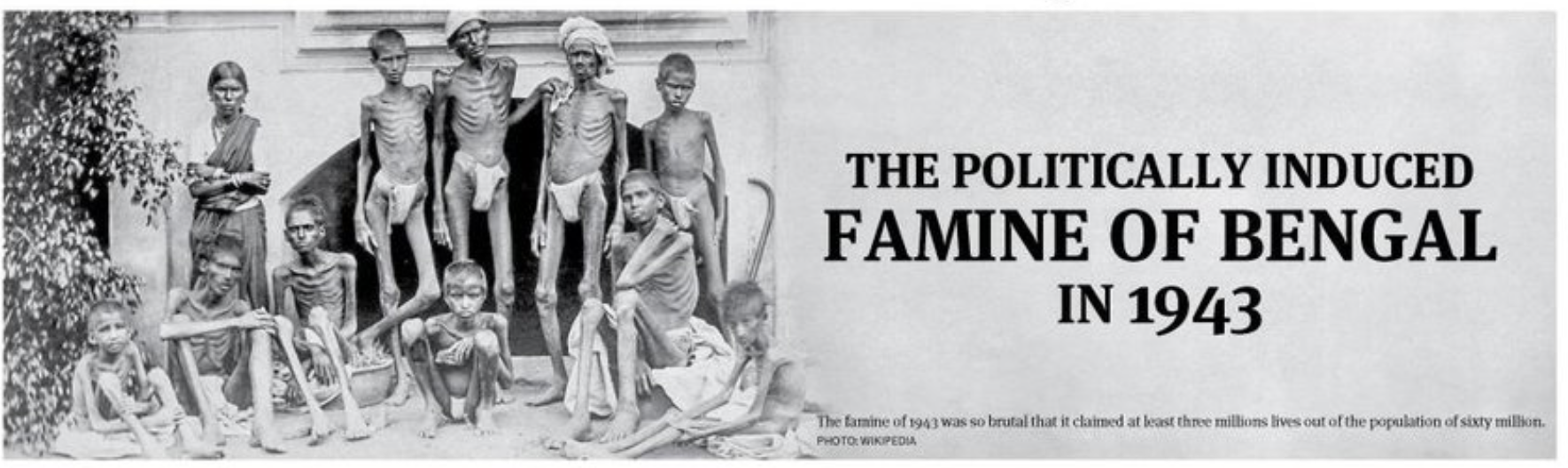
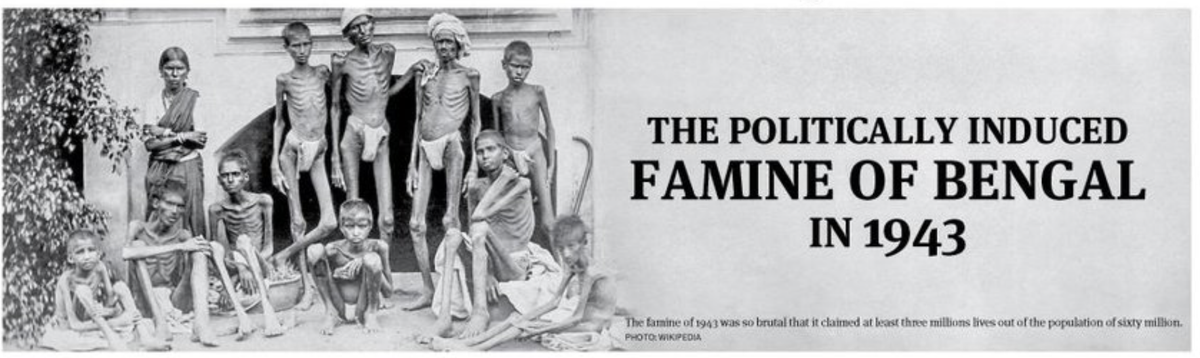
Victims of the Bengal Famine, 1943. The politically induced famine claimed at least three million lives. (Photo: Wikipedia, Public Domain)
The rice paddies were green that year. I want you to hold that image.
Not brown. Not fallow. Not scarred by drought or flood or the failure of the monsoon. Green. The fields of Bengal in the autumn of 1943 were producing rice — and three million people were starving to death in the roads beside them.
I first heard about Bengal not from a book but from a man who had lived it. At a dinner in London years ago, I was seated beside a retired Calcutta physician in his late eighties — sharp-eyed, deliberate with his words. When the conversation turned to famine, he set down his fork and went very still.
He was six years old in 1943. His family lived outside Midnapore. His mother kept a small rice store in the back of their house — not for sale, just enough. One morning, soldiers came and took it. All of it. They called it the Denial Policy. His father protested at the district office and was told the rice was needed for the war effort. Within three months, his mother was dead. Within five, his father. The boy survived because a rumour reached him that there was food in Calcutta. There wasn’t. But the rumour was enough to get him walking.
He told me this without anger. As if what had happened was so large, so structural, that rage had nowhere to land.
“They did not kill my parents with a bullet,” he said. “They killed them with a policy.”
I have carried that sentence for years.
Let me give you the architecture. Because architecture is what this was — not a disaster, not a famine in any honest sense of the word, but a constructed outcome. A supply-chain denial event executed through policy, administered through bureaucracy, and justified by the calculus of imperial war.
In March 1942, Japan took Rangoon. Burma fell. With it vanished between one and two million tons of rice that Bengal imported annually to feed itself. That single severance — one supply line, cut by conquest — exposed a dependency that colonial administrators had spent decades engineering and precisely zero years preparing to mitigate.
But the Japanese did not cause the famine. They created the preconditions. What followed was entirely British.
Within weeks, the colonial government launched what it called the “Denial Policy.” Not a relief policy. Not a contingency plan. A denial. Anticipating a Japanese invasion, British commanders ordered the preemptive destruction of Bengal’s capacity to feed itself. In coastal districts — Chittagong, Noakhali, the Sundarbans — soldiers confiscated rice stocks and destroyed them. Thousands of tons dumped into rivers. Under the “Boat Denial” policy, over 46,000 boats were seized or scuttled — the arteries of commerce in a land defined by its waterways.
Fishermen lost their livelihood overnight. Farmers lost their transport. The distribution network that moved food from where it grew to where it was eaten collapsed. Not because the system failed. Because someone dismantled it.
I wrote in The Underwriter’s War about how an insurance premium — not a torpedo, not a blockade — closed the Strait of Hormuz. A quiet recalculation in a London office made a shipping lane economically impassable while it remained physically open. Bengal in 1943 was the same mechanism running eighty years earlier. The food existed. The fields were producing. But the system of access had been deliberately withdrawn. You do not need to sink a single ship to starve a population. You only need to remove the means by which food travels from where it grows to where it is needed.
And then the prices began to move.
On 11 March 1943, the provincial government rescinded its rice price controls. Rice that had sold for thirteen to fourteen rupees per maund surged to thirty-seven by August — eventually reaching eight to ten times pre-crisis levels. The government blamed hoarding. When they searched for hidden stocks, they found almost nothing.
The rice was not hidden. It had been exported.
India shipped more than 70,000 tonnes of rice out of Bengal between January and July 1943. During a famine. While people died in the streets of Calcutta. The colony was not permitted to spend its own sterling reserves to import food. Not permitted to use its own ships. Every request for grain — from Australia, from Canada — had to pass through Churchill’s War Cabinet in London. For months, those requests were rejected.
Churchill.
I write his name and I feel the weight of a historiographical war that has raged for eighty years. His defenders point to the shipping crisis, the U-boat threat, the logistical nightmares of global war. They are not wrong about the constraints. But constraints are not the same as choices.
Leopold Amery — Secretary of State for India — recorded in his diary what happened when he pleaded for more shipping to Bengal. Churchill’s response began, by Amery’s account, with a flourish about Indians “breeding like rabbits” and being paid a million pounds a day for doing nothing about the war.
On 4 August 1943, the War Cabinet agreed to send 150,000 tons of barley and wheat. Churchill himself wrote that “something must be done.” But the gap between acknowledgment and action was measured in months and bodies. Viceroy Wavell’s telegrams were met with delay. The shipping that could have carried grain carried other things — war matériel, strategic reserves, the logistics of campaigns deemed more important than Bengali lives.
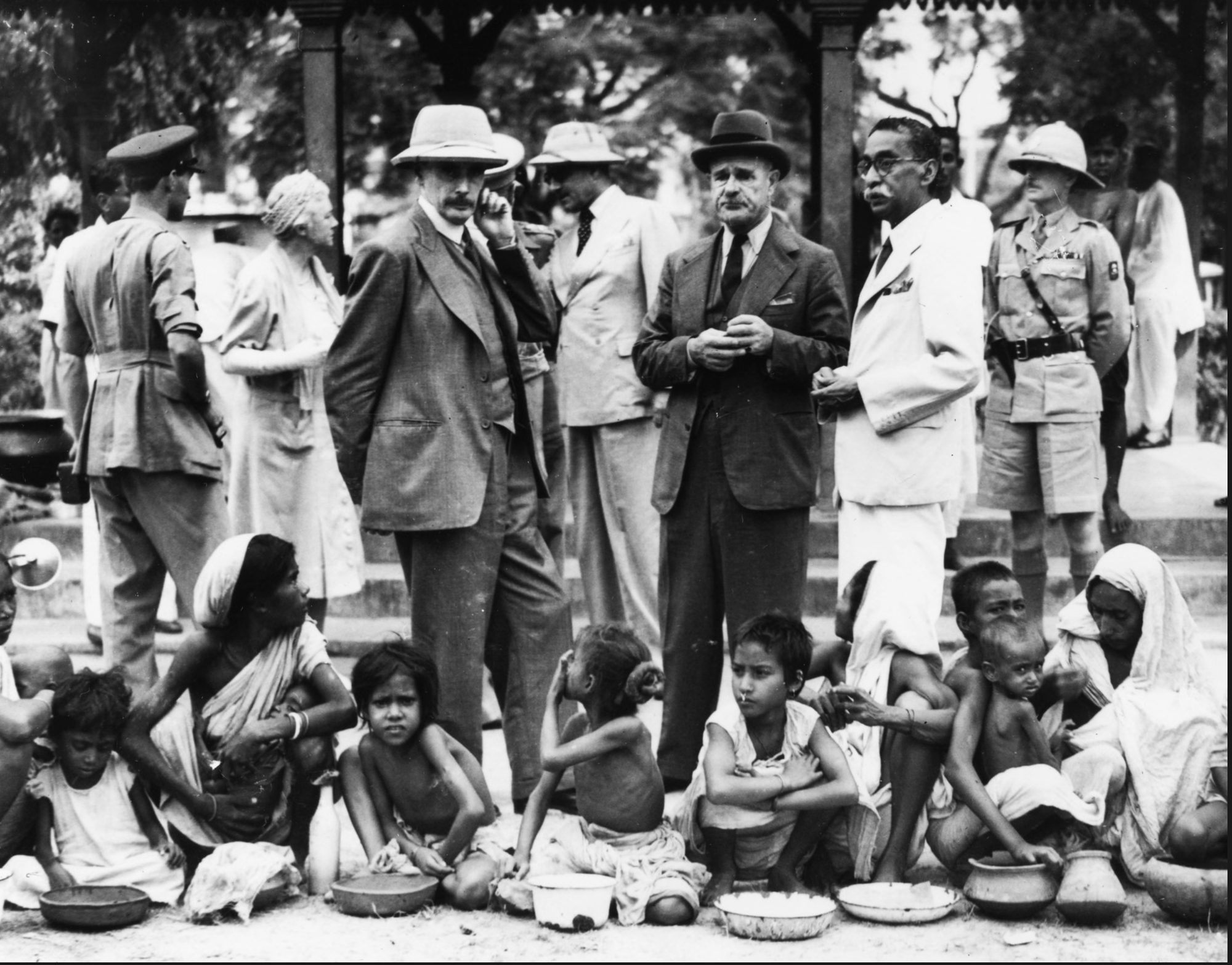
British officials inspect famine relief efforts in Bengal, 1943. The contrast between the standing administrators and the starving children at their feet captures the famine’s essential architecture. (Photo: Public Domain)
Here is what I need you to understand, because this is not history for its own sake. One-third of globally traded fertiliser passes through the Strait of Hormuz today. India sources sixty-four percent of its urea imports from GCC suppliers. When war-risk premiums spiked three hundred percent this month, the missiles that struck the Skylight and the MKD Vyom were only the visible trigger. The deeper closure was actuarial — underwriters in London withdrawing coverage entirely, making the strait economically impassable even where it remained physically navigable. The fertiliser shipments that determine whether a farmer in Uttar Pradesh can plant his Kharif crop slowed to a crawl. Nitrogen fertiliser operates on a biological clock. A shipment two weeks late does not produce a two-week delay. It produces an entire lost season.
Bengal in 1943 is the precedent. The decision was not to starve Bengal. The decision was that Bengal’s starvation was an acceptable cost. The mechanism — the quiet withdrawal of access, the rerouting of supply, the prioritisation of strategic interests over civilian food security — is running again, through the same waters, dressed in newer language.
The Famine Inquiry Commission, convened after the disaster, attributed the catastrophe to natural shocks, market failures, and administrative breakdowns. A perfect storm.
But Amartya Sen — who was nine years old in Bengal in 1943, who watched people die, who would later win the Nobel Prize for his work on famine — dismantled that narrative. Sen demonstrated that Bengal’s food availability in 1943 was actually higher than in 1941, a year with no famine. The problem was not supply. It was entitlement — who had the power to access food, and who did not.
Madhusree Mukerjee went further. In Churchill’s Secret War, she documented the systematic diversion of shipping, the export policies, the cabinet-level decisions that prioritized stockpiling over survival. A study in Geophysical Research Letters confirmed what revisionist historians had argued for decades: the 1943 famine was the only modern Indian famine not linked to drought. The study’s language was clinical. “Complete policy failure.”
Not crop failure. Not monsoon failure. Policy failure — the kind that requires meetings, memoranda, and the quiet agreement of powerful men that certain lives matter less than others.
The Gospel of Matthew records Christ saying: “I was hungry and you gave me nothing to eat.” The indictment is not against those who lacked food. It is against those who had it and chose not to act.
Every empire learns the same lesson: you do not need to occupy a country to control whether its people eat. You only need to control the logistics. In The Coup That Never Ended, I traced the line from 1953 Tehran to today. Here, I am tracing an older line: from 1943 Calcutta to the Strait of Hormuz. The same imperial grammar — written in shipping routes instead of sentences — that treats civilian hunger not as a crisis to be averted but as a cost to be managed.
Three million dead. Green fields. Full granaries. And a supply chain not broken by accident but dismantled by design.
In the Mahabharata, there is a moment during the great dice game when Yudhishthira gambles away his kingdom, his brothers, his wife, everything. The tragedy is not that he lost. It is that every elder in the court watched it happen. Bhishma sat silent. Drona looked away. The men with the power to stop the destruction chose not to — bound by protocol, by loyalty to the wrong throne, by the calculation that intervention would cost them more than silence. Only when Draupadi cried out to Krishna — beyond the court, beyond the elders, beyond every human institution that had failed her — did a higher force intervene where conscience would not.
Bengal, 1943, was a Sabha moment — without the divine rescue. The food existed. The ships existed. The capacity to act existed. And the court watched in silence.
Whether the silence falls in 1943 Calcutta or in the insurance offices that today determine which tankers sail through Hormuz, the structure is identical. Only the distance between the decision-maker and the dying has changed — longer now, mediated by more layers of deniability. But the architecture is the same. And the dead are just as real.
The question that remains — and it is the question that should haunt every analyst, every allocator, every policymaker who models Hormuz as an energy event and ignores the food chain collapsing behind it — is whether we have learned to read that grammar yet. Or whether we will sit, as Bhishma sat, watching the dice fall, knowing what comes next, and choosing silence because the cost of speaking is higher than the cost of someone else’s starvation.
The rice paddies were green that year.
Remember that.
— Nazem
Sources: Amartya Sen, Poverty and Famines (1981); Madhusree Mukerjee, Churchill’s Secret War (2010); Vaidyanathan et al., “Drought and food shortages” in Geophysical Research Letters (2019); Famine Inquiry Commission, Report on Bengal (1945); Srimanjari, Through War and Famine: Bengal 1939–45 (2009); Leopold Amery, The Empire at Bay: The Leo Amery Diaries 1929–1945 (1988).
Nazem Alkudsi, CFA, is the founder of @LongArcNews. A former CEO in the Abu Dhabi sovereign wealth ecosystem and four-decade veteran of institutional investing, he writes about capital, power, and civilisational patterns.