The Libraries That Burned Twice

On Nalanda, Baghdad, and the Semiconductor Chokepoint Where the World’s Knowledge Now Lives.
Nazem
Long Arc News is a reader-supported publication. To receive new posts and support my work, consider becoming a free or paid subscriber.
Bihar, 1193
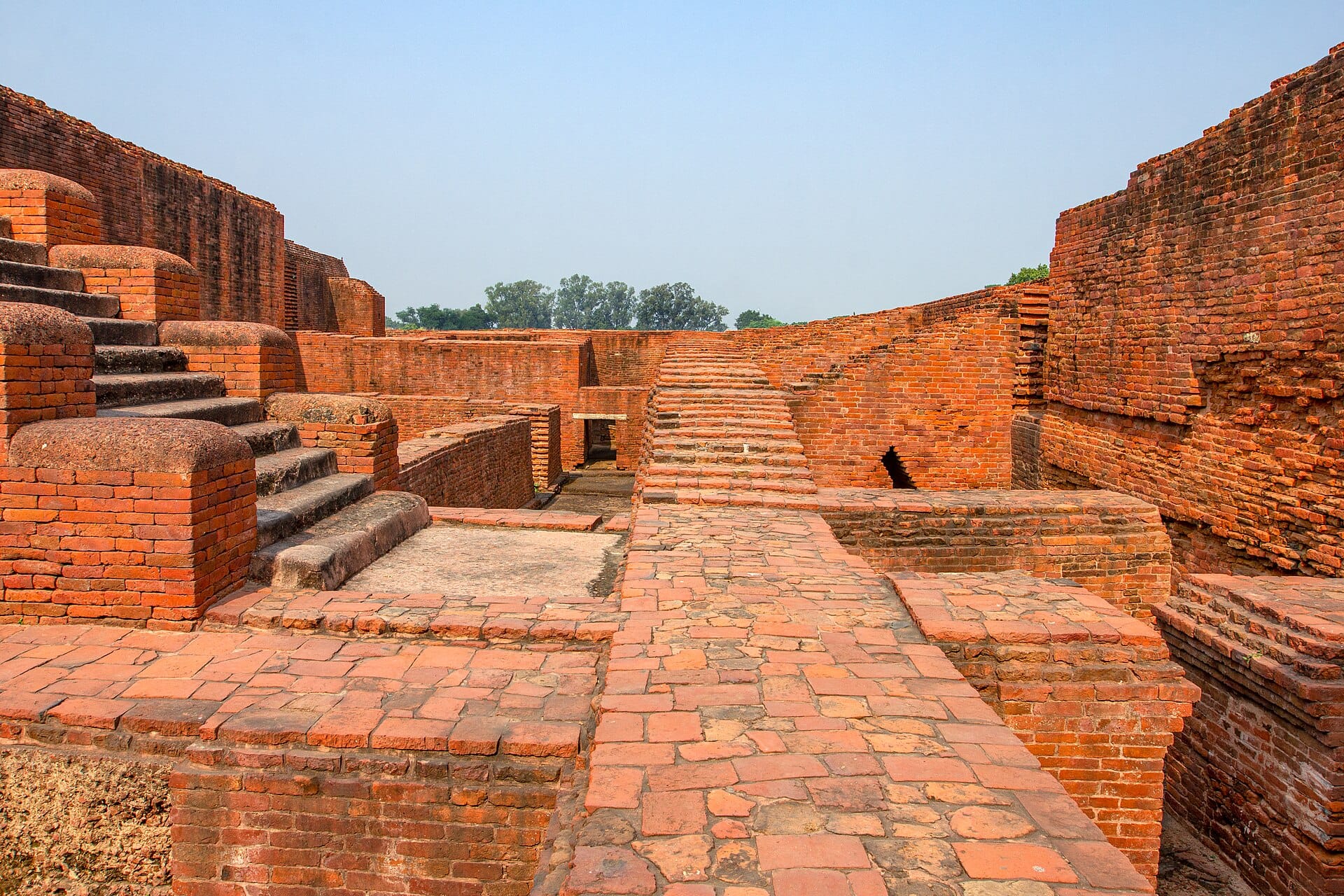
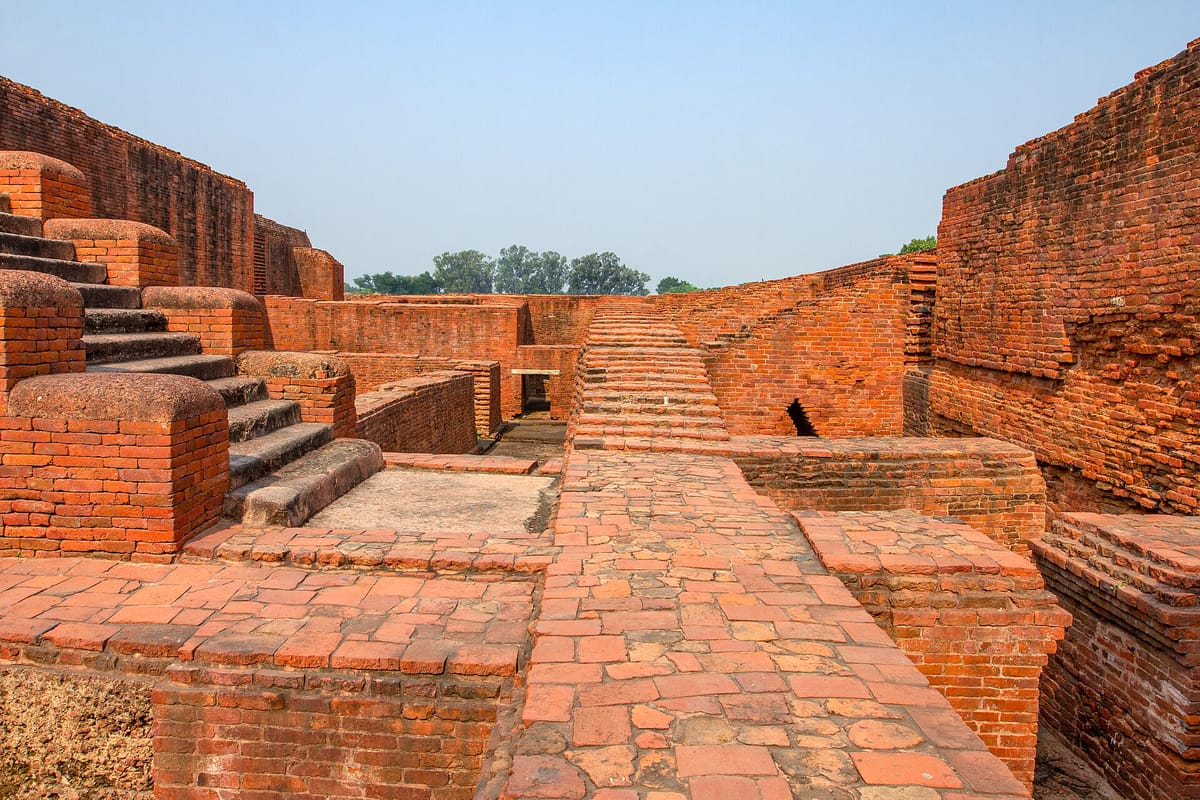
The ruins of Nalanda Mahavihara, Bihar.
The conqueror stood in the library holding books he could not read.
Bakhtiyar Khilji had come to Bihar in 1193 with a force so small that early chronicles describe it almost as a raiding party — two hundred horsemen, maybe fewer, moving fast through territory they did not know. What they found behind the walls of the great monastery complex was not a garrison. It was a city of scholars. The Persian historian Minhaj-i-Siraj, writing in his Tabaqat-i Nasiri just decades later, records what happened next with the flatness of a man describing inventory: they summoned Hindus who might explain the import of the books. But — in Minhaj-i-Siraj’s words — the whole of the Hindus had been killed.
I want you to sit with that sentence. The conquerors needed someone to tell them what they had captured. And they had already murdered everyone who could.
What had they captured? What was it that burned, those three months when the smoke sat over the low hills of Bihar like a season that would not pass?
A man I knew — a retired Indian civil servant, a Bihari by birth, precise with his words in the way that men who have spent a career choosing them carefully tend to be — once described visiting the ruins at Nalanda as a young man. He said the brick foundations stretched in every direction, too large to take in from any single vantage point. “You stand there,” he told me, “and you realise you are walking on what was once the largest university on earth. And then you realise that the word university did not even exist in Europe when this place was already eight hundred years old.” He said it without bitterness. With something closer to awe — and a grief so old it had become geological.
Nalanda, at its height, was home to ten thousand students and two thousand teachers — in the seventh century, when the population of London was perhaps fifteen thousand souls. Hartmut Scharfe of UCLA notes that the donors whose seals bore emblems of Lakshmi, Ganesha, Shivalinga, and Durga. The institution was Buddhist, but its support was civilisational. Hindus, Jains, and Buddhists alike sustained it. The Chinese pilgrim Xuanzang, who studied there around 637 AD, left accounts in his Da Tang Xiyu Ji so meticulous that archaeologists still use them to identify buildings in the ruins. Those who entered joined an institution that had been refining its methods of inquiry for centuries before Oxford was a market town.
And then there was the library itself. The Dharmaganja — the Treasury of Knowledge — stood nine storeys tall. Sacred texts alongside works on medicine, metallurgy, the movement of stars. Transmission lineages maintained without interruption for seven centuries. A monk would copy a manuscript, and his student would copy the copy, and the network widened across half a continent.
For eight hundred years, Nalanda had functioned as a compounding engine. The fire did not destroy a collection. It severed a network whose roots ran under half a continent. Tibetan accounts say it burned for three months. The smoke hung over Bihar like weather.
Borges imagined a library containing every book that could ever be written — every possible combination of thought. He called it the Library of Babel. Nalanda was not that library. But it was the closest thing the ancient world had built to a system that could generate such knowledge endlessly. What haunts me is not what was lost. It is what was never generated. What understanding of the human mind — and the Nalanda scholars were, above all, students of consciousness — was incinerated in a nine-storey tower by a man on horseback who could not read a single page of what he burned?
You cannot model it. That is what makes it a permanent impairment and not a temporary loss.
Sixty-five years later, and three thousand miles to the west, the pattern repeated. The Ghurid armies that destroyed Nalanda came from the east of the Islamic world. And the library that burned next — at the hands of Mongol armies who shared neither their faith nor their language — belonged to the heart of that same civilisation. History has a long memory, and its lessons do not spare the teacher.
• • •
Baghdad, 1258
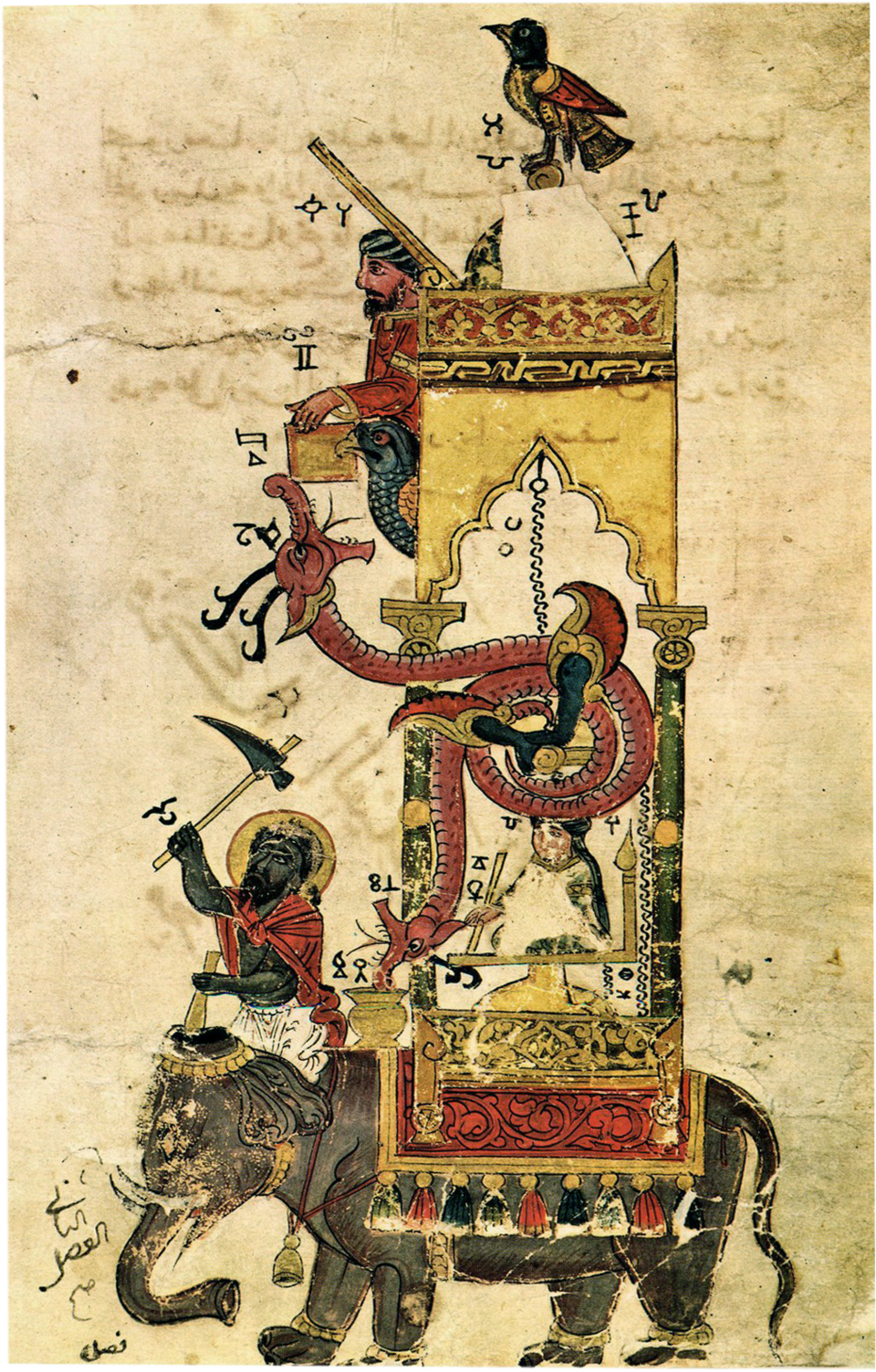
The Elephant Clock, from al-Jazari's Book of Knowledge of Ingenious Mechanical Devices (1206) — completed fifty-two years before the Mongols destroyed Baghdad.
Hulagu Khan’s Mongol army entered Baghdad in February 1258. The Abbasid Caliph, al-Musta’sim — a man whose advisors had urged him not to resist, and whose other advisors had urged him to resist, and who had taken both pieces of advice simultaneously by doing neither effectively — surrendered the city on the thirteenth of Safar.
What followed was not a battle. It was an extinction event.
Later historians would claim the Tigris ran black with ink and red with the blood of scholars. Whether literal truth or the apocalyptic compression of collective memory, the image endured because the scale of what was destroyed demanded a symbol large enough to hold it.
Four centuries of compounding, gone. The House of Wisdom — the Bayt al-Hikma — had been the intellectual centre of the Islamic Golden Age. Greek philosophy, Indian mathematics, Persian astronomy, original works in optics, chemistry, algebra. Some scholars argue it was not a single building but a network — translation and scholarship distributed across libraries, madrasas, and princely courts. If so, what the Mongols destroyed was not an archive but an architecture of thought. And once that architecture died, it could not be rebuilt by reassembling its parts.
• • •
The Balance Sheet
I know that pattern. I once sat in a boardroom watching the best team I had ever worked alongside dismantled in a single quarter. The mandate changed. The talent left. The shell survived. The compounding stopped. It never restarted. I spent four decades evaluating assets — sovereign assets, institutional portfolios, the balance sheets of nations. I learned to tell the difference between a temporary drawdown and a permanent impairment. What happened in that boardroom, and what happened in Baghdad, was the same thing: not a drawdown. A permanent impairment. The capacity itself was gone.
George Saliba of Columbia showed that Islamic science did not collapse after 1258. Nasir al-Din al-Tusi survived the siege — walked out of a city whose libraries were ash and whose scholars floated in the Tigris — and convinced the Mongols to build him an observatory at Maragha. He produced brilliant work. The talent survived because talent is liquid. Tusi relocated to Mongol patronage the way a portfolio manager relocates to the fund that still has assets.
But the institution could not make that move. The House of Wisdom could not board a horse and ride to Azerbaijan. The culture of sustained collaboration that turns individual insight into civilisational knowledge — all of it was illiquid, non-portable, and destroyed.
• • •
The Concentration
As this essay goes to press, the Strait of Hormuz is functionally closed. I wrote about the mechanics of this in The Underwriter’s War. Brent crude at a hundred and twenty-six dollars a barrel. We understand what concentration risk looks like when it involves oil.
But the concentration risk we have not yet confronted involves silicon. TSMC commands over sixty percent of global foundry revenue and more than ninety percent at the advanced nodes required for AI. The manuscripts of the twenty-first century are etched into silicon in a single geography across the strait from a nuclear-armed power. The United States has begun forcing TSMC to build fabs on American soil — but reshoring fabrication from one concentrated geography to another does not eliminate concentration. It changes the landlord. The tenant nations remain tenants.
This is the structural question that India, the UAE, and Saudi Arabia have each begun to answer on their own terms. Not by waiting for someone else’s fab to be built somewhere more convenient. By building their own.
• • •
The Substrate

A processed silicon wafer. Over ninety percent of advanced chips are fabricated in a single geography.
India’s semiconductor ambitions are not theoretical. They are, right now, the most consequential test case of whether a civilisation can rebuild the library before the next fire arrives.
Consider what is already underway. The Tata-PSMC fabrication plant rising in Dholera, Gujarat — eleven billion dollars, a joint venture with Taiwan’s Powerchip — is expected to produce its first chip by the end of this year. Not frontier chips. Foundational silicon — the kind that runs automotive systems, telecom infrastructure, defence electronics. Across ten approved projects, the India Semiconductor Mission has committed nineteen billion dollars to building what did not exist five years ago.
India is not trying to out-compete TSMC at the frontier. It is trying to ensure that if the global library burns, the subcontinent still possesses a printing press. And for the engineers in Bengaluru and Hyderabad — my readers, many of you — the question is personal. Whether India will remain, in the language of agricultural tenancy, a sharecropper on silicon fabricated elsewhere.
Abu Dhabi’s MGX — co-leading investment in Anthropic, partnering in the five-hundred-billion-dollar Stargate initiative — is driven by the same logic. Saudi Arabia’s hundred-billion-dollar Project Transcendence is driven by the same logic. Call them venture bets if you want. They are civilisational insurance — the construction of sovereign knowledge infrastructure by nations that have read history and decided they will not be tenants on someone else’s substrate.
December 2026. The first chip from Dholera. Remember the date.
• • •
The Drain
But there is a quieter burning that has been underway for decades, and it does not require horsemen or siege engines. It requires only a visa and a plane ticket.
Over one million Indian scientists and engineers now live in the United States. Seventy percent of IIT’s computer science elite — the minds trained at the institutions India built to replace what Nalanda once was — choose America. I know an IIT Delhi graduate, top of his class in computational neuroscience, who now optimises advertising algorithms in California. His mother still teaches mathematics in Patna. India spends billions training them. America collects the yield. The compounding happens elsewhere.
The Arab world knows this haemorrhage intimately. Half of all newly qualified Arab doctors emigrate. More than a million Arab experts live in developed countries, and most never return. I have watched this across the region — brilliant young analysts, fluent in three languages, disappearing into London or New York within two years of completing their education. The pull is not malicious. It is gravitational. Talent flows toward the places where compounding is already underway.
Call it what it is. The brain drain is not a metaphor for knowledge destruction. It is knowledge destruction — measured not in manuscripts burned but in theorems never proved at home, in companies never founded in Bengaluru or Cairo or Riyadh. The semiconductor fabs will produce chips. But chips without the engineers to design what runs on them are raw material, not sovereignty. The brain drain is someone upstream diverting the river. The canals will carry nothing if the water is gone.
• • •
The Canal
When the Mongols took Iraq, they did not only burn the libraries. They destroyed the Nahrawan Canal — the irrigation system sustaining Mesopotamian farming since the Abbasid golden age. Modern Iraq is still less cultivated than it was before the invasion. Eight centuries. The land is fertile. The Tigris flows. But the system of distribution was shattered so completely that the region has never fully recovered. Knowledge systems are like irrigation. Not like wells. You do not replace a canal by digging a hole in the ground. You rebuild the entire network. It is the work of generations. And it can be destroyed in an afternoon.
Ibn Khaldun wrote in the Muqaddimah that the past resembles the future more than one drop of water resembles another. The Mahabharata teaches that dharma protects those who protect it — dharmo rakshati rakshitah. Confucius warned that a man who takes no thought about what is distant will find sorrow near at hand. Three civilisations, three scholars, converging on the same structural insight: build before the flood. Build because the building is the thing that matters.
Nalanda burned because its defenders did not imagine a horseman from the Afghan highlands arriving at its gates. Baghdad burned because its caliph could not conceive that the system which had sustained civilisation for four centuries could be dismantled in thirteen days. The libraries burned because the people who built them believed that what had compounded for so long could not be interrupted.
I hear that belief in conference rooms today. I heard it about Hormuz, too, until February. Ask yourself: do you know where the silicon in your company’s products is fabricated?
The question is not whether the library will burn. Libraries have always burned. The question is whether we are building the next one fast enough — and in enough places — that when the fire comes, the compounding does not stop.
I do not have the answer. But I know what the ash smells like.
That retired civil servant — the Bihari, the one who walked the ruins — said something else I have never forgotten. The strangest thing about Nalanda was not the destruction. It was that the monks had no walls. No army. “They believed,” he said, “that what they were doing was so obviously valuable that no one would destroy it.”
He paused.
“They were not wrong about the value. They were wrong about the world.”
— Nazem
• • •
The views expressed here are my own. This essay draws on the work of Minhaj-i-Siraj, Xuanzang, Hartmut Scharfe, George Saliba, Ibn Khaldun, and data from Counterpoint Research, the India Semiconductor Mission, and the NFAP. I am grateful to the scholars whose research made this argument possible.
Nazem Alkudsi, CFA, is the founder of @LongArcNews. A former CEO in the Abu Dhabi sovereign wealth ecosystem and four-decade veteran of institutional investing, he writes about capital, power, and civilisational patterns.