The Monk Who Would Not Take Sides
Thich Nhat Hanh, 1926–2022, and what his refusal asks of us now.
Read slowly.
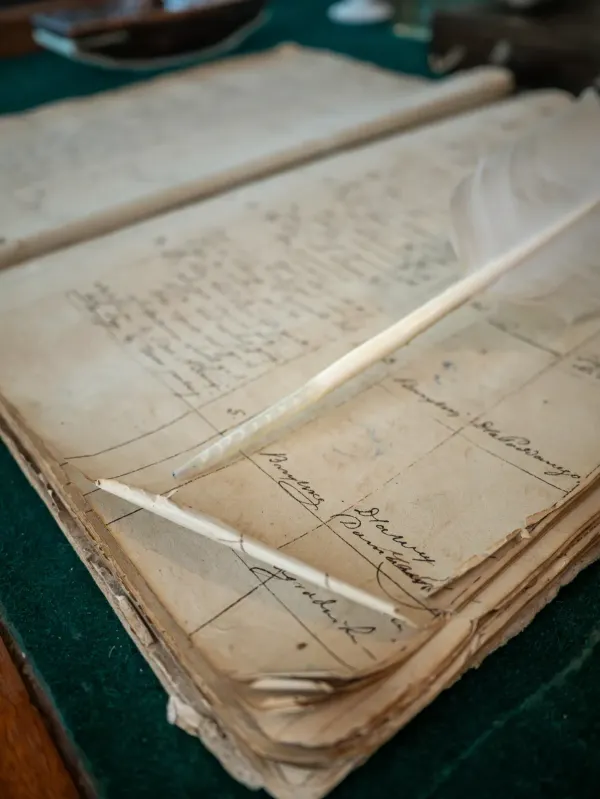
The letter arrived in the ordinary way. Stamped, hand-addressed, opened at his low writing desk by the window. A farmhouse in rural France, the summer of 1978. Twelve years since he had last seen Vietnam. Hundreds of letters a week were arriving from the refugee camps — Singapore, Malaysia, Indonesia, Thailand, the Philippines — and this was one of them.
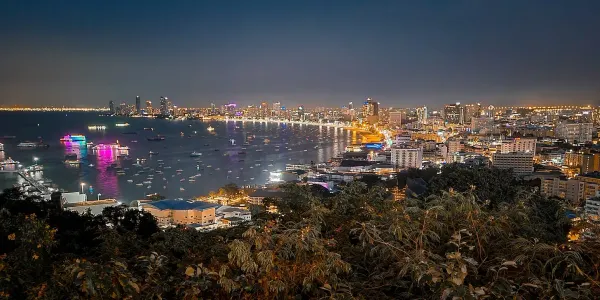
The sender wrote about a twelve-year-old girl. She had been on a boat off the Gulf of Siam, fleeing the country he could not return to. A Thai pirate had boarded. After what had been done to her, she had stepped off the side of the boat into the water.
He read the letter. He sat with it for a long time.
Then he went into his meditation the way a man walks into a forest when the house has caught fire — slowly, deliberately, the only door left open.
And here is where any essay about him must either succeed or fail, because what he saw in that meditation is the whole teaching of his ninety-five years, and if the prose turns it into a concept it has betrayed him.
He saw the girl. Of course he saw the girl. Anyone would see the girl.
What he also saw, eventually, was that if he had been born in that fisherman's village — the sun, the nets, the hunger, the hundred small humiliations of being poor on a coast the world had stopped seeing — he might have become the pirate. The same body. The same breath. A different wind.
And so the poem that came that night had three people in it. A child in the sea. A man with his heart not yet capable of seeing and loving. And a monk at his desk in southwest France — Thich Nhat Hanh — writing them both into himself because the alternative was a lie.
He had been refusing that lie his whole life.
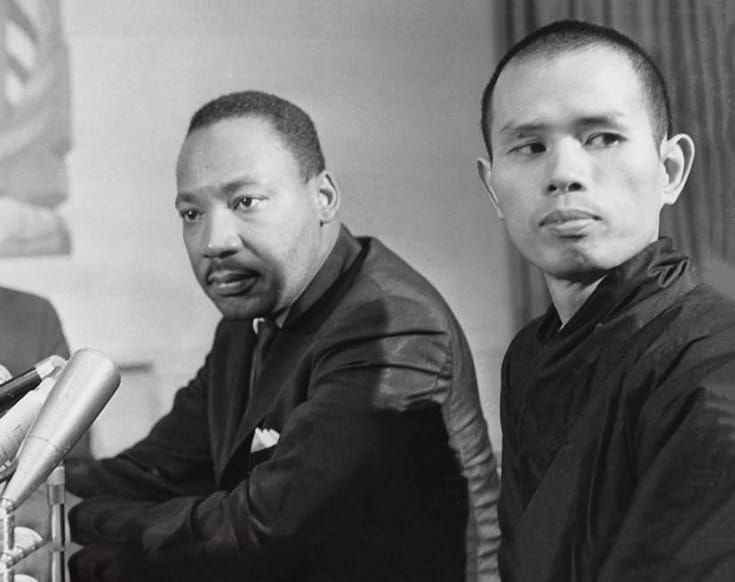
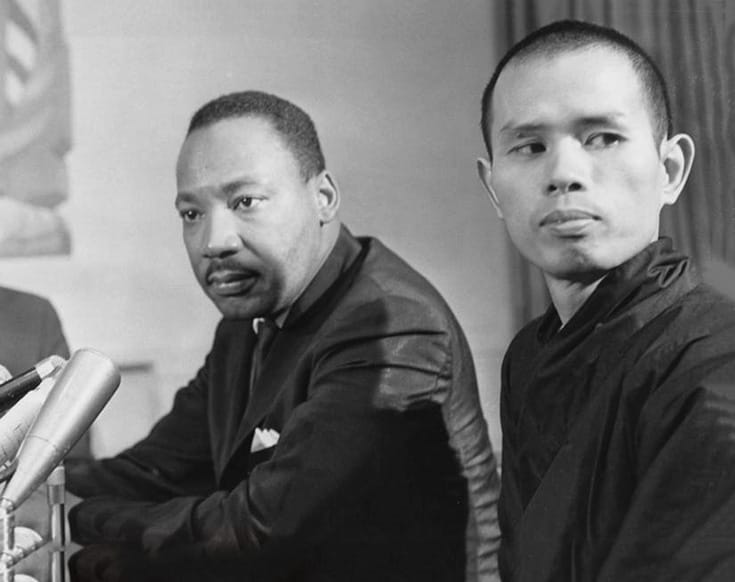
The 1965 letter — sent from Saigon to a Baptist preacher in Atlanta whose name had been everywhere that spring — was titled In Search of the Enemy of Man. He had already understood by then that the enemy of man was not another man. It was something prior to men. Something that made them available to become the pirate, the policeman, the president, the bomber, the bombed. Martin Luther King read the letter. A year later, on the last day of May 1966, they met in Chicago. A. J. Muste of the Fellowship of Reconciliation had arranged it.
By that point Thay had already left Vietnam. He had planned to be gone for weeks. He was gone for thirty-nine years.
What happened in between was this. He went abroad and said aloud, in English, that neither Hanoi nor Saigon spoke for the Vietnamese people. Hanoi answered by banning him. Saigon, which had already been waiting for a pretext, answered by banning him too.
A monk who will not take sides in a war is the one thing a war cannot metabolize.
They spat him out.
King, who understood what it cost to refuse the sides your own people had been assigned, wrote to the Nobel Committee on the twenty-fifth of January 1967. The letter called him the gentle Buddhist monk from Vietnam. Said he knew no one more worthy. Said the world needed this man visible. In private, among his own advisors, King called him brother. The Committee gave no Peace Prize that year. They gave none to anyone.
Four months later the two men met for the second and final time. Geneva. A hotel. Pacem in Terris, convened by the World Council of Churches. Thay was staying on the fourth floor. King had invited him to breakfast on the eleventh. Thay was delayed by the press. When he arrived, King had kept their breakfast warm. He had waited. Over that late breakfast Thay told him something he would be glad, afterwards, to have said. In Vietnam they were calling King a bodhisattva — an awakened being who had chosen to remain among the unawakened to help them see. Eleven months after that breakfast, King was dead in Memphis.
The Sanskrit word is shunyata. He preferred, in English, a word he made up: interbeing. He said emptiness was not absence. It was the presence of everything, held without a separate self. The cup is empty of milk; it is not empty of cup. A flower is empty of any permanent flower-essence; it is full of sun and rain and soil and the hand of whoever planted the seed. To see a thing truly is to see what it is made of that is not itself.
A reader trained in finance will recognize the move. So will a reader who has sat with Ibn Arabi. The traditions speak different grammars. They point at the same object.
What shunya does, when it is practiced rather than merely read, is make sides impossible. Not because every side is equal. Because no side is separate. The pirate is not the girl. But the pirate is also not separate from the village that made him, the coast that was emptied of fish, the long colonial prehistory that turned the Gulf of Siam into a place where men with nothing hunted people with less. To take a gun to the pirate, Thay wrote, was to shoot the whole arrangement. Including ourselves.
His refusal was not a pose. It was the visible shape of what he saw.
This is a hard teaching. It is especially hard in a year when bombs are falling on children again, and both the bombs and the children are demanding that we pick. Shunya does not release anyone from responsibility. It releases us from the lie that responsibility begins at the line where our own skin ends.
There is a shelf in a room in Abu Dhabi where three of his books have stood for longer than I can remember. They were opened at different moments, at hours when something in a life required another vocabulary than the one the day had given. That is the thing about him. He does not ask to be believed. He asks to be practiced. A lecture watched once might do nothing. Watched at the right hour, after the wrong news, it opens a seam that the rest of the noise cannot close.
In 1982 he bought a farm near the village of Thénac in the Dordogne. There were plum trees. He called the place Plum Village, and it became what monasteries become when their founder is paying attention — slow, gardened, a place where people who arrived shouting found themselves, three days in, washing a bowl more carefully than they had ever washed anything.
He did not return to Vietnam until 2005. Thirty-nine years, almost exactly. In November 2014, a brain hemorrhage took most of his speech. He kept teaching — with his eyes, with his hand on a student's shoulder, with the angle of his smile — for another eight years. In 2018 he asked to be taken home to Tu Hieu. The temple where he had been ordained at sixteen. The first place that had called him by the name he would carry through everything. A narrow room. The one he had slept in as a novice.
On the twenty-second of January 2022, in that room, his breath left a body that had spent seventy-nine years teaching other bodies to notice their breath. He was ninety-five. The Gulf of Siam was still there. So were the refugee boats, under other flags. So were the wars, under other names.
What he left was a practice. Not a side. A way of seeing that refuses, patiently, to believe the sides are where our eyes were trained to find them. A way of sitting with the pirate and the girl and the monk in the same body and calling that body by all of its true names.
The letter still sits on the low table by the window. The bowl is still in the cupboard. The breath is still available to whoever has the courage to follow it inward past the last place where a side would hold.
And the unguarded face of everyone we have been told to fear is still waiting, on the other side of the fear, to be called home.
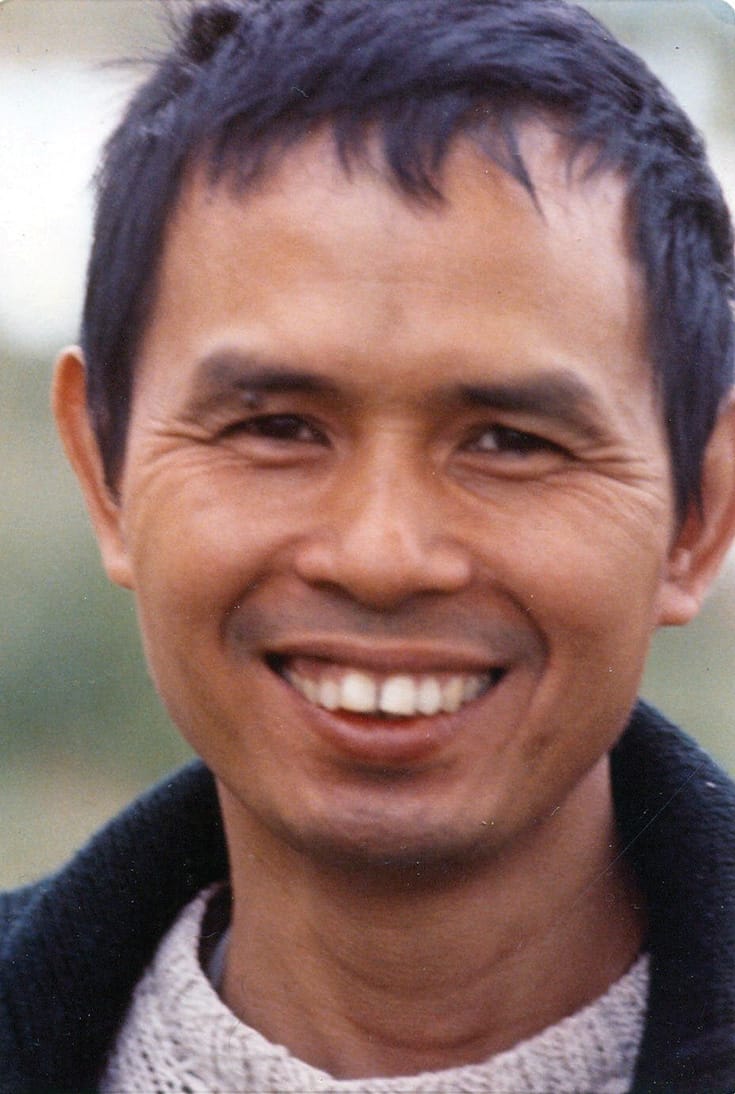
Thay