What Lin Zexu Started

On the Intended and Unintended Consequences of the Opium Wars — and What They Ask of Anyone Watching a Chokepoint Close
• • •
Twenty million people would die because of what happened in those trenches.
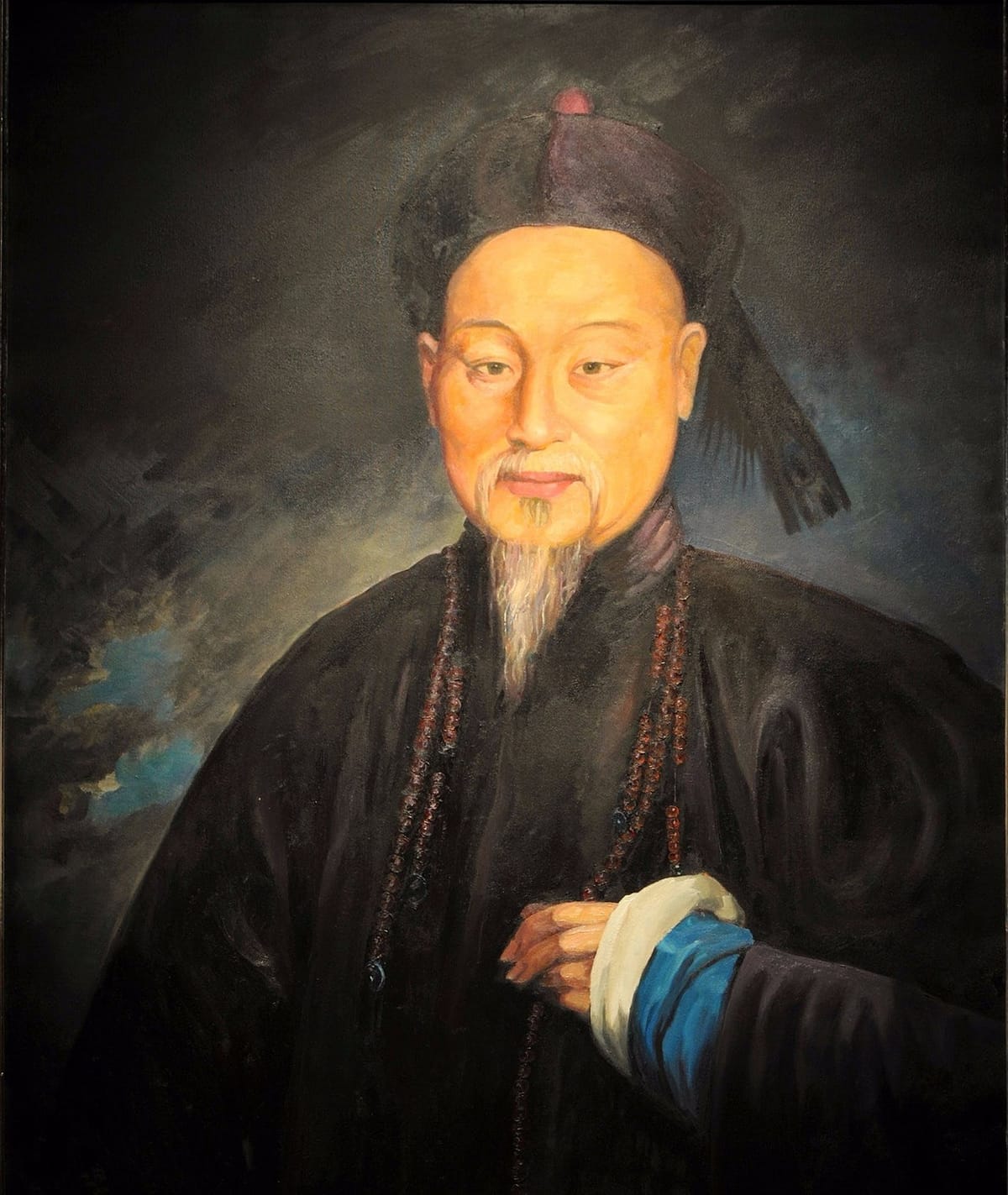
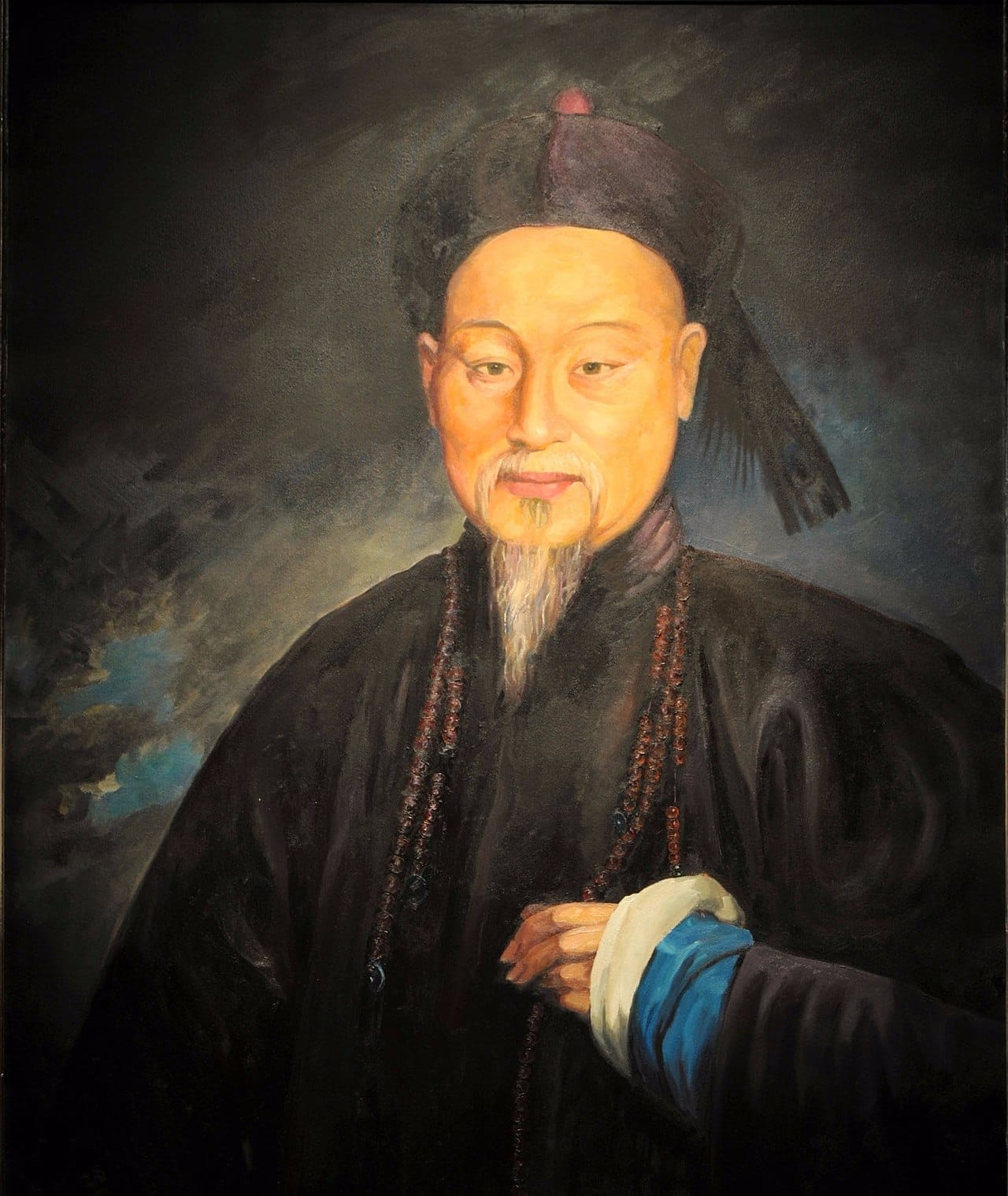
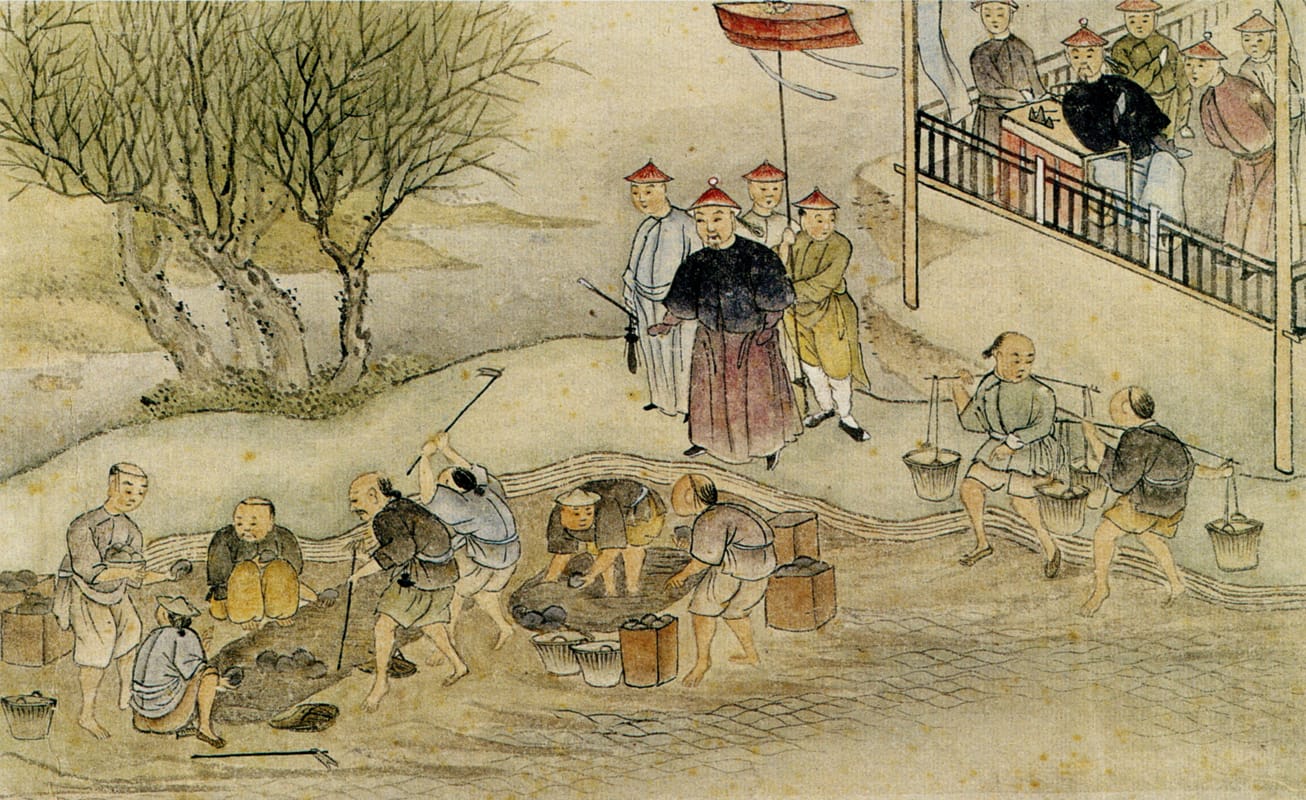
But in June 1839, standing on the shore at Humen, the man who ordered the trenches dug could smell nothing but victory. Lin Zexu — the empire's most competent official, incorruptible, meticulous, feared by the merchants who profited from the opium trade and trusted by the Daoguang Emperor who wanted it stopped — watched twenty thousand chests of British opium dissolve into the Pearl River Delta. Salt and lime in long channels, the tide pulling the poison out to sea. The operation took twenty-three days. Workers waded knee-deep in the slurry, and the stench — vinegar-sharp, chemical — carried across the water to where foreign merchants stood on the decks of their ships, writing furious letters to Parliament. Lin Zexu composed his own letter, addressed to Queen Victoria, asking whether her conscience could bear the knowledge that her subjects sold poison to his people. The letter never reached her. It did, however, reach The London Times in 1840 — the diplomatic channel failed, but the moral indictment entered the British public record anyway, where it haunted the parliamentary debates that followed.
He believed he was saving his civilisation. He was, in fact, giving the most powerful navy on earth exactly the pretext it needed.
That gap — between what Lin Zexu intended and what his actions produced — is where this essay lives. The Opium Wars are not a story about drugs or gunboats, though they contained both. They are a story about the distance between the consequences men intend and the consequences that actually arrive, sometimes a decade later, sometimes a century. And that distance is the most dangerous space in geopolitics. It is where empires go to miscalculate.
• • •
I spent four decades in institutional investing — long enough to know that the most catastrophic losses never come from the risks you model. They come from the second and third-order effects that the model cannot see. The Opium Wars are the most instructive case study in that library, and I am stunned how rarely anyone in the rooms where I spent my career bothered to read it.
Begin with what the British intended. It was brutally simple. China held what Europe wanted — tea, silk, porcelain — and wanted nothing Britain made. The only currency China would accept was silver, and between 1821 and 1830, the East India Company spent over nineteen million pounds on Chinese goods, nearly all of it draining out as metal. The physical weight of national wealth leaving an island.
The intended solution was opium. Grown in Bengal, processed in factories in Patna and Ghazipur, sold through intermediaries to Chinese smugglers. The intended consequence was the reversal of the silver drain. And it worked — spectacularly, appallingly. By the late 1830s, the flow had reversed. Silver was haemorrhaging out of China. Britain's trade deficit had become China's monetary crisis.
Now list the unintended consequences of that single commercial decision:
Thirteen and a half million addicts by 1906. A quarter of China's adult male population hollowed out. Entire provinces in the south collapsing into something that resembled not poverty but entropy — the slow disintegration of a society's capacity to sustain itself. Organised smuggling networks that would later harden into political and criminal structures. And the destruction of a monetary system that had functioned for centuries — because the Chinese peasant earned in copper but paid his taxes in silver, and when opium reversed the silver flow, the real tax burden on a farmer who had done nothing wrong doubled or tripled within a decade. That fiscal suffocation created the conditions that would set twenty million people on a path toward death.
Nobody in the East India Company boardroom intended any of that. They intended a spreadsheet to balance. The spreadsheet balanced. And a civilisation buckled.
I think about those boardrooms more than I should. I have sat in rooms not entirely unlike them — different century, different commodity, different view from the window, but the same silence when someone names a number large enough to change a country. You learn, after enough years in those rooms, that the silence is not caution. It is the sound of men deciding not to ask the next question. The difference between those rooms and the East India Company is not moral. It is informational. We have the history they did not. The question is whether we read it.
• • •
Lin Zexu's intended consequence was clear: destroy the opium, save the empire. His unintended consequence was equally clear: he gave Lord Palmerston the casus belli that British merchants had been lobbying for. Sixteen warships. Four armed steamers. A detachment of Royal Marines. The First Opium War was not fought over opium. It was fought over market access — the right of one civilisation to force another to trade on its terms.
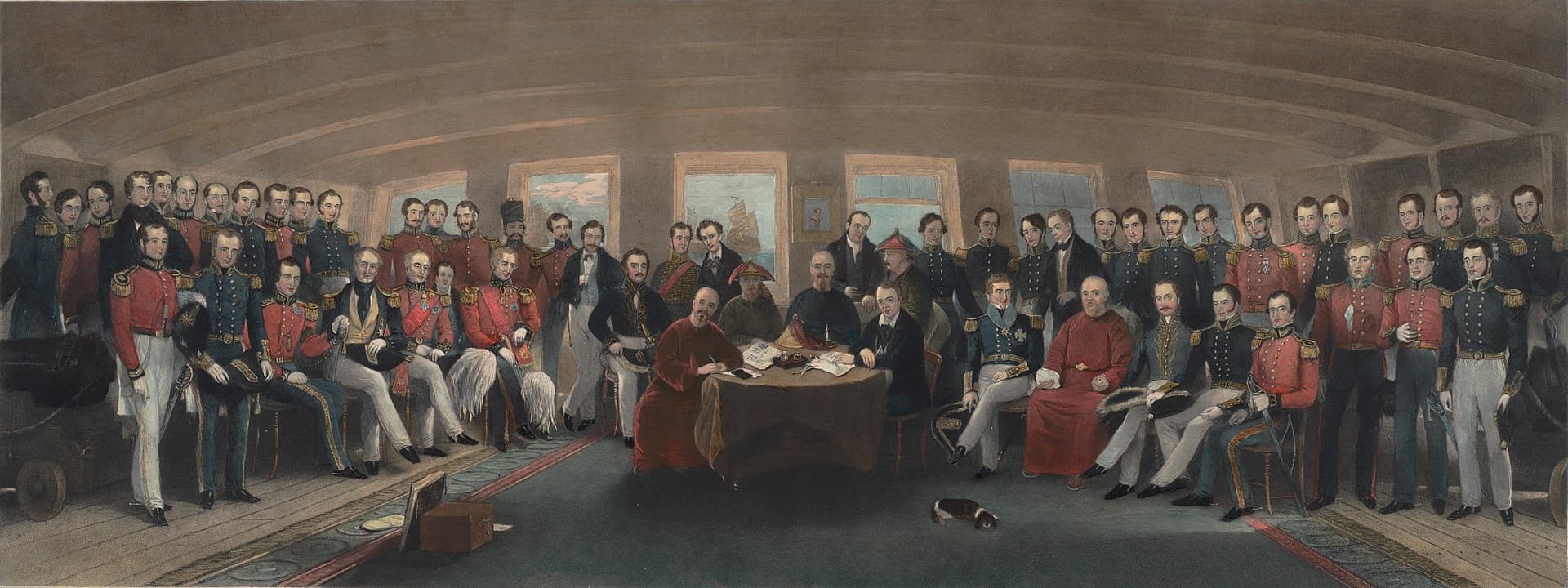
The Treaty of Nanking, in 1842, delivered everything Britain intended. Hong Kong ceded. Five treaty ports opened. Twenty-one million silver dollars in indemnities. Extraterritorial rights — meaning British citizens in China answered to British law, not Chinese law. A sovereignty carve-out so brazen it would shape Chinese legal reform for the next century.
Now trace what the treaty produced that nobody intended.
The Taiping Rebellion. Between 1850 and 1864, somewhere between twenty and thirty million people died — some scholars say more — in the largest civil war in human history. The connection to the Opium Wars is not metaphorical. The indemnities bankrupted the Qing state. The silver outflow destabilised the currency. The opium epidemic destroyed the social fabric of the southern provinces where the rebellion ignited. And the Qing's humiliating defeat demonstrated that the dynasty could not protect its people — a legitimacy wound from which it would never recover.
Hong Xiuquan, who led the Taiping, believed he was the brother of Jesus Christ. He built a theocratic state that controlled a third of China for fourteen years. Most of the twenty million dead died not from combat but from the famine and plague that followed. This was not a consequence anyone in the House of Commons debated when they voted to go to war. Gladstone, who had opposed the war by nine votes — nine — could not have imagined it. The British wanted market access. They got a continental apocalypse.
The Second Opium War, which followed in 1856, compounded every fracture the first had opened. The pretext this time was the Arrow incident — a Chinese-registered lorcha boarded by Qing officials in Canton, its British flag allegedly hauled down. The flag may or may not have been flying. It did not matter. Palmerston, again, saw his opening. Anglo-French forces marched to Beijing and, in October 1860, burned the Yuanmingyuan — the Old Summer Palace — to the ground. The fire lasted three days. Captain Charles Gordon, who watched the looting before the burning, wrote home that the destruction made him feel sick. The palace had contained libraries, astronomical instruments, silks that had been woven before the Norman Conquest of England. All of it — ash. The intended consequence was to punish the Qing court for seizing British negotiators. The unintended consequence was to sear into Chinese memory a symbol of civilisational violation so potent that Xi Jinping would reference it by name a hundred and fifty years later.
There is a passage in Tolstoy's War and Peace where he insists that no general, no emperor, no strategist controls the forces they set in motion — that the grand narratives we construct after the fact bear no resemblance to the chaos of the event itself. The Opium Wars are Tolstoy's thesis in historical form. Every decision was rational within its own frame. Every consequence was irrational in the aggregate. The system was more complex than any of its actors, and it punished their clarity with outcomes none of them could recognise as their own.
• • •
Follow the chain further. The Taiping Rebellion weakened the Qing. The weakened Qing attempted modernisation through the Self-Strengthening Movement — "Chinese learning for substance, Western learning for function" — but the indemnity payments from the wars drained the very resources needed for reform. Japan, watching from across the sea, adopted wholesale modernisation and defeated China in 1895. The Boxer Rebellion in 1900, an anti-foreign uprising born of precisely the resentments the Opium Wars had planted, drew an eight-nation military response and imposed further indemnities so crushing that the Boxer Protocol alone — 450 million taels, compounded to nearly a billion — consumed the state budget for decades.
The Qing fell in 1911. Not to a great revolution but to a cascade of provincial defections triggered by an accidental explosion in revolutionary barracks. Two thousand years of imperial rule ended not with a decisive battle but with a slow structural collapse whose foundations had been cracked in 1842.
The warlord era that followed — twelve years of fragmentation, violence, and opium-funded regional strongmen — created the vacuum into which two forces rose: the Kuomintang and the Chinese Communist Party. Both drew their legitimacy from the same source. Both promised to end what the Chinese had begun to call bainian guochi — the Century of Humiliation. The phrase itself is worth pausing over. It was not coined by propagandists. It emerged organically from the experience of a civilisation that had considered itself the centre of the world and discovered, through repeated military humiliation, unequal treaties, and territorial dismemberment, that it was not. The psychological wound preceded the political programme. When the programme arrived, it had the force of a civilisation's accumulated grief behind it.
Mao Zedong, standing in Tiananmen Square on the first of October 1949, said: "Ours will no longer be a nation subject to insult and humiliation. We have stood up." The sentence carried a hundred and ten years of weight. Every word in it pointed backward to Humen, to Canton, to the Treaty of Nanking, to the opium dissolving in the tide.
The British wanted to sell tea. They got a communist revolution.
• • •
This is where the story becomes something other than history. This is where it starts to feel like a morning briefing.
The Century of Humiliation did not end when Mao declared it over. It became, instead, a governing principle — a psychic architecture that shapes Chinese foreign policy to this day with a consistency that most Western analysts underestimate. Xi Jinping's "Chinese Dream" is not a slogan. It is a direct continuation of the anti-humiliation narrative, institutionalised through patriotic education, state media, and party doctrine. Standing before exhibits of Opium War artifacts at the National Museum in 2012, Xi connected China's past suffering to its future rejuvenation in terms that left no ambiguity. The CCP's legitimacy does not rest on economic performance alone. It rests on being the force that ended a wound the British opened in 1839.
Watch what this produces in practice. The Belt and Road Initiative — the largest infrastructure programme in human history — is framed explicitly as an alternative to the Western-dominated economic order. De-dollarisation efforts, yuan-denominated energy deals, currency swaps with Gulf states worth billions — all of these are, at their root, responses to a question the Opium Wars asked: what happens when your economy depends on a currency and a system controlled by someone who can weaponise it against you?
China learned the answer in 1839, when silver became a weapon. It learned it again in 1858, when opium was legalised at gunpoint. It learned it a third time when the Boxer indemnities were denominated in gold, linking Chinese debt repayment to a standard it could not control — a quiet financial subordination that outlasted the military occupation by decades. It has not forgotten. Nations that have been forced to trade in someone else's currency on someone else's terms develop long memories. They also develop strategies, and the strategies tend to emerge on timescales that those accustomed to thinking in quarterly earnings cycles find difficult to perceive.
The nation that was forced into a trade regime it could not refuse now builds alternative systems with the patience and discipline of a civilisation that thinks in centuries, not quarters. Currency swaps with Gulf states. Yuan-settled energy transactions that bypass the dollar entirely. Infrastructure lending on terms that create new dependencies — gentler than gunboats, but dependencies nonetheless. And in the corridors where the world's hydrocarbons pass through narrow water, a growing presence that is not military but financial, not coercive but gravitational, and which owes its existence to a wound opened at Humen in 1839.
I say this not as a critic of any particular state — I say it as a citizen of the Gulf, a man whose professional life was spent inside the sovereign wealth architecture of the Gulf, who has watched the region I carry in my body become the stage on which these century-old consequences now converge. I can feel it in the pricing of things. In the new denominations on energy contracts that used to be settled in one currency and are now, quietly, being settled in another. In the way certain corridor risks have moved from the appendix of the briefing document to page one. The Opium Wars did not end at the Pearl River. They are arriving, in forms Lin Zexu could never have imagined, at chokepoints he never heard of.
• • •
There is an irony here so large it almost escapes notice.
The power that emerged from the Century of Humiliation — the power that Mao said had "stood up" — now offers its currency as the medium through which the world's most vital commodity corridors might be repriced. Not through military force, as Britain used in 1839. Through infrastructure, through lending, through the quiet accumulation of dependency. The tools are different. Whether the grammar is different remains an open question — and it is a question that anyone sitting in a Gulf capital, watching energy corridors narrow and currencies shift, should be asking with more urgency than I currently see.
I will say it plainly, because I am old enough and have buried enough forecasts to have earned the right: the people I know in this region — the allocators, the strategists, the ministers who read the same briefings I do — are not asking this question loudly enough. They are modelling the first-order effects. They are not tracing the chain. And the chain, as the Opium Wars teach us, is where the dying happens.
Because the deepest lesson of the Opium Wars is not about Britain, or China, or opium. It is about the nature of consequences in complex systems. Every actor in the story — the East India Company, Lin Zexu, Palmerston, the Qing court, Gladstone — acted on intentions that were coherent within their own frameworks. And every single one of them produced consequences that dwarfed their intentions, consequences that cascaded across decades and continents, consequences that are still arriving now, in places and currencies and chokepoints that the original actors could not have conceived.
A trade deficit produced a drug epidemic. A drug epidemic produced a war. A war produced a treaty. A treaty produced a rebellion that killed twenty million people. A rebellion weakened a dynasty. A weakened dynasty fell. A fallen dynasty produced a century of fragmentation. Fragmentation produced revolution. Revolution produced a nuclear power. A nuclear power now offers its currency as the alternative to the system the West built — in corridors and straits where the world's energy passes through spaces so narrow a captain can see both shores from his bridge.
That chain is not a metaphor. It is a mechanism. And mechanisms, once understood, carry an obligation: to ask, before the next force is applied to the next chokepoint, whether anyone in the room has truly traced the consequences to their end. Whether the men making decisions about narrow waterways and precious commodities today have studied what happened the last time men made decisions about narrow waterways and critical commodities — and whether they have the honesty to admit that the forces they are acting upon are wilder than any strategy document can contain.
The Quran warns: wa ittaqu fitnatan la tusibanna alladhina dhalamu minkum khassatan — "and fear a trial which will not strike those who have wronged among you exclusively." The Torah commands that when you besiege a city, you shall not destroy its trees, because the tree of the field is man's life. Paul writes to the Galatians: "Be not deceived; God is not mocked: for whatsoever a man soweth, that shall he also reap." The Mahabharata asks, through Gandhari mourning her hundred sons on the field at Kurukshetra: what was won here? Four traditions, separated by thousands of miles and centuries, arriving at the same insight. The consequences of force do not confine themselves to the combatants. They radiate outward. They always have.
Lin Zexu could not have known. He acted with moral clarity and strategic intelligence, and the world he acted upon was larger than any single mind could hold. That is not an indictment of Lin Zexu. It is a description of the world — then, and now.
He was exiled to Xinjiang, where he dug canals in the desert. The posting was meant to destroy him. Instead, he improved the irrigation of the Ili Valley, because that was the kind of man he was — the kind who builds, even in disgrace, even when the empire he served had already begun to fall apart around him. Before he left Canton, he wrote: "Were it the will of Heaven to revitalise this land, how could its fate be sealed by a single person's fall?"
The question is still open. I hear it in every corridor I walk through, in every meeting where the numbers are large enough to change a country and the silence is loud enough to fill the room. I heard it this morning.
— Nazem
• • •
This essay is a work of historical analysis based on publicly available academic and archival sources. It does not represent the editorial position of any government and should not be construed as commentary on any state's foreign policy or current bilateral relationships.
Sources: Julia Lovell, The Opium War (2011); Stephen R. Platt, Imperial Twilight (2018); Hsin-pao Chang, Commissioner Lin and the Opium War (1964); Jonathan Spence, The Search for Modern China (1990); Zheng Wang, Never Forget National Humiliation (2012).
Nazem Alkudsi, CFA, is the founder of @LongArcNews. A former CEO in the Gulf sovereign wealth ecosystem and four-decade veteran of institutional investing, he writes about capital, power, and civilisational patterns.