The Tower That Never Opened

Essay one of three. Cambodia.
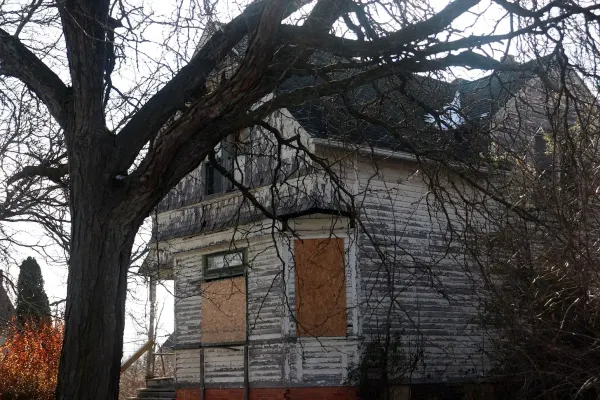
Yim Sreymao opens her shop at five-thirty in the morning, before the cement dust has settled from the night air. She sells rice, fish sauce, condensed milk, plastic sandals, the small inventory that turns over a few dollars a day in a neighborhood that used to be busier. Above her shop, an unfinished concrete tower rises against the Sihanoukville sky. The tower has no windows. The interior is bare. A Chinese investor began construction before the casinos closed, and abandoned the site sometime after the gambling ban and the pandemic arrived together in 2019 and 2020. The investor has not returned. Yim Sreymao said to a Cambodian journalist, in a sentence that did not appear in any Western newspaper: I have never seen the owner. He went to China already.
She has never seen him. He is not coming back.
This is one tower. There are several hundred others like it in Sihanoukville in 2026. Some taller. Some nearer the sea. All of them empty. The city beneath them is the visible end of a story that began fifty years ago, in a war Cambodia did not declare, that produced a regime that emptied the cities, that produced an invasion that ended the regime, that produced a government that has invited a foreign power to build infrastructure across the country on terms no Cambodian government thirty years ago would have agreed to. The tower above Yim Sreymao’s shop is the surface. The story is underneath.
What is this city, in 2026? A statistical answer is possible. Between 2014 and 2019, Chinese investment in Sihanoukville reached approximately 1.3 billion dollars. Ninety percent of businesses in the city were Chinese-owned at the peak. The Sihanoukville Special Economic Zone hosted more than two hundred enterprises by 2025. The Phnom Penh-Sihanoukville Expressway, built by China Road and Bridge Corporation, opened in October 2022 at a cost of two billion dollars, reducing the drive from five hours to two.
That is the statistical answer. It is not the whole answer.
Kong Samol drives a tuk-tuk through Sihanoukville. He has driven one for fifteen years. He told a journalist that since the Chinese came, his expenses have gone up and his earnings have gone down. He did not explain the mechanism, but a Cambodian listening would have understood it. The Chinese brought money and the money brought prices, and when the money left the prices stayed. Kong Samol still drives. The city around him has changed three times in his working life. Each change has cost him something the next change did not give back.
And there are the buildings. Cement skeletons rising from soft red earth, rebar curling at the top like grass that grew too fast. The Chinese names are still on some of the construction signs, the paint cracking. Cambodian children play in the unfinished lower floors. Stray dogs sleep in the lobbies. The towers were going to be casinos, condominiums, hotels, shopping arcades. They are nothing now. But they are not empty in the way a clearing is empty. They are heavy with what was meant to happen and did not.
How did this city, and this country, arrive here?
The question has a shape. Each answer is a step backward. Behind the unfinished tower is the political settlement that invited the investor. Behind the political settlement is the rise of one man and his single party. Behind that man is the Vietnamese army that returned him to his country in January of 1979. Behind the Vietnamese army is the regime the army came to end. Behind the regime is the war that produced it. The war is where the answer lives, but the answer is not visible from where we are standing. It must be excavated.
Begin with Hun Sen. He governed Cambodia for thirty-eight years. He became foreign minister at twenty-seven, in January of 1979, the youngest in the world at the time. He had defected from the Khmer Rouge eighteen months earlier to escape the eastern zone purges in which his fellow officers were being arrested and killed. He crossed the border into Vietnam. He returned with the Vietnamese army that took Phnom Penh on January 7, 1979. He has been a senior figure in every Cambodian government since.
In July of 1997 he eliminated the prince who had been his co-prime minister under the United Nations settlement of 1993. The coup was brief. The prince fled. The Cambodian People’s Party consolidated. In 2017 the country’s only credible opposition party was dissolved by the Supreme Court. Its leader, Kem Sokha, was imprisoned on a treason charge no serious observer of Cambodian politics believed. The Cambodia Daily, the country’s last independent English-language newspaper, was closed in the same year over a tax dispute no serious observer believed either. By 2023, when Hun Sen handed power to his son, the ruling party held one hundred and twenty of the one hundred and twenty-five seats in the National Assembly. Hun Manet was sworn in on the 22nd of August. He was educated at West Point, then NYU, then Bristol. His younger brother Hun Many is deputy prime minister. The sons of the father’s old comrades sit in the ministries their fathers built.
The Vietnamese army that brought Hun Sen back arrived in late December of 1978. Between one hundred and one hundred and fifty thousand troops. Division 341 of Army Corps 4. The full-scale offensive began on the 25th of December. The Khmer Rouge’s outer defensive lines collapsed within a week. Phnom Penh fell on the 7th of January, 1979. The People’s Republic of Kampuchea was proclaimed the next day. The Khmer Rouge retreated west into the jungles along the Thai border, where they conducted a guerrilla war for another two decades.
This is one of the moral knots of the twentieth century, and I want to name it carefully, because the careful naming is part of what the careful reader will look for. The Vietnamese army ended the Cambodian genocide. The United States and China and the ASEAN governments refused to recognize the government that ended it. The Khmer Rouge, in coalition with Prince Sihanouk and a smaller non-communist faction, continued to hold Cambodia’s seat at the United Nations until 1991. The country that had been emptied of its cities and stripped of its educated class was placed under an economic embargo by the democracies of the world, while the regime that had done the emptying and the stripping was permitted to speak in Cambodia’s name from a chair in New York.
I am not the first to point this out. But it bears pointing out, here, in this essay, because the question of who pays for the silence after a war is the question this entire series has been asked to answer. Cambodia paid. The world chose, and Cambodia paid.
To arrive at what made Hun Sen possible, you must walk through what Hun Sen lived through. The Khmer Rouge took Phnom Penh on the 17th of April, 1975. Within hours, they began the evacuation of the city. Two million people were told that the Americans were about to bomb the capital, that the evacuation was temporary, that they would be permitted to return in three days. They were not permitted to return. The roads out of the city were lined with the dying within a week, and the survivors arrived in a countryside the new regime had decided would be the only Cambodia. The rest of the country was to be erased.
What followed was four years of something for which the existing vocabulary was inadequate, and is still inadequate. Several Cambodian survivors have done what could be done with words. Loung Ung was five in April of 1975, the daughter of a Lon Nol military police officer. She remembered, later, a sixth birthday observed in a labor camp. She wrote that instead of celebrating with birthday cakes, she chewed on a piece of charcoal. Haing Ngor was a surgeon. He survived by hiding his profession, his glasses, his education, and posing as a taxi driver. He wrote afterward that nothing had shaped his life as much as surviving the Pol Pot regime, that this was who he was. Chanrithy Him lost her parents and five siblings. She wrote that telling her story was a form of personal justice.
By the time the Vietnamese army arrived in January 1979, approximately 1.7 to 1.9 million Cambodians were dead. The figure is contested, the methodology contested, the demographic models contested. The basic shape is not contested. Roughly a quarter of the country was killed by its own government in four years. Eighty-one percent of the violent deaths were men, which would shape the gender composition of Cambodia for two generations. The ethnic Cham and the ethnic Vietnamese were targeted for genocide in the formal sense. The educated were targeted as a class. Anyone who had worn glasses, or who could read French, or whose hands were soft from office work, was at extreme risk of being killed.
Why did this regime, of all the regimes of the twentieth century, succeed in taking power in Cambodia of all places? The standard answer is ideological. The Khmer Rouge were Maoists. They had been inspired by the Cultural Revolution. They were the product of a French-educated intellectual cadre that had embraced an extreme form of agrarian communism. All of this is true. None of it is sufficient.
In 1969, before the United States began the systematic bombing of Cambodia, the Khmer Rouge was a marginal insurgent group of perhaps one thousand to five thousand fighters. By 1973, the year the bombing ended, the Khmer Rouge had over two hundred thousand. Between those two numbers, in four years, is the answer to the question of how the regime took power. The bombing made the regime.
The American bombing of Cambodia between 1965 and 1973 amounted to approximately five hundred thousand tons of ordnance. Owen and Kiernan revised this figure upward to 2.7 million tons in 2006, then downward to 500,000 in 2010, after a coding error in the original Air Force database was identified. The corrected figure is now the scholarly baseline. Nearly half of that total, close to 250,000 tons, fell between February and August of 1973, in the six months after the Paris Peace Accords were supposed to have ended the American war in Indochina. The Nixon administration had transferred the bombing fleet from Vietnamese targets to Cambodian targets. Congress voted to end the bombing in June, with an August 15 termination date, and in the final 45 days the Seventh Air Force dropped over 82,000 tons of bombs in a frantic attempt to stabilize the Lon Nol regime. William Harben, the chief political officer of the U.S. Embassy in Phnom Penh, wrote in his cables that funeral processions were being mistaken for enemy movements and razed by B-52 strikes.
The bombing did not stop the Khmer Rouge. The bombing recruited them. A CIA Directorate of Operations report dated May 2, 1973, noted explicitly that the communists were using damage caused by B-52 strikes as the main theme of their propaganda, and that the propaganda was effective with refugees and in areas subject to B-52 strikes. A Khmer Rouge officer, Chhit Do, told the journalist Bruce Palling that cadres would take villagers to see the bomb craters as evidence of the inhumane nature of the government. After a bombing raid, he said, the survivors were terrified and half crazy, and ready to believe what they were told.
The line that does the most work in this section comes from the man who would, after the bombing, become the head of state of Democratic Kampuchea. At his trial before the Extraordinary Chambers in the Courts of Cambodia in November of 2011, Khieu Samphan turned to the court and said: you seem to forget that between January 1970 and August 1973, the United States carpeted the small Kampuchean territory with bombs. Could you imagine, he asked the court, what the situation was like for the Cambodian people during such carpet bombings? Let the regime’s own architect name what made his country into the soil his regime would grow in. The essay does not need to argue the causal claim if Khieu Samphan has argued it under oath in a court of law.
So now you can see it.
The bombing produced the displaced peasantry. The displaced peasantry produced the Khmer Rouge. The Khmer Rouge produced the genocide. The genocide produced the Vietnamese invasion. The Vietnamese invasion produced Hun Sen. Hun Sen produced the conditions for the Chinese pivot. The Chinese pivot produced the casino boom in Sihanoukville. The casino boom produced the tower above Yim Sreymao’s shop.
It is a single chain of consequence, fifty years long, that runs from a B-52 over the Cambodian border in the early 1970s to a Chinese investor’s abandoned skyscraper in a coastal city in 2026. Each link was forged by the previous link. Each forged the next. No link was inevitable, but each became inevitable once the previous had been forged. This is what the introduction to this series meant by the word migration. The war did not end in 1975. It migrated.
And it is still migrating. On the 5th of April, 2025, Prime Minister Hun Manet stood beside General Cao Qingfeng of the Chinese Central Military Commission and presided over the inauguration of the China-Cambodia Ream Naval Base Joint Support and Training Center, southeast of Sihanoukville, on the Gulf of Thailand. The water depth had been dredged from two or three meters to between eight and eleven. A new 363-meter pier had been constructed, capable of accommodating Chinese naval vessels. General Cao described the base as a symbol of the iron-clad friendship between China and Cambodia. Twelve days later, on the 17th of April, President Xi Jinping made a state visit to Phnom Penh, and a definitive financing agreement was signed for the Funan Techo canal: one hundred and fifty-two kilometers of waterway, from the Mekong to the Gulf of Thailand, financed at 1.156 billion dollars. The canal will bypass Vietnamese ports, which currently handle a third of Cambodia’s external trade. Hanoi has objected. Phnom Penh has been clear that the canal will be built regardless of any objection. Approximately 2,305 households in Takeo province are still waiting, as of early 2026, for the compensation packages they were promised when their land was taken.
In January of 2026, the USS Cincinnati made a port call at Ream. Admiral Paparo of U.S. Indo-Pacific Command announced the resumption of Angkor Sentinel exercises and the lifting of the American arms embargo. Hun Manet’s government is now described, in Washington and in Beijing both, as engaged in strategic balancing.
This is what the war that ended in 1975 looks like in 2026. The combatants are not the same. The mechanism is.
I write this from the Gulf, but I am the grandson of a region that outside powers have been rearranging for as long as anyone alive remembers. Lines drawn by men in London and Paris in 1916 became countries that did not know they were countries until they were told. Lines drawn by Washington and Moscow during the Cold War became governments their people never chose. The story of Cambodia is not my story. But the question of what happens to a country when its future is decided in capitals it has never seen is a question I have carried since childhood.
In February of 1982, the regime of Hafez al-Assad turned its artillery on the city of Hama. The neighborhood at the heart of the old city, al-Hader, was where both my maternal grandfather’s family and my maternal grandmother’s family had lived for generations. Al-Hader was flattened. My mother was in Aleppo when the news began to trickle in, in fragments, contradicted by state radio. I was a child. I could feel her pain, then, the way children feel the pain of their mothers, without being able to name it. I have spent forty years trying to imagine what those weeks were like for her, and for the family who waited to know what had become of the streets their parents and grandparents had walked.
The Cambodian story is not my story. But the question of what regimes do to their own cities, and what the world chooses not to say in the years afterward, is one I have carried since childhood. The unfinished tower above Yim Sreymao’s shop is one shape this question takes. There are other shapes. Next week we will walk through one of them. The bombs that fell on Laos between 1964 and 1973 are still detonating in 2026, in fields where children are still losing legs to ordnance that was meant for someone else’s war. The country that did not declare the war is the country that has been answering for it for fifty years.
The mechanism does not stop. But this essay must.