The Country That Chose

The Vietnam War and its neighbors: Essay Three
The heat comes off the concrete at U-Tapao in a way you can almost see, a wavering in the air above the strip, and through it a small jet from Kunming settles down and taxis toward the terminal. It is an ordinary afternoon in May. The passengers coming down the stairs are tourists, most of them young, looking at their phones for the cars that will take them to the beaches an hour up the coast. None of them look at the runway. It is only a long grey rectangle, wide enough for two aircraft side by side, thick enough that it has not been rebuilt in sixty years.
It was poured that deep for a reason. The strip was laid in the mid-1960s, by American naval engineers, to carry the heaviest bombers the world had then made. The war those bombers flew to was not Thailand's. The country had not been invaded, had declared nothing, had sent no armies into the fight when the runway was laid. And yet the war came here all the same, down through this concrete and the six other airfields like it, and it did not leave the country the way it found it.
Near the fence an old man in a faded vest watches the tourists go. Behind him the cranes are already up over the next thing, an airport city the government is raising on this ground, worth nearly three hundred billion baht, its concession running to the year 2076. The strip the war built is becoming the foundation of a resort.
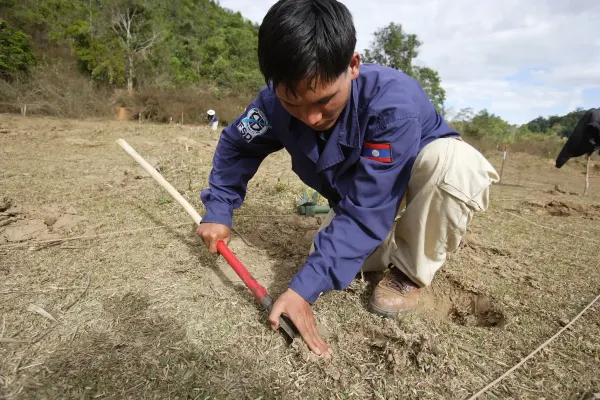
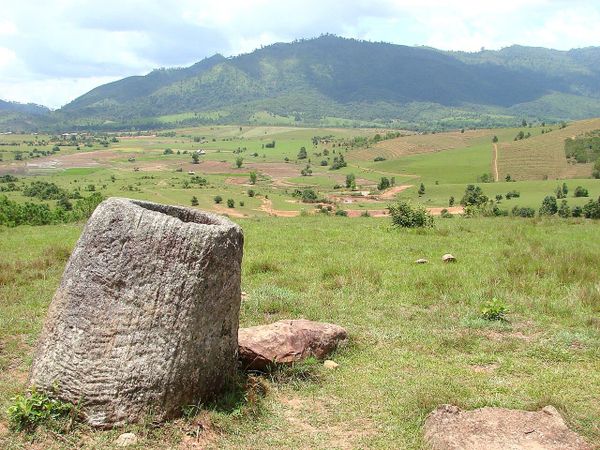
Laos was bombed until its plain of jars filled with iron the size of a fist, the kind that still comes up under a child's hoe. Cambodia was bombed too, and then turned on itself in a way that has no bottom. Thailand was neither bombed nor occupied. It was changed from the inside, by a war it agreed to host and never had to fight. The other two were ruined by what was done to them. Thailand's wound is of another kind: it chose.
To see why a Thai government would open its country to a foreign air force, go back to 1962 and stand inside the fear of the soldiers who ran the place. They looked north and saw the thing they had been raised to dread. Laos was coming apart, the war in Vietnam was widening, and the communism that had taken China seemed to be coming down the rivers toward the Mekong. Bangkok did not believe, whatever it said aloud, that it could stand against that alone.
Thailand had an old habit of survival. For more than a century its kings had kept it independent by bending, giving a little to whichever great power leaned hardest, never planting their feet so firmly the country could be knocked down. It was the one kingdom in the region never ruled from Europe. But bending works in a world of several powers leaning from several sides, and in the Cold War one direction counted. The men in Bangkok leaned the whole way into it.
On the sixth of March, 1962, the foreign minister Thanat Khoman and the American secretary of state Dean Rusk signed a joint statement whose careful language carried an enormous meaning. The American promise to defend Thailand, it said, was individual as well as collective, which meant Washington need not wait for its treaty partners to act. The Americans were not cynical in this. They believed, with the conviction of their age, that communism would take the whole region if it were not stopped somewhere, and that Thailand was the somewhere. With that sentence the bases became possible, seven great airfields in time, and the better part of fifty thousand American servicemen on Thai soil. The public was told almost nothing of what they were for. The bombing those airfields launched belongs to the countries next door. What stayed was the door they opened into Thailand itself, and almost everything that remade the country came through it.
What came through the door, at first, looked like a miracle.
It came as roads. In the late 1950s, with American funds, Thailand built the Friendship Highway, the Mittraphap, running from the centre of the country into the dry northeast the capital had half forgotten. It was the first road in the kingdom built to an international standard, and it had a double use: it carried supplies toward the bases, and it bound the poor interior to the rest of the nation for the first time. The deep-water port at Sattahip grew on the same logic, and in 1966 a treaty of amity opened Thailand to American business. The frame of a modern economy was being laid down at speed, and the war paid for the steel.
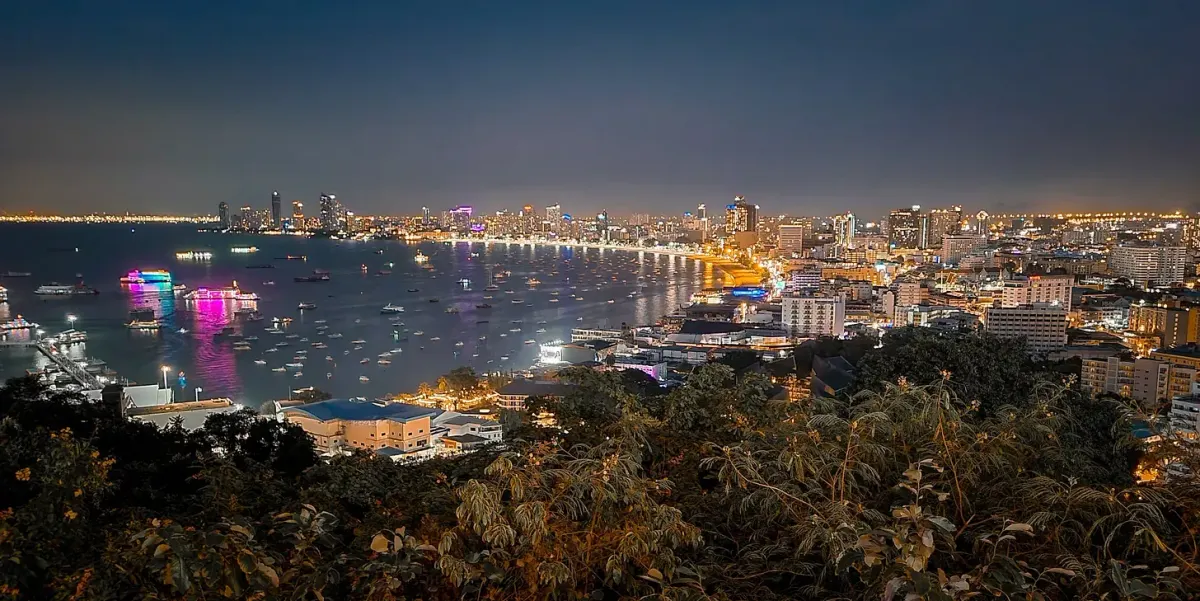
Then there were the soldiers on leave, hundreds of thousands of them, and an economy grew up to take their dollars. Within a few years Bangkok had hundreds of bars built around the off-duty American. At Pattaya, a fishing village before the war, the man who opened the first hotel remembered it filling, in 1965, not with holidaymakers but with the engineers building the runway at U-Tapao. The village became a resort. Young women came down from the northeast to work the bars and sent their wages home, so that the road the Americans had built carried the women south and the money north.
Three older trades were caught in that same current and changed by it. Prostitution and gambling were not new to Thailand, as old as any port; what the war did was industrialise them, give them dollars and permanence and scale, and turn a margin of the economy into something nearer a pillar. The narcotics were a harder case. The opium of the highlands was older than any American, but the networks that now moved heroin, first to the soldiers who wanted it and then into the cities of Thailand itself, were built to the size of the war. None of this was American design. It was the side effect of magnitude, of forcing that much money and appetite through a small country in a few years. The bill came due later, and Thais paid it: addiction through the towns in the early 1970s, districts that did not close when the soldiers left, a new disease that would travel that same road a decade on, and the money that fattened the men who ran the traffic and the violence with them. The road that brought the wealth brought the rest, on the same wheels.
But the deepest thing that came through the door was not money. It was the army. A frontline ally is armed, and Thailand was armed, year after year, with weapons and training and the quieter machinery of a security state. The men who already held power grew richer on it and surer of themselves, and the institution they commanded grew until it was no longer one power among several but the power from which the others took their permission.
This was not new to the country, but the war made it permanent. The army had first seized the government in 1932, when it ended the absolute monarchy, and had taken power by force a dozen times since. What the alliance did was settle the habit into the bones, fund it, arm it, and hand it a Cold War reason that silenced argument. A general who took the state could now do it as the wall against communism, with a great power behind him. The civilian governments that came and went between the coups governed at the army's sufferance.
A country cannot take in that much of a war and have it touch only its roads and its banks. A society that agrees to stand on the front line of someone else's war begins, after a while, to treat its own quarrels as battles in it. The students who wanted a freer country could be called communists, and so could the workers who asked for a better wage and the farmers in the northeast who only wanted to keep their land. The fire Thailand had kept off its borders had come in through the door with everything else, and by the mid-1970s it was near the surface.
There is a field at Thammasat University in Bangkok where, on certain October mornings now, people hold sheets of clear acrylic up against the buildings. Printed on them are photographs from one morning fifty years ago, and a person tilts the sheet until the doorway in the old picture lines up with the doorway still standing, the same stone, so that for a moment the past lies over the present like a second skin. The hardest of these shows this same grass covered with young men stripped to the waist, made to lie face down in rows while armed men stand over them. It was taken here. The ones lying in it were students, and many had only hours to live.
Before dawn on the sixth of October, 1976, the police and the army and the gangs the state had armed came onto this campus. For weeks the students had been named communists in league with Vietnam, plotters against the throne, insulters of the heir to it; a newspaper had run a doctored photograph claiming to show a student dressed as the prince. Two men who had hung posters in the provinces were already dead, beaten and strung from a gate. By sunrise the campus was being fired into with the weapons of war, and the students caught in the open had nowhere to go.
What was done then is hard to set down, and was meant to be. People were shot. People were beaten to death with whatever lay to hand. Some were hanged from the trees along the avenue while a crowd gathered to watch, and a photographer caught a man swinging a folding chair into one of the hanging bodies as the people around him smiled. That photograph won a prize in America the next year. The official count was forty to forty-six; the man who had led the university said it was past a hundred. Against what had happened in Cambodia it was a small number. It was not a small thing.
A well-known monk had given the killers their absolution in advance: to kill a communist, he said, was not demeritorious, because the thing being killed was not truly a man. That evening the army took the government and began the work of forgetting. No one was punished. The killing was scrubbed so thoroughly from the schoolbooks that for years a Thai child could pass through a whole education and never learn it had happened.
One student who lived through it, who spent two years in prison and became a historian, has given the rest of his life to making the country remember. He calls what it lives in not forgetting but its opposite, an unforgetting, the state of being able neither to recall a thing nor to let it go. Another survivor, a first-year student on that field, wrote that every October the sixth an old sadness takes her she cannot account for. The army the bargain had built had turned its weapons on the country's own young, then filed the morning away as carefully as the graves were filed away in Laos.
The army did not loosen its grip after that. Power was taken by force again in 1991, in 2006, in 2014, each time from an elected government, each time in the name of order. Between the coups the courts learned to do the same work by other means, dissolving parties and removing prime ministers the generals found inconvenient. The most popular electoral movement of the century, built around Thaksin Shinawatra and then his sister and his daughter, was put out of power three times in twenty years, twice by soldiers and once, in 2025, by a court ruling.
In February of 2026 the country voted again, and the winner was a royalist who makes no secret of his closeness to the generals, lifted into office on a wave of nationalist feeling stirred by fighting along the Cambodian border, where Bangkok had handed the army full discretion to answer perceived insults with force. A progressive movement that had run on pulling the military out of politics lost. Sixty years after the runway was poured, the institution the war had fed was still the decisive power in the land. The fire the bargain was meant to keep outside, that had burned at Thammasat, had never gone out. It had only changed what it was willing to be called.
So how should one think of Thailand? Two readings offer themselves, and both hold at once. In the first, Thailand is no victim. It saw the danger, judged that alignment was safer than neutrality or defiance, and leaned the whole way in with its eyes open. It took the bases and the money, built the roads and the resorts, and has prospered since on foundations the war poured. Its leaders were not tricked; they made a calculation, and on its own terms it held. Set beside Cambodia and Laos it can even look like wisdom, the wisdom of a man who reads the weather and builds where the storm will not reach.
In the second, the bargain was paid for by people who were never asked. A small country tied to a giant is never the giant's equal. The army the alliance fattened was turned not outward at the giant's enemies but inward, at Thailand's own. The students shot down on their grass had not signed the agreement of 1962. Thammasat was the bill for a choice a few frightened men had made long before most of the dead were old enough to vote.
Why did Thailand bend without breaking when the others broke? Not virtue, and not luck. Beneath its politics it had a state that could hold. Since the reforms of King Chulalongkorn it had built one, a real civil service, an army that belonged to no single man, an idea of the nation older than any government on top of it. So when the violence of the age came inside, the structure beneath did not give: the taxes were collected the next morning, the currency held, the country could do the terrible thing it did and remain a country. Cambodia had rested its order on one prince, and when he fell there was nothing underneath to stop the Khmer Rouge. Laos had never been one country at all, only three factions under a name. A state is what lets a people survive its own history, and the one that had it paid in another coin.
Beneath even this lies the oldest constraint, which is not a matter of will. Thailand sits at the hinge of the mainland, between the Indian world and the Chinese, on the road any power that means to hold the region must travel, and it could not leave that place. The Americans who came in the 1960s thought in terms of a war and settled it inside a generation; the power rising now to the north thinks in terms of the map, and has lived beside that road for three thousand years. They believed they were holding a line that had to be held, and could not see, as perhaps no power outside a country can, the price the country would pay for being the ground it was drawn on. This is not a tale of villains but of consequence, of how the weight of an act outlasts the intention behind it.
I have watched a smaller version of this from the inside, and I have not been able to unsee it since. My working life was spent among very large powers, funds and states and the men who spoke for them, forever circling one another for advantage, and in that company I was the small party. I learned early what the small party learns. Lean too far toward one of the giants and another will remember it, and the price arrives later, quietly, in a form you did not predict. So I became careful. I gave little away in a room, kept my weight in the centre, made no move that could be read as choosing a side. It kept me standing in that world for a long time. What it cost arrived later: the man who can commit to no one belongs to nothing. The rooms and the names are not mine to give. But I know in the body what it is to survive by position rather than by strength. My own answer was to hold the centre; Thailand's was to lean the whole way to one side. Both are answers the small give to the same danger, and both are paid for.
That is the thread that ties these three together, and it reaches far past them; a reader from the Middle East, or from anywhere a great power has fought across a smaller one, will know its shape without being told. A small country in a neighbourhood on fire cannot make the fire pass it by; that power it does not have. The one thing it can settle is the currency it will pay in. Thailand paid in alignment. It was not destroyed, and it is paying yet, inwardly, in a wound that does not show from the air.
Go back to the field at Thammasat, to the person holding the acrylic sheet up against the morning, lifting the old picture until its doorway finds the doorway still standing, the same stone, so that the dead lie for a moment over the living who cross the same grass to class. The image works only because the buildings never moved. The killing and the ordinary Tuesday share an address.
The runway is the same trick laid flat. Soon the jet from Kunming will not come down on a Cold War airfield; it will come down at an airport city, and the concrete poured to carry the heaviest bombers ever built will hold up a hotel. Nothing will be hidden. It will only stop lining up, the way a photograph stops lining up when you lower it from the light. The old man at the fence still knows where the seam is. When he is gone the strip will be a foundation and nothing else, and a foundation does not answer for what it was poured to bear.