The Mirror Above the Counter
On the question we replaced, and what it cost.

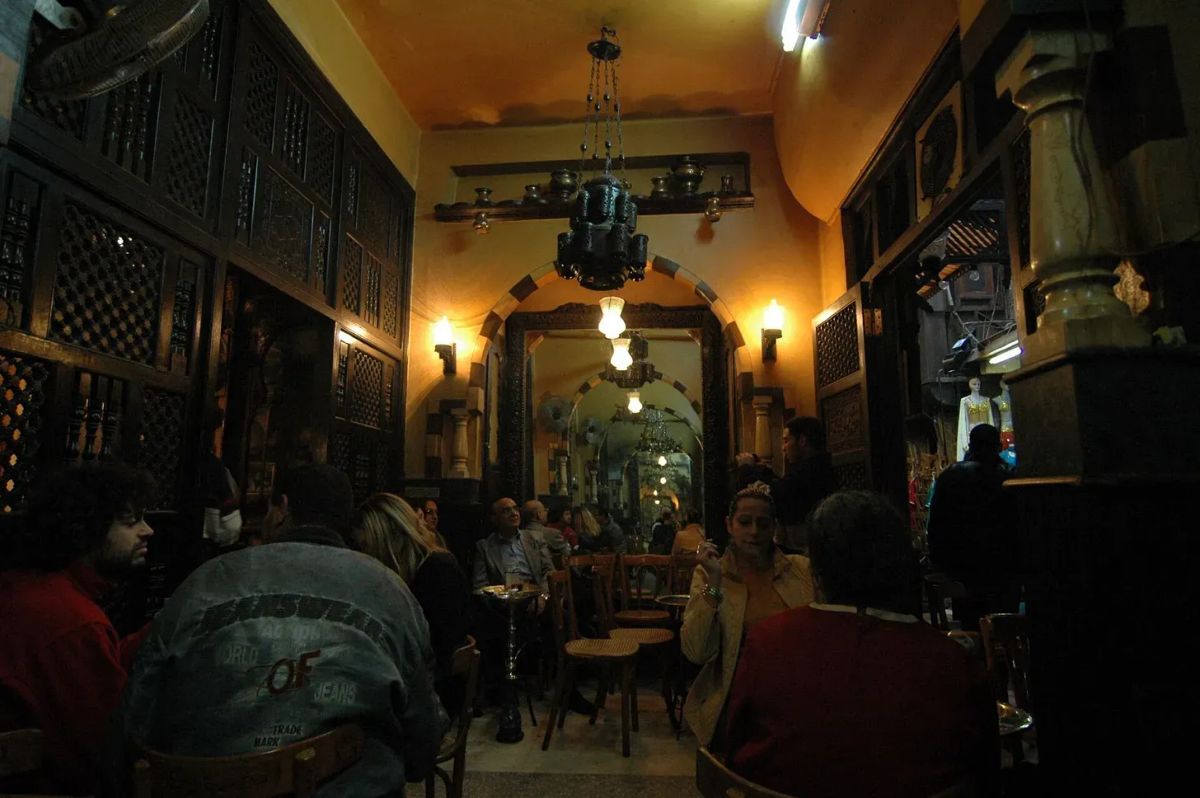
In a coffeehouse in Cairo where Mahfouz once sat — the Fishawy, on a side street off Al-Hussein, where he held court for half a century — the mirror above the counter has been replaced by a screen.
It is just before noon at El Fishawy, in the heart of the Khan el-Khalili, where the same café has been open since 1797 and the mirrors that remain on the walls have darkened with the smoke of generations. Mahfouz took his coffee at one of these tables, watched the alley, listened, and went home and wrote down what he had heard. He wrote in cafés because he said silence was the enemy of writing — he needed the noise of life around him.
The screen is mounted high above the counter. A market channel. Numbers scroll across the bottom of the frame in red, then in green, then in red again. The grandfather sitting beneath it is perhaps seventy. The boy beside him is six, and has been pulling at his sleeve for some time. A glass of tea arrives without being ordered, because the waiter is the son of the waiter who served the grandfather's father, and some things in this room still happen without being asked. The adhan begins. The grandfather does not hear it. The boy stops pulling at the sleeve and takes out a phone of his own.
This is what we have built. The war, the AI boom, the records on the indices — those are weather. What we are watching now is climate. Three generations in a single room, and the only one of them looking at anything that will outlast the afternoon is the waiter, who is watching the tea.
• • •
Last week the American stock market hit new highs while consumer confidence in the same country fell to the lowest level on record. The columnists called it a paradox. It is not a paradox. It is the visible edge of a substitution that has been underway for forty years, and not only in America — the quiet replacement of one kind of moral question with another. The old question was how is our society doing. The new question, which sounds the same and is not, is how are the markets doing.
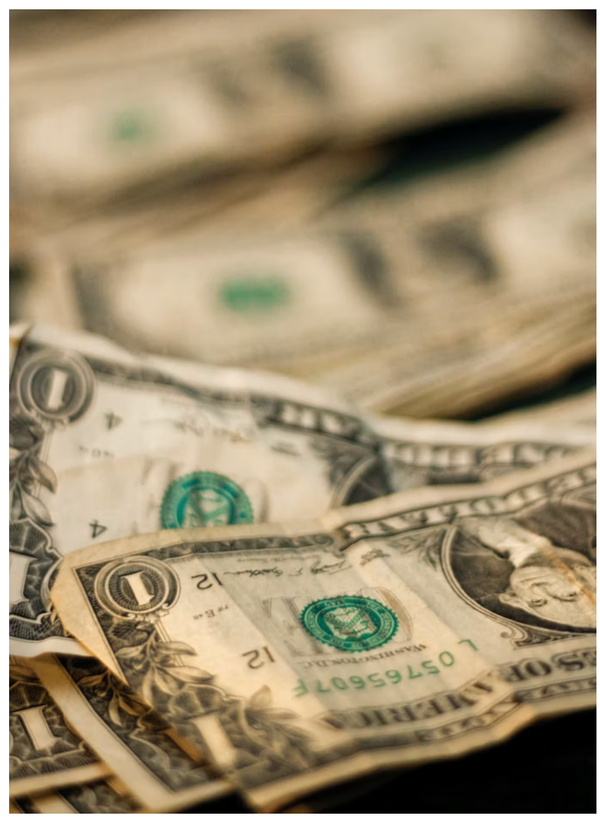
In the postwar decades the market itself still worked something like a mirror. The numbers reflected, however imperfectly, the lives of people you might pass on a street. Wages rose with productivity. The middle class expanded. Ownership broadened. Unions, progressive taxation, broad manufacturing employment — these passed equity gains through to wages with reasonable fidelity. The mirror reflected. What changed was not the mirror. The room behind it emptied, and the surface kept showing the room as it had been, until someone, at some point in the 1980s, replaced the mirror with a screen, and the screen no longer showed the room. It showed a dial. Capital's share. Labour's share. The numbers continued to scroll, in red and green, but they were no longer reflections of anything most people lived inside.
Those of us who managed capital through these decades did not invent the doctrine that produced this change. We accepted it, applied it, and were rewarded for applying it well. The bottom half of Americans now own roughly one per cent of equities by value. The top tenth own around eighty-eight. By most estimates, buybacks and dividends combined now exceed capital expenditure at most large American firms — the money corporations make is increasingly returned to shareholders rather than reinvested in the business that produced it. Artificial intelligence is the first technological wave openly marketed to investors as a labour-cost compressor.
I do not say this to mourn the dial. The dial is a real instrument. Capital allocated well has lifted hundreds of millions out of poverty in my own lifetime, and the mechanism that did the lifting was, in part, this one. Markets are also genuine human cooperation across distance, a way of trusting strangers we will never meet, a system that encodes information no committee or planner has ever managed to encode as well. The people who built the dashboard were not stupid. They were, many of them, idealists, and the idealism was not entirely misplaced.
The argument is harder than that, and worth saying clearly. We have asked the dial to carry weight it cannot carry. We have asked one instrument to register the health of bodies, the strength of bonds, the protection of the weak, the silence in which a child grows — and the instrument was never designed to register any of these, and our continuing to expect it to is its own form of magical thinking. The cost of the expectation has fallen, almost without exception, on people who were not consulted in the building of the dashboard. That is the part that needs to be admitted before the rest of the argument can be made. The dial is real. The substitution, asking the dial to be the dashboard, was a category error.
Because the disconnect is the smaller half of the story, and it is not only an American story. The larger half is what the substitution did to the question itself, in every society it reached.
• • •
A society is not measured by one thing. Ibn Khaldun, who lived his last years and taught at Al-Azhar a few hundred yards from where the grandfather is sitting, watched societies through asabiyyah — the binding spirit of a people, the invisible solidarity that makes a city possible before it makes a market possible. He thought a civilisation could be measured by the strength of its asabiyyah, and that when the binding loosened, no amount of wealth could hold the structure up. The Vedic kings were judged by dharma — by whether the weakest in the kingdom were protected, by whether the king's conduct matched the rhythm of the land, by whether the order of the household reflected the order of the cosmos. The Buddhist frame watched suffering and its causes, and held a kingdom accountable for whether its arrangements increased or relieved the suffering of those who lived under them. The Sufis watched the polish on the heart, the slow accumulation or removal of the rust that gathers on a soul when it lives only for itself. The Greeks distinguished oikonomia — the management of the household for human flourishing — from chrematistics, the accumulation of money for its own sake. Aristotle thought a polis that confused the two would corrupt its citizens' very capacity to judge what a life is for. Twenty-three centuries later we built CNBC, and its successors in Asia and the Arab world, and the same liturgy began to play in every language at once.
These older instruments were not poetic flourishes. They were dashboards. Each civilisation kept its own ledger, and read its health through several columns at once. The dashboards had more than one dial.
What we have done, over four decades, across most of the world, is reduce the dashboard to one. And what the eye does not look at, the mind eventually cannot see.
The cost is not abstract, and not only American. The share of Americans who say most people can be trusted has fallen from forty-six per cent in the early 1970s to around a third today. The United States has the lowest life expectancy of any wealthy country despite spending the most per capita on health. In Britain, loneliness reached a level severe enough that the government, in 2018, appointed a Minister for Loneliness — a phrase that contains an entire essay in it. Japan followed three years later. The Japanese have a word, kodokushi, for dying alone and undiscovered, and the cases run into the tens of thousands each year while the Nikkei sits at multi-decade highs. In India, household financial savings as a share of disposable income have fallen sharply even as Sensex coverage saturates the news cycle and the middle class learns to read its days through the price feed. None of this appears on the dial. None of it is news. None of it moves the index.
• • •
I want to speak now to those of us who will read this from inside power. We sit on the boards, manage the funds, write the regulations. I have sat in those rooms. I am not innocent of them.
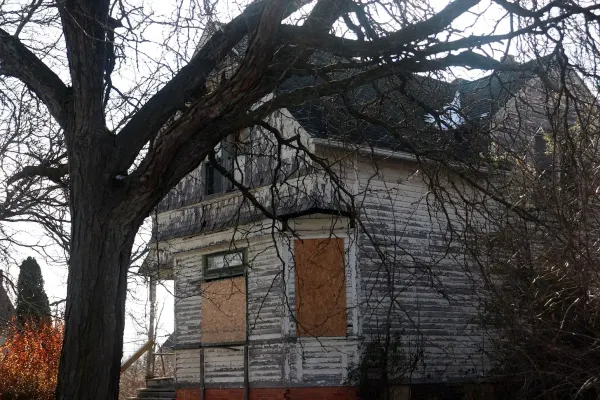
The choice of which ethic a civilisation lives by is not a technical question. It is a moral one. Those of us who allocate capital allowed a single measure — financial return — to become the proxy for every other good, and then we allowed it to expand. It is no longer confined to listed markets. We — and I use the word advisedly, having sat on enough investment committees to have signed off on my share of it — have allowed private equity and private credit to spread the same single ledger into hospitals, into housing, into the dental practice on the corner that used to be owned by the dentist. The new religion has its doctrine and its priesthood and its sacraments, and it baptises everything it touches in the language of optimisation, until a school becomes "underperforming" the way a position becomes underperforming, and a neighbourhood becomes a thesis, and a nursing home becomes a cash flow. Some of us in those rooms knew what we were funding. Some of us did not ask.
What we have lost in the substitution is not just other measures. We have lost other ethics — care, stewardship, hospitality, the protection of the weak. These were the cornerstones of every civilisation worth its name, and we have allowed them to be quietly recategorised as costs, externalities, friction. They survive in private life — in the older mosques and temples and parishes, in friendships that have outlasted careers, in households where someone is still keeping the older standards alive — but they have been pushed out of public reckoning. The cornerstones remain in place; we have only stopped reading them.
I have asked younger people across the region — undergraduates, junior analysts, the children of friends — what measures of a society's health they would consider alongside GDP. Most pause for a long time. A few name one. Almost none name three. They have been given Aristotle on a syllabus and Ibn Khaldun in a frame on a wall, and they have not been given the language to read either. The fault belongs to us, not to them — to what we placed in front of their eyes during the years their eyes were being trained.
Mahfouz, in the Cairo Trilogy, watched a single family across three generations the way every honest novelist watches what passes through a household without anyone deciding to pass it down. The trilogy is, among other things, a study of inheritance — what is transmitted through a family without anyone deciding to transmit it, and what is lost without anyone deciding to lose it.
The dial is being passed down without anyone deciding. So is the loss of the other dials. So is the narrowing of the ethic. We are not bequeathing our children only a debt of carbon, though we are. We are not bequeathing them only an inequality, though we are. We are bequeathing them an instrument of perception, and a single moral language to describe what they will see through it. A child who has only ever seen prosperity measured as portfolio value will struggle, as an adult, to recognise poverty when it takes the form of vanished kinship, eroded attention, lost capacity for stillness.
The instrument shapes what counts as real. The most consequential pollution of the financialised age may not be carbon. It may be the pollution of the gaze, and the narrowing of the moral vocabulary that follows it.
• • •
There is a moment I keep returning to.
A dinner some years ago, in a city it does not matter to name. The portfolio had done well that quarter. I was explaining the position to someone across the table whose face I can no longer reconstruct, only the fact that I was animated, that I was using my hands. My mother phoned. I did not pick up. I called her back two hours later, when the dinner had ended and I was alone in the car, and she told me, in the slightly smaller voice she used for the things she did not want to bother me with, that she had been frightened. She did not say frightened of what. She did not need to. She was old, alone in the apartment, and it was late. The market was up two per cent that day.
I remember the number. I do not remember what I said to her.
The Sufis have a phrase for this kind of inheritance. The rust on the heart. It accumulates not from one great wound but from a thousand small refusals to polish. Each generation either passes down the polishing or passes down the rust. We have, on the whole, passed down the rust and called it sophistication.
• • •
There is a window I want to leave open before the essay closes.
My grandmother, in the house I knew as a boy, presided over a world that ran on standards no screen could measure. She had been raised in a household where servants moved through rooms like quiet weather, and she had built her own household the same way — not as an absence of work but as a particular kind of attention, exacting, watchful, trained over decades. She knew when a guest had been welcomed properly and when they had not. She knew which silences in a conversation meant something was wrong and which meant something was being thought. She understood the difference between hospitality as a performance and hospitality as a discipline, and she upheld the second one all her life, knowing what such standards cost the people who maintained them with her. The women who came to see her in the afternoons came because she received them in a particular way — without hurry, without distraction, with the full quality of her attention turned toward whoever was speaking. This was oikonomia in the Greek sense, the household run for human flourishing rather than for accumulation, and she was its last serious practitioner I have known. None of it would have shown up on any screen anywhere. None of it could be optimised. None of it produced a number. It was, by the only measure that finally matters, an entire civilisation operating at full capacity inside the rooms of a single house.
That is what we are losing. Not in the abstract. In houses across the world, where someone older still knows what proper attention looks like, and someone younger has stopped sitting in the room with them because they are looking at something else.
• • •
The grandfather will die soon. The boy beside him will inherit a city, a country, a world, and beneath all of these, an instrument — a way of looking, a single ethic, a default channel through which his attention will run for the rest of his life unless something or someone interrupts it. The instrument will tell him that prosperity is a number and that the number is rising. It will not tell him about the river, or the adhan, or the waiter, or the tea. It will not tell him about his grandfather. It will not have the words.
But there is still time. The boy is six. The instrument is not yet fused to his eye. My own grandchildren are small enough that the screens have not yet found them. Mahfouz's books are still on the shelves, and the Fishawy's mirrors are still darkening, and the adhan still rises five times a day from a minaret that has stood through every empire that ever thought it was the last one.
We are not choosing between progress and tradition. We are choosing whether the next generation inherits a single ethic or many — whether they grow up able to read the bonds between people, the strength of the weak, the soil and the silence and the trust, alongside the price feed. The cornerstones are still there, only left unread. We can teach the reading again, or we can let the language go.
What is the dial you are watching. What did your father watch. The answer is the inheritance.
— Nazem