What the Water Shows
The pot is small. What it holds is not.
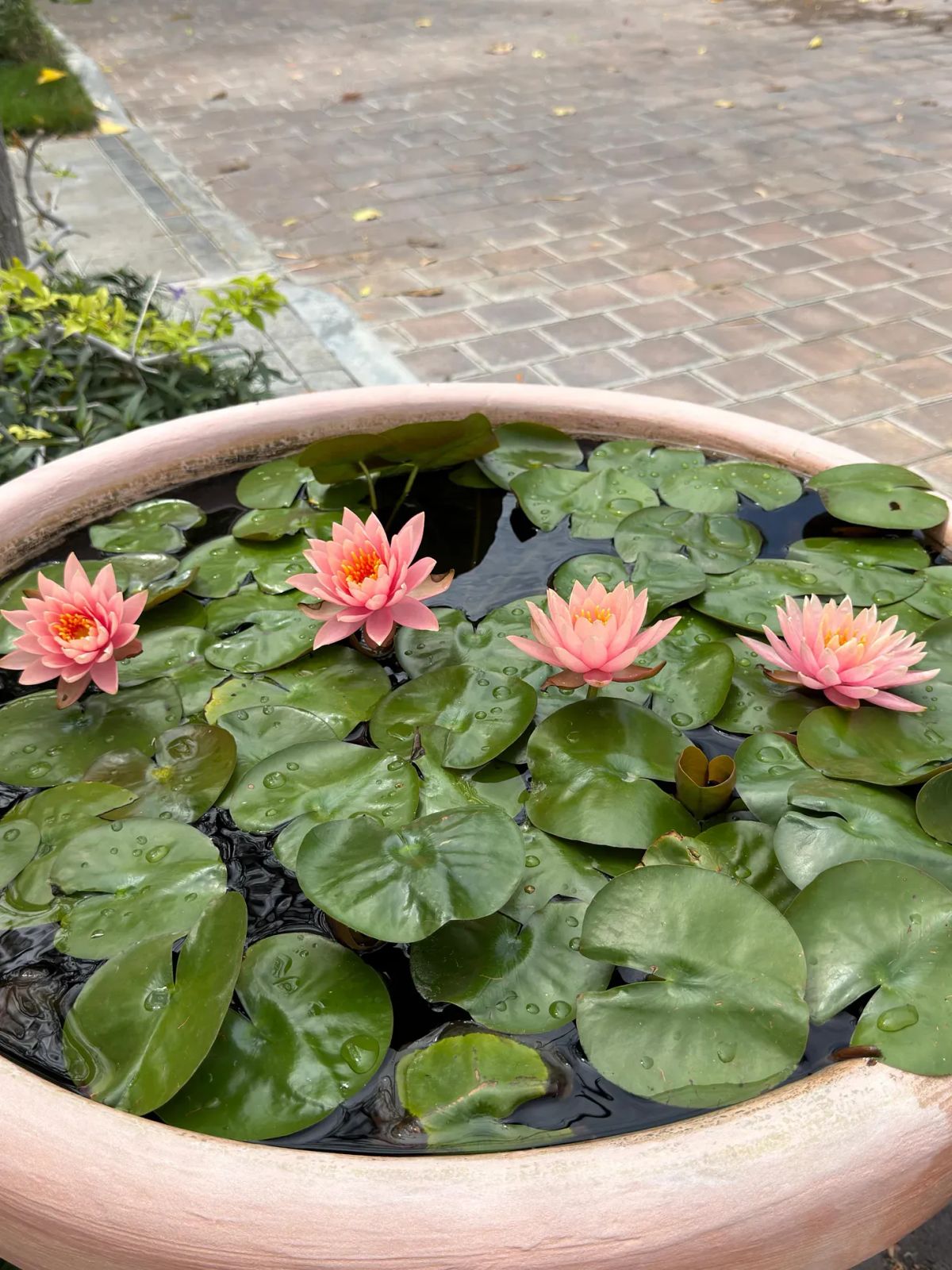
Twelve clay pots, set in a row that faces the rising light. Mud at the bottom of each. Water above the mud. And in the water, the lotus — white, pink, blue. The pink ones are opening this week.
I come at the hour before the sun has fully cleared the wall. There is a soft grey on the surface that the first gold has not yet found. I am alone. I am barefoot. I carry nothing in my hands.
The lotus came to me through Mahayana Buddhism, through the teaching that beauty is not despite the mud but because of it. The flower does not apologise for the mud. The flower does not transcend the mud. The flower is what the mud became, when the mud was patient enough. To watch a lotus open is to be reminded that one is also mud, and one is also patient, and one is also — if one is willing — capable of opening into something one had not known was already inside.
There is someone in my life who loves the lotus the way I love it. We have never had to explain it to each other. Some friendships rest on shared opinions; the closer ones rest on shared affections, and the truest of those rest on a shared affection for something silent. The lotus has been our silence.
I lean over the first pot.
The water holds my face. Greyer than I remember it being. Older. The lines around the eyes deeper than the lines I think I have. This is what the water always does — it returns you slightly more truthful than the mirror in the bathroom.
I lean a little further, and the face changes.
It is my father now. Not the photograph of him. The actual face, as I remember it from the morning he taught me how to hold a spoon. The Aleppo light in his eyes. A young man, barely out of his early twenties, who did not know what was coming and who carried himself as though he did. The water does not idealise him. It shows the small fatigue under his eye, the place where the worry sat — the worry of a man who had become a father before he had finished becoming himself.
I move to the second pot.
My grandfather. The face of the man whose signature is still in archives — the last democratically elected president of a country that was, in the years of his presidency, a republic in the proper sense of the word. The water does not show him at the rostrum. It shows him at a table, alone, late at night, the way I have seen him in one photograph my mother kept. A man who had read enough history to know what was about to happen, and who chose to act anyway. He is looking at me. I am looking at him. The water does not flatter either of us.
The third pot.
His mother — my great-grandmother. Widowed young, in a city that rarely forgave widows. She raised her two sons alone. She sent them both to school. She kept sending them. And in 1929, the year the world's stock markets fell apart and the world's certainties with them, she watched her elder son receive a doctorate from the University of Geneva. His brother was on the same road behind him. Read that twice. A widow in our part of the world, in the years when widows were expected to disappear into the household of a brother-in-law and grow quiet — put two sons through doctorates in Switzerland. The face that arrives in the water is not old. She is in her forties. There is no self-pity in it. There is the particular kind of fatigue that women in our line carry without naming, the fatigue of holding a household together with one hand and two futures with the other. The lotus blooming pink in front of her did not yet exist in her century, and yet she would have recognised it. The mud she walked through was older than the mud in this pot.
The fourth pot, and now we go further back.
A great-grandfather, governor of Aleppo under the Sublime Porte. The water does not show him in his robes of office. It shows him in the moment after a council had ended, the door had closed, and what had been decided was carried home in silence to a wife who knew not to ask. The vilayet had its grain shortages that year, its tax revolts, its quarrels between guilds, its difficult harvest. He governed it. The face is severe and tired and decent, in the proportions in which those three qualities mix in men who have served a long time.
The fifth pot.
The other great-grandfather. Governor of Baghdad in another decade of the same long dusk. Different river. Same trust. The water shows him reading by lamplight a dispatch he has read three times because what it asks of him cannot be answered in one reading. The face has my forehead. The set around the mouth is mine. I am bowing now over each pot in turn, and the bowing has become a prayer I did not plan.
The sixth pot is composite. Older men. Names in chronicles I have read and names not in chronicles. The bone structure repeats. The forehead repeats. The water shows them all without commentary.
By the seventh pot the faces are no longer ancestors. They are me.
The young man at ADIA, studying balance sheets all night long, the office quiet at three in the morning, the slow chill of the second cup of coffee that had gone cold while he was inside a row of numbers. The CIO with the sleepless quarter. The CEO who closed the airport concession and the sewage plant and went home to a child's birthday he had nearly missed. The author at his desk before dawn, fingers cold, the manuscript open. The advisor walking the marble of the Mandir in the cool before opening, when the priests have lit the first lamp and the air is sweet. The grandfather of his own grandchildren now. The man standing in his garden, alone, before sunrise, looking into water.
By the tenth pot the faces are not from this life.
I cannot tell you what they are. I can only tell you that the water shows them and the water does not lie. Some of them have wanted things I cannot now want. Some of them have grieved things I cannot now name. They are not memories. They are pressures. A monk in a hill country I have never visited but recognise. A merchant on a road I have walked in a dream. A woman, once, near a river I cannot name. The doctrine of reincarnation is not something I have to defend at the lotus pond. The pond does not require the doctrine. The pond simply shows what is there.
A drop falls from my finger back into the pot. That is the only sound I have made.
By the twelfth pot the face is not a face.
It is the surface of the water itself, holding the first gold of the sun, which has now cleared the wall. Whatever was looking up has stopped being separate from what was looking down. The lotus, pink and open, is the same age as everything that has ever bloomed. The mud is the same mud. The water is the same water. The clay holds the sky. The man bowing is one of many men, and the many men are one.
I straighten up.
The garden returns to itself. A bird whose name I do not know crosses the wall.
And I will come back tomorrow. The pots will be here. The mud will be here. The lotus will be here, blooming or closing, depending on the hour and the heat and whatever else the lotus answers to that I do not.
The face in the water will be here.
Whoever is looking will be here.
— Nazem
• • •
Nazem Alkudsi, CFA, is the founder of @LongArcNews. A former CEO in the Abu Dhabi sovereign wealth world and four-decade veteran of institutional investing, he writes about capital, power, and civilizational patterns.