The War That Did Not End
An introduction to a three-part series on Vietnam, Cambodia, Laos, and Thailand

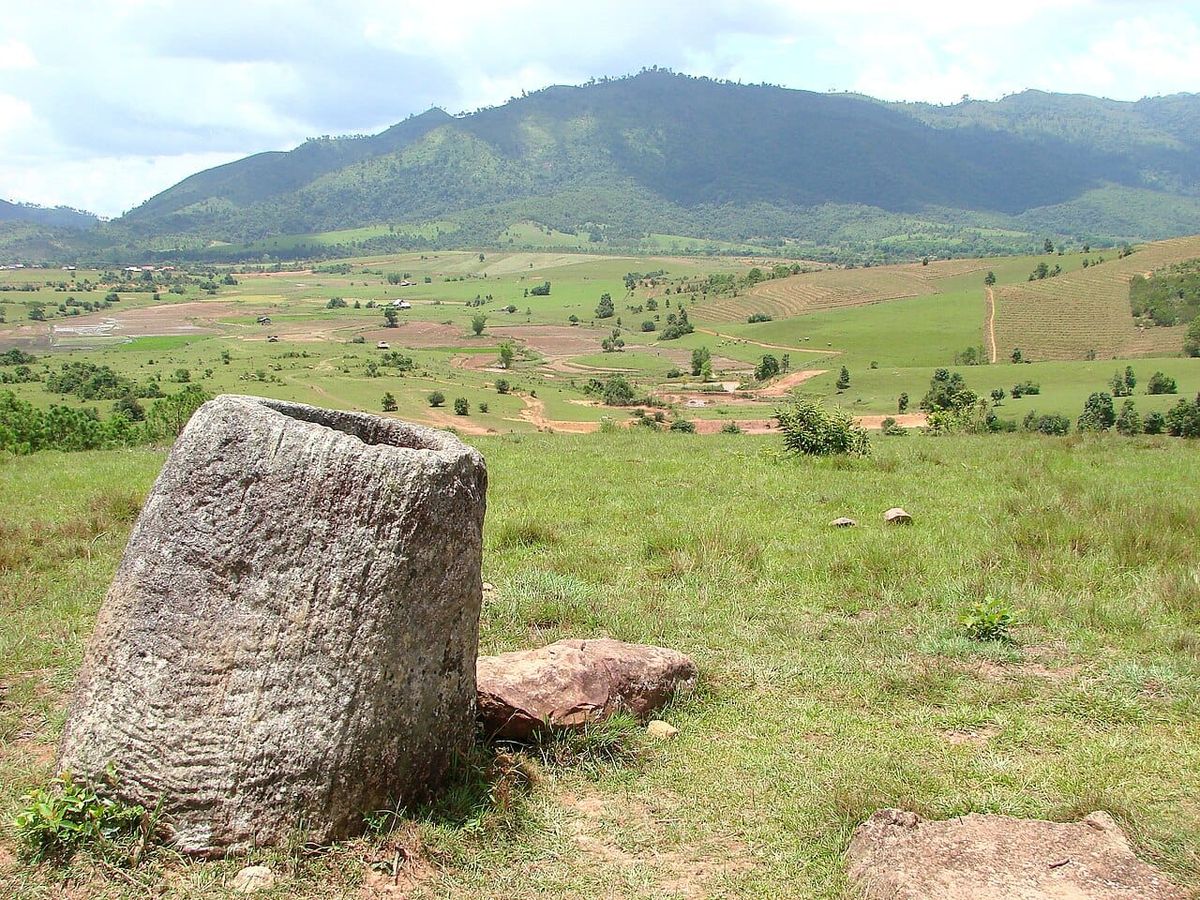
Two thousand years of stillness, nine years of bombing, fifty years of waiting. Xieng Khouang Province, Laos. Photograph from Wikimedia Commons, CC BY-SA 3.0.
The framework agreement was signed in October 2024, in a room in Beijing where Hun Manet stood beside his Chinese counterparts with his right hand resting on the edge of the lectern, his weight slightly forward, and watched the documents being initialled on a project called the Funan Techo canal. One hundred and eighty kilometres of waterway from the Mekong to the Gulf of Thailand. Financed at terms that would have been refused by any Cambodian government thirty years ago, and were not refused on this October afternoon by a government that had stopped having alternatives. The cameras photographed the handshake. The Chinese state news agencies released the photograph the same evening. The Cambodian state news agencies released a slightly different one the next morning. Almost no English-language newspaper printed either.
Hun Manet is the son of Hun Sen, who governed Cambodia for thirty-eight years, who came to power on the back of a Vietnamese invasion that ended the Khmer Rouge in 1979, and whose own political formation took place in a refugee camp on the Thai border in the years when Cambodia had ceased to function as a country and become, instead, a geography across which other countries' wars were fought. The canal the son was witnessing the signing of in 2024 will be dug across a country whose rural economy was destroyed in the early 1970s by American aircraft flying out of Andersen Air Force Base on Guam and out of U-Tapao in Thailand. The peasants who farmed that economy were displaced by the bombing into Phnom Penh, where they became the urban poor whom the Khmer Rouge inherited in April 1975 and marched back into the countryside they had fled. Many of them did not survive. Their grandchildren, the ones who are alive, will work on the canal.
What I am about to walk you through is the story of how that canal came to be. You may have read a great deal about this war already. You may have read almost nothing. Either way, what I am about to set in front of you is something the standard histories do not quite contain.
The textbooks tell us the war in Vietnam ended on two dates. The Paris Peace Accords were signed in January 1973. The last helicopter lifted off the embassy roof in Saigon in April 1975. The history written by the combatants, by Washington most of all, but also by the Vietnamese state that survived the war and the Vietnamese diaspora that did not, places these two dates at the boundary between war and peace. Before the dates, war. After the dates, the postwar. This is the calendar that has organized fifty years of memorial speeches, college courses, films, novels, monuments, and op-eds.
The calendar is American. It is the calendar of the country that decided when the war began and when, for itself, the war ended. It is not the calendar of the countries that did not decide either of those things. Cambodia in 1975 was not entering a postwar period. Cambodia in 1975 was entering a genocide that would kill roughly a quarter of its population, generated by conditions a war Cambodia did not declare had set in motion. Laos in 1975 had already become, and would remain, the most heavily bombed country per capita in the history of human warfare. Thailand in 1975 was a country whose political and economic structures had been remade by hosting United States bases through ten years of someone else's war, and would never return to what they had been before the bases came.
The war did not end. The war migrated.
This is what I would like you to consider with me over the next several weeks. Wars do not stop at their borders. They produce two countries: the one that fought, and the one that was ruined by accident. The combatants get the treaties and the cemeteries and the histories. The neighbors get the rest of their century rearranged. The pattern by which this happens is not mysterious, and once you have learned to recognize it you cannot un-see it. People move. The receiving country, which had no say in the matter, finds itself with a population whose grandchildren will still be a separate political category eighty years later. Capital flees, but in fleeing it builds something. Banks, insurance markets, a permanent floor under regional costs that does not lower itself once the danger passes. And then there are the institutions that arrive during the emergency. Black markets. Parallel security services. Foreign sponsors who do not announce themselves. They were supposed to be temporary. They were not. They become, in the years that follow, the founding furniture of whatever comes next. The story of war was written by the combatants, and so it does not see this. The series you are about to read is an attempt to see it.
There is a moral weight to that omission which I want to name plainly. Half a century of memorial speeches in Washington, and the children of Xieng Khouang are still losing legs to American cluster bombs in 2026. That is not history. That is what is happening this week, while you are reading this sentence.
We will walk together through three countries. The first essay takes us into Cambodia, where the pattern operated at its most extreme, where the war that ended in 1975 produced a genocide in 1975 and, fifty years later, a Chinese client state in 2026, a state whose flagship infrastructure project is a canal designed, among other purposes, to bypass Vietnamese ports and lessen Cambodia's dependence on the country whose army once ended its slaughter. The second essay takes us into Laos, where the unexploded ordnance from a war the Laotians did not fight is still detonating today, killing children in the same provinces it killed their grandfathers in 1968, and where the Chinese railway that opened in December 2021 has begun a different kind of integration with consequences we are only beginning to understand. The third essay takes us into Thailand, where the war operated without bombs, through basing rights and service economies, and where the contemporary political settlement runs in unbroken thread from the bases at U-Tapao and Korat through Thaksin and the coups to the cabinet meeting that took place in Bangkok last week.
Three countries. Three relationships to the same war that do not resemble each other at all. Time horizons that stretch from yesterday to the next century. By the time we reach the end of the third essay, I hope you will see the war the way the countries that did not fight it have always seen it, which is as something that did not end at all, and that is still organizing the geopolitics you are reading about in this morning's newspaper.
Let me be honest with you about what my seat allows and what it does not. I write from the Gulf, from a balcony in Abu Dhabi where my grandfather's photograph of Damascus before the French Mandate still hangs on the wall behind the desk. I have never stood in a Phnom Penh ricefield in the year the bombs were falling. I have never walked the Plain of Jars at harvest, watching a deminer's flag flutter above a hillside my grandfather used to farm. The wars I am writing about are not mine. But the question of what wars do to the countries that did not declare them is mine, because I have watched it happen in my own region, in my own lifetime, in the lives of cousins and neighbors and family friends, and I have come to believe that bearing witness to it is a kind of duty that crosses the borders of who can claim what suffering as their own.
This is the longer arc the publication is named for. Most of what wars do is not what their combatants meant to do. Most of what they leave behind is in the countries that did not declare them. The story of the war in Vietnam, told from inside Cambodia and Laos and Thailand, is one of the cleanest illustrations of this we have. It is not the only one. It is the one we are going to start with.
I am glad you are here.
The first essay begins next week.